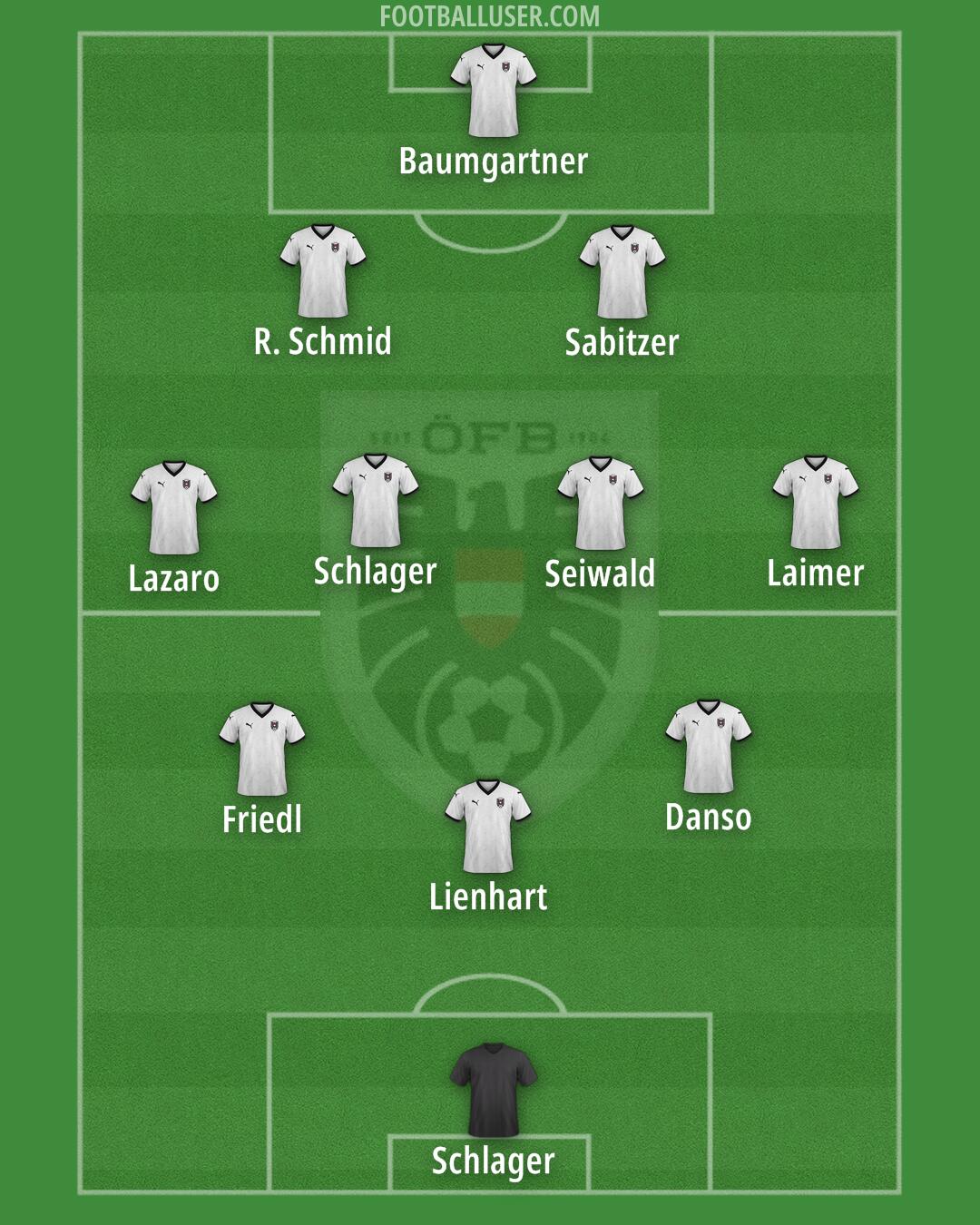

Austria National Football Team Formation
 January 9, 2026


Starting Lineup
Danso · Lienhart · Friedl · Laimer · Schlager · Seiwald · Sabitzer · R. Schmid · Baumgartner · Lazaro · SchlagerA high press and aggressive verticality define the identity of Austria in a 3-4-3 formation. This lineup relies on heavy pressure to win the ball back quickly and strike before the opponent can settle. By spreading the pitch through wide players, the team seeks to break lines and create chaos in the final third.
Schlager operates between the posts to command his area and start attacks from the back. A back three forms the foundation of the defense, with Lienhart, Friedl, and Danso providing a solid block. Lienhart acts as the central pillar, while Friedl and Danso cover the spaces to the left and right, looking to intercept passes and win aerial duels. The unit stays compact to deny space between the lines, ensuring the defense can step up together when the team presses high.
The midfield functions as a narrow engine room designed to control the central zone. Seiwald and Schlager work in the middle to shield the back three, with Seiwald often looking to break the line with his driving runs. They connect the defense to the attackers by recycling possession and switching play. Lazaro and Laimer occupy the wide areas, providing the width necessary to stretch opposing banks of four.
Attacking movements come from three dedicated forwards who pressure the opposition backline constantly. Baumgartner leads the line as the lone striker, working to hold up the ball and create space for those running past him. R. Schmid and Sabitzer act as wide attackers, ready to cut inside or overlap to create crossing opportunities. These three forwards press in a coordinated wave, forcing mistakes from defenders near their own goal.
This formation offers several tactical advantages, particularly in how it creates wide overloads. When Laimer and Lazaro push forward, they create extra numbers to overwhelm the opponent. Austria also benefits from a strong ability to press high in coordinated waves, making it difficult for teams to build from the back. The speed of transition allows Sabitzer and R. Schmid to exploit space immediately after a turnover in the middle third.
Austria utilizes this 3-4-3 to dominate territory through aggressive pressing and rapid forward movements. This system is best suited for matches against teams that struggle to play under pressure or leave space behind their midfield.