Arsenal Football Formation
 January 9, 2026


Starting Lineup
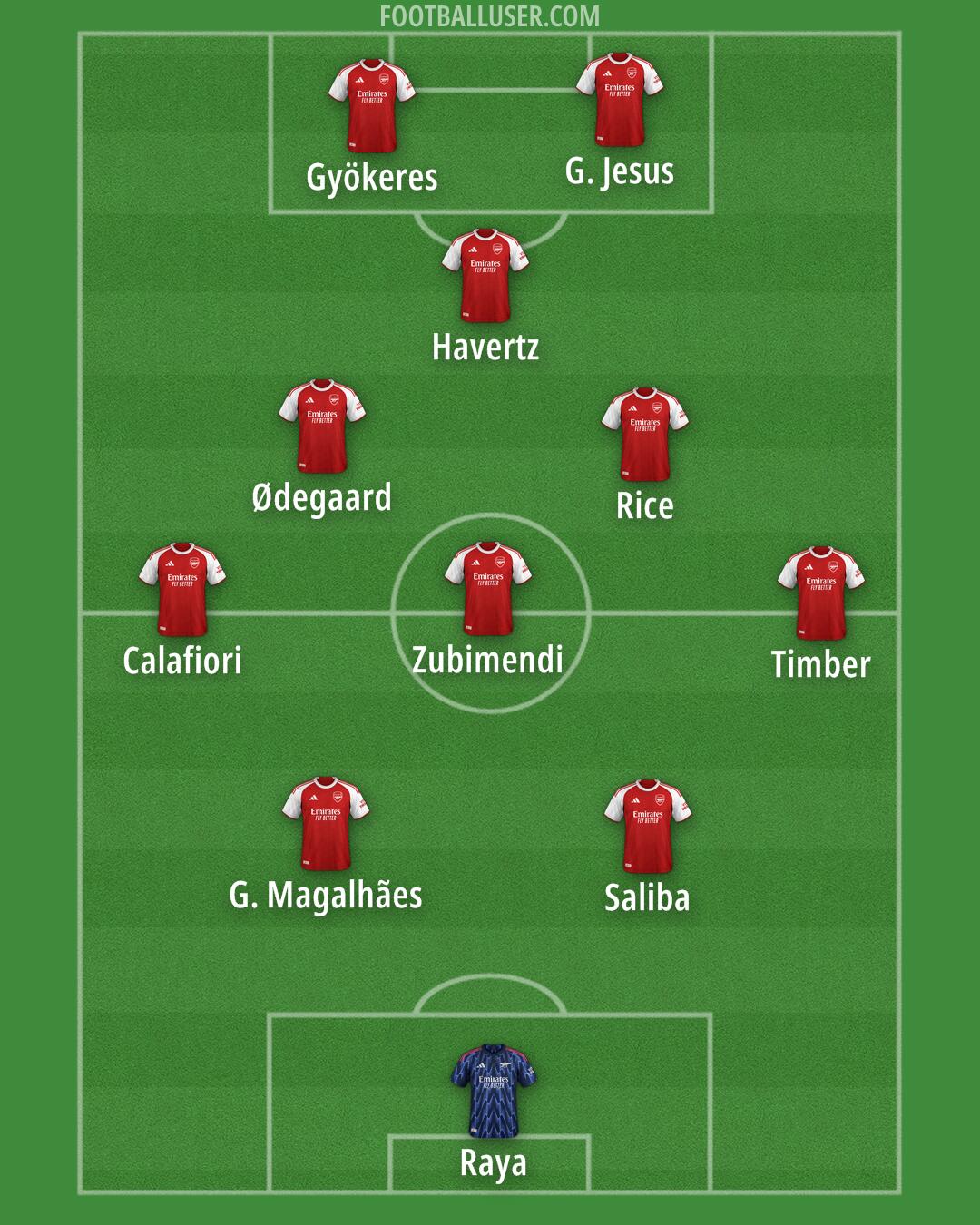
Gyökeres · G. Jesus · Ødegaard · Havertz · Rice · Zubimendi · Calafiori · Timber · G. Magalhães · Saliba · RayaA heavy emphasis on central dominance and overwhelming midfield numbers defines Arsenal in this 2-6-2 formation. This lineup aims to control the tempo by flooding the middle of the pitch to starve the opponent of the ball. By concentrating personnel in the central zones, the team seeks to play a possession based game that suffocates the opposition. This specific formation is built to dominate through short passing and constant central pressure.
Raya stands between the posts to command the defensive unit. Behind him, the back line consists of just two central defenders, Saliba and G. Magalhães, who must maintain a high line to keep the team compact. Saliba brings immense physical presence and recovery speed to the defense, while G. Magalhães provides strength in the air. Because there are no full backs, these two must be ready to step up and intercept long balls or cover wide areas when the ball is switched quickly.
The heart of the Arsenal team lies in a massive six man midfield block. Calafiori and Zubimendi sit deep to shield the two defenders, acting as the primary pivots to break the lines with their passing. Timber operates alongside them to add extra security in the middle. Ahead of this base, Rice drives forward to link the play, while Ødegaard acts as the main creator with his vision and ability to find pockets of space. Havertz joins this group to provide extra height and presence in the middle, making the central area incredibly difficult to penetrate.
Up front, the team utilizes two strikers to occupy the opponent's central defenders. Gyökeres acts as a powerful left striker who can hold up the ball and run in behind, while G. Jesus operates as a right striker. Both forwards are tasked with pressing the opposition backline to force turnovers high up the pitch. The movement of these two creates space for the attacking midfielders to make late runs into the box, ensuring the attack is not just reliant on the two frontmen.
The main tactical advantage of this lineup is the massive numerical superiority in the middle of the pitch. By packing the center, the team can easily switch play or use short passes to bypass a pressing opponent. Another strength is the ability to press high in coordinated waves, using the six midfielders to trap players in tight spaces. This density makes it very hard for opponents to play through the center, forcing them into wide areas where they are less dangerous.
This formation creates a central powerhouse designed to crush opponents through pure ball retention. It is best suited for games against teams that sit deep and try to play on the counter, as the midfield will always be one man up.