
Mozambique National Football Team Formation
 January 10, 2026


Starting Lineup
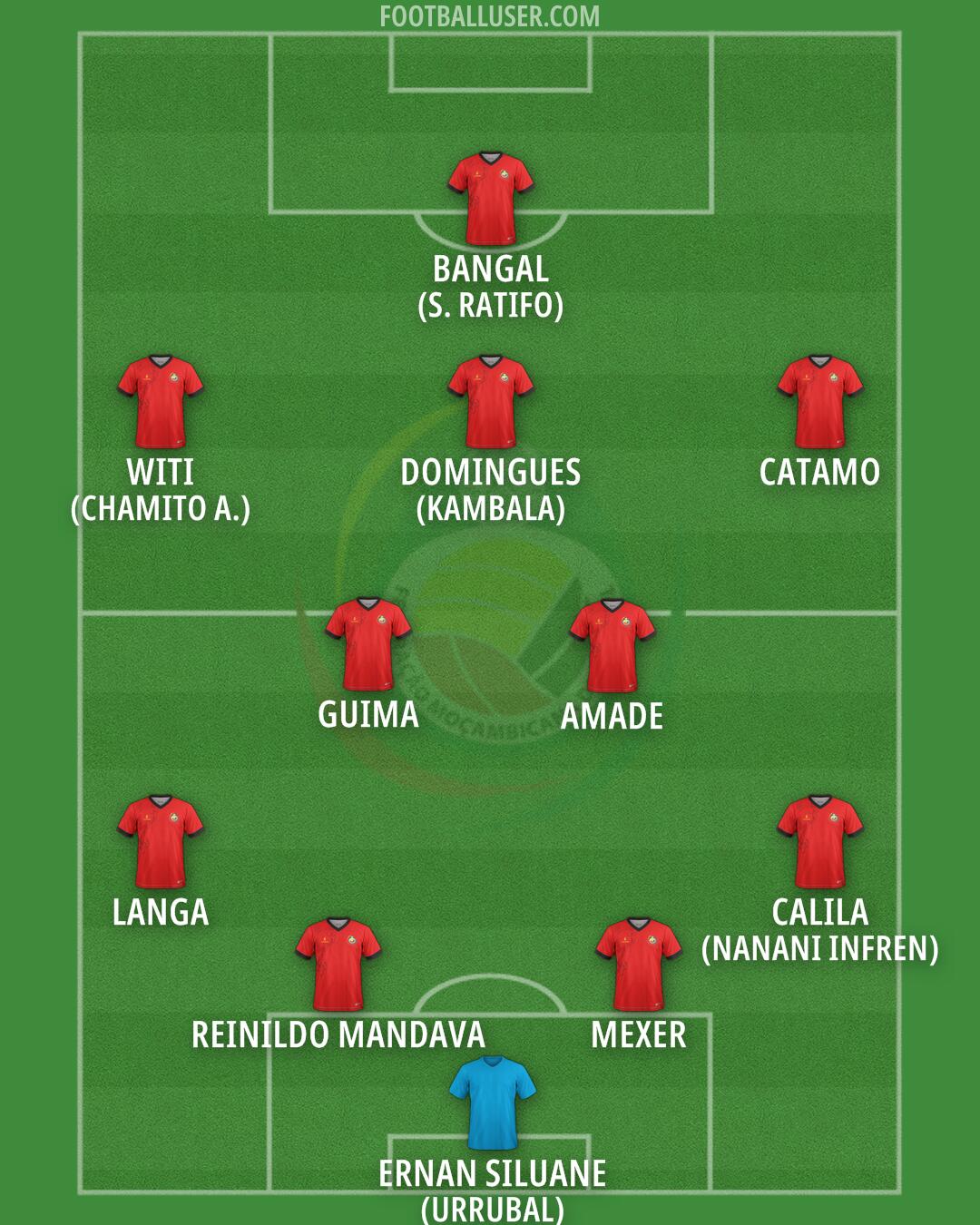
CALILA (NANANI INFREN) · MEXER · REINILDO MANDAVA · LANGA · AMADE · GUIMA · CATAMO · DOMINGUES (KAMBALA) · WITI (CHAMITO A.) · BANGAL (S. RATIFO) · ERNAN SILUANE (URRUBAL)A vertical style of football defines the lineup for Mozambique as they deploy a 4-2-4. This formation focuses on rapid transitions and overwhelming the opposition with numbers in the final third. By committing players forward, the team seeks to punish opponents quickly through direct passing and aggressive movement in the attacking half.
Ernan Siluane acts as the last line of defense in goal. Ahead of him, the back four operates to maintain a compact block when the team sits deep. Mexer and Reinildo Mandava form the central pairing, where they must use their positioning to intercept passes and win aerial duels. Calila and Langa operate on the flanks, tasked with tracking back to cover wide areas and stepping up to support the midfield during buildup.
The midfield relies on a double pivot to control the center of the pitch. Amade and Guima work to shield the defensive line and break the lines with vertical passes. These two players must stay disciplined to prevent the defense from being exposed, acting as the link between the back four and the heavy front line. They focus on winning the ball and immediately looking to switch play to the attackers.
Four players lead the pressure in the attacking third. Witi and Catamo occupy the wide positions as wingers, looking to cut inside or deliver crosses into the box. Bangal and Domingues operate as two forwards, providing a constant presence in the center to hold up the ball and harass defenders. This front line is designed to press high, forcing mistakes from the opposition to create immediate scoring chances.
Mozambique gains a significant advantage through their ability to create wide overloads and numerical superiority in the attacking zone. The presence of four forwards makes it difficult for a standard back four to track every run, often leaving central defenders isolated. Furthermore, the speed of transition allows the team to catch opponents out of position before they can get behind the ball.
This 4-2-4 formation creates a high-risk, high-reward identity centered on attacking intent. It is best suited for matches where the team needs to break down a defensive opponent or exploit gaps in a high defensive line.