
Inter Football Formation
 January 12, 2026


Starting Lineup
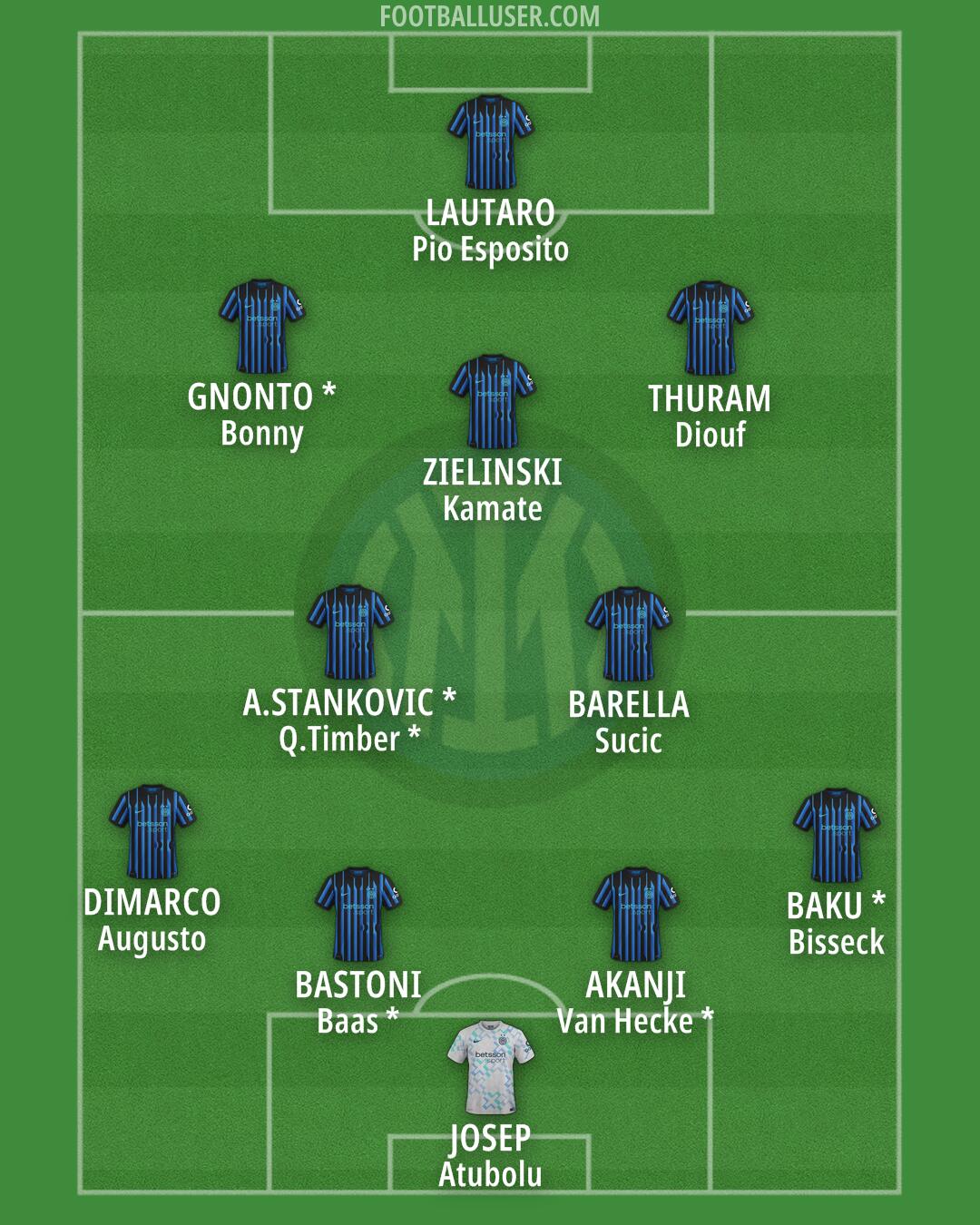
LAUTARO (Pio Esposito) · GNONTO * (Bonny) · ZIELINSKI (Kamate) · THURAM (Diouf) · A.STANKOVIC * (Q.Timber *) · BARELLA (Sucic) · DIMARCO (Augusto) · BAKU * (Bisseck) · BASTONI (Baas *) · AKANJI (Van Hecke *) · JOSEP (Atubolu)A heavy emphasis on verticality and high pressing defines Inter in this 4-2-4 formation. This lineup aims to overwhelm the opposition in their own half by pushing high up the pitch to force turnovers. By spreading the attackers wide, Inter intends to play a direct style of football that punishes mistakes quickly.
Josep starts between the posts to organize the defensive line. A back four consists of Dimarco on the left and Baku on the right, with Akanji and Bastoni occupying the central roles. Dimarco likes to push high to provide width, while Akanji and Bastoni must stay compact to cover the space behind the advancing full backs. Bastoni acts as a ball playing defender to initiate attacks, whereas Akanji provides aerial strength and physical presence to block crosses.
The midfield functions as a double pivot to provide a foundation for the rest of the team. Barella works to drive forward and break the lines with his high energy and pressing intensity. Beside him, captain A.Stankovic holds the central zone to shield the defense and connect the back four to the front four. This pair must stay disciplined to prevent the team from being caught on the counter.
In the attacking third, the team employs four players to stretch the opponent. Lautaro and Zielinski operate as two central forwards, with Lautaro looking to hold up the ball and find pockets of space. Thuram and Gnonto occupy the wide areas as wingers, looking to cut inside and drive at the defense. This front line is expected to press aggressively to win the ball back immediately after losing possession.
Several tactical advantages emerge from this aggressive lineup. The presence of four attackers creates constant pressure on the opposition defenders, often leading to numerical superiority in the final third. When Dimarco and Baku overlap, they create wide overloads that force the opposing wingers to track back deep. This setup also allows for quick transitions, as the midfield can quickly find the front four to exploit gaps in a high defensive line.
Inter relies on this high octane 4-2-4 to dominate games through sheer offensive pressure. This formation works best when facing opponents that sit deep and struggle to cope with rapid vertical movements.