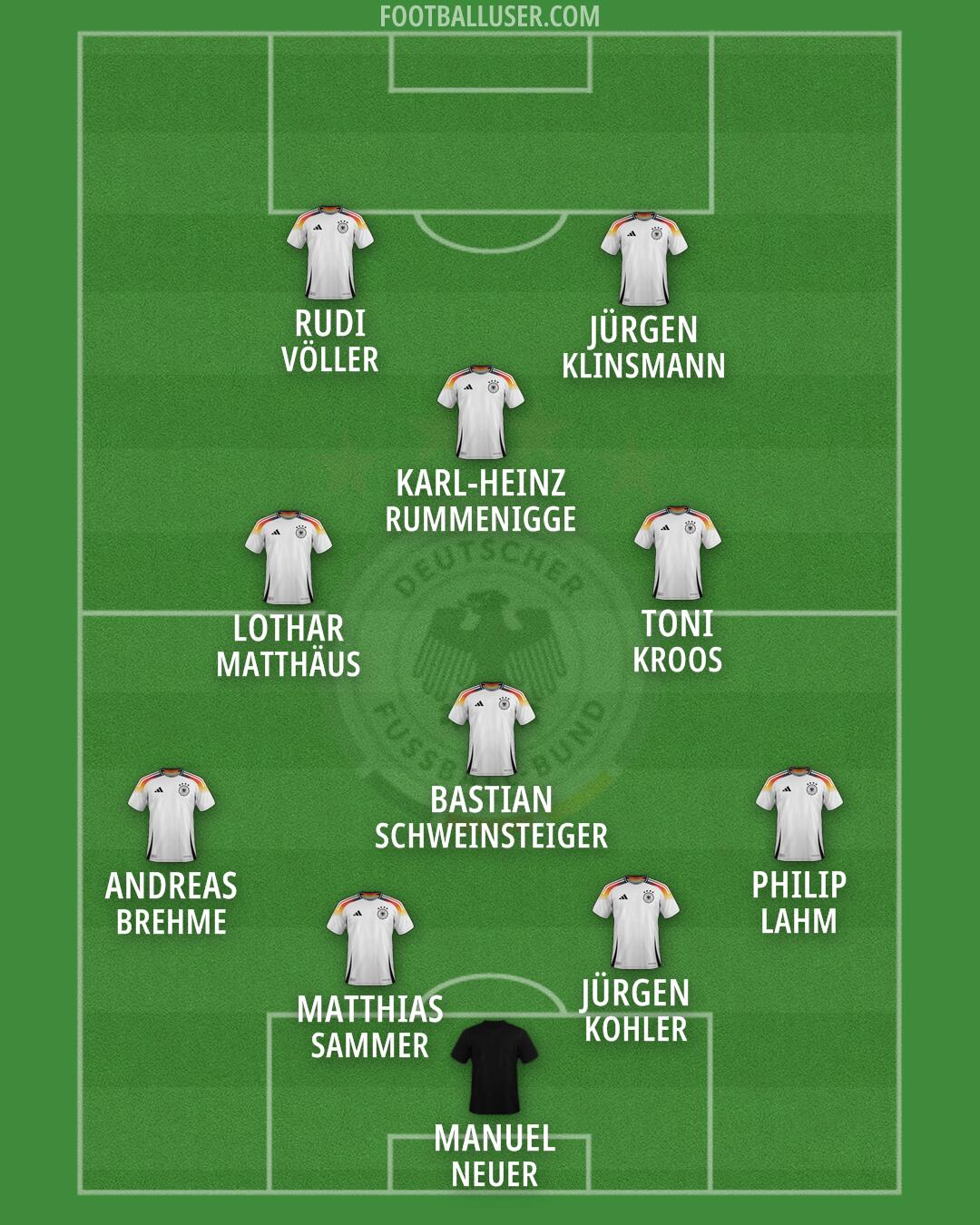

Germany National Football Team Formation
 January 15, 2026
 lucaosantos85


Starting Lineup
MANUEL (NEUER) · PHILIP (LAHM) · LOTHAR (MATTHÄUS) · BASTIAN (SCHWEINSTEIGER) · TONI (KROOS) · ANDREAS (BREHME) · JÜRGEN (KOHLER) · MATTHIAS (SAMMER) · KARL-HEINZ (RUMMENIGGE) · RUDI (VÖLLER) · JÜRGEN (KLINSMANN)A focus on defensive solidity and rapid verticality defines the lineup for Germany, which operates within a 5-3-2 formation. This system aims to sit deep and absorb pressure before hitting opponents in transition. By maintaining a heavy presence behind the ball, the team can absorb waves of attacks and rely on quick passing to catch defenders out of position.
Manuel protects the goal as the primary line of defense. The back five consists of Bastian as the central anchor, flanked by Matthias on the left and Jürgen on the right. These three central defenders work to block shots and win aerial duels. Andreas and Philip operate as the wide defenders, tasked with providing width when the team pushes forward and tracking back to support the central trio when defending deep.
In the middle of the pitch, the midfield acts as a compact engine. Lothar and Toni occupy the central roles, where they work to intercept passes and shield the defensive line. Karl-Heinz operates as the attacking midfielder, sitting just ahead of the two pivots to link the defensive unit with the forwards. This three man block can shift laterally to close down passing lanes and prevent the opposition from playing through the center.
The attack relies on a two man strike force to lead the line. Rudi and Jürgen lead the press from the front, trying to force turnovers in the final third. When the team wins the ball, the goal is to find these two forwards quickly, using them to hold up the ball or run into space behind the defensive line. The width provided by Andreas and Philip allows the attackers to pull defenders out of position, creating gaps for Rudi or Jürgen to exploit.
One major advantage for Germany is the ability to create wide overloads when Andreas and Philip push high into the attacking half. Another strength is the compactness the formation offers when defending in a low block, making it very difficult for opponents to find space between the lines. This setup also allows for quick transitions, as the team can quickly move the ball from the central defenders to the attacking trio.
This 5-3-2 formation provides a robust platform for teams that want to control the game through defensive discipline. It is most effective against opponents that commit many players forward and leave large spaces behind their defense.