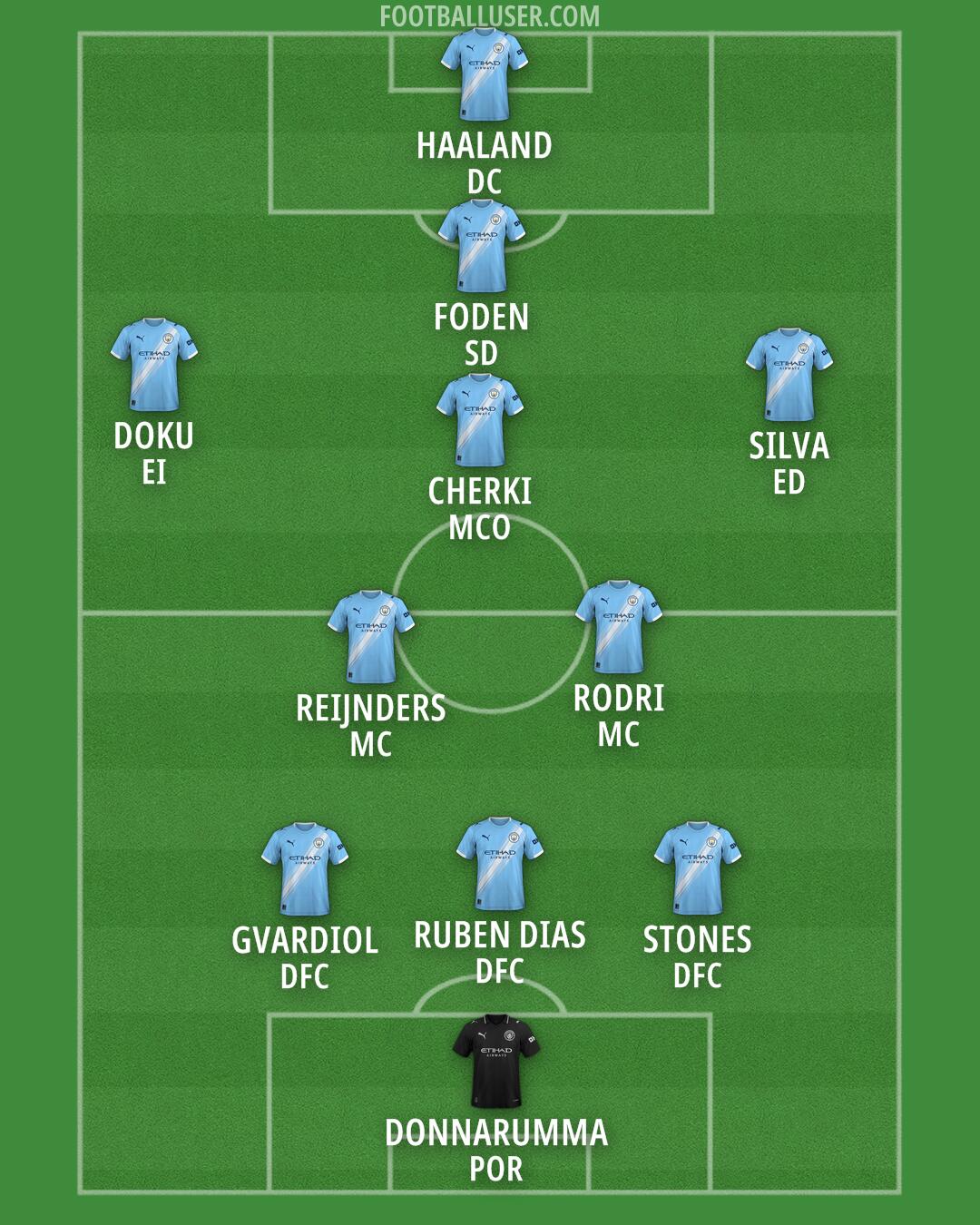
Man City Football Formation
 January 16, 2026
 Lautaro


Starting Lineup
DONNARUMMA (POR) · RUBEN DIAS (DFC) · STONES (DFC) · GVARDIOL (DFC) · RODRI (MC) · REIJNDERS (MC) · SILVA (ED) · DOKU (EI) · HAALAND (DC) · FODEN (SD) · CHERKI (MCO)A high pressing and heavy possession identity defines Man City in this 5-4-1 formation. This lineup focuses on controlling the ball and suffocating opponents in their own half to regain possession quickly. By keeping players close together, the team aims to dominate the ball and dictate the tempo of every match.
Donnarumma stands between the posts to provide security during transitions. The defensive unit sits in a back five, with Ruben Dias acting as a central presence to lead the line and command the box. Alongside him, Rodri and Reijnders provide stability, with Rodri using his ball playing ability to start attacks from deep. Stones and Gvardiol act as the wide defenders, pushing up to provide width and overlapping runs to support the midfield.
The midfield operates in a compact block designed to control the center of the pitch. Rodri drops deep to shield the defense and connect the back line to the rest of the team. In front of him, Cherki and Silva work to find pockets of space and break the line with vertical passes. Doku provides extra movement in the central area, while Foden acts as an attacking ten to link the midfield to the lone striker.
Haaland leads the line as a lone striker, tasked with holding up the ball and making runs into the channels. The attack relies on the width provided by Stones and Gvardiol to stretch the opposition. When Man City move into the final third, Foden and Doku push high to support the striker, creating central overloads. The goal is to use quick passes to isolate defenders and create scoring chances through central penetration.
This formation offers several tactical advantages for Manchester City. The back five provides massive compactness when defending deep, making it very hard for opponents to find space between the lines. There is also a significant ability to press high in coordinated waves because the midfield and forwards sit so close to the opposition defense. This setup creates numerical superiority in the middle of the park during the build up phase.
The 5-4-1 formation prioritizes ball control and high pressing intensity. It is best suited for matches where the team needs to dominate possession against a team that sits deep and looks to counter.