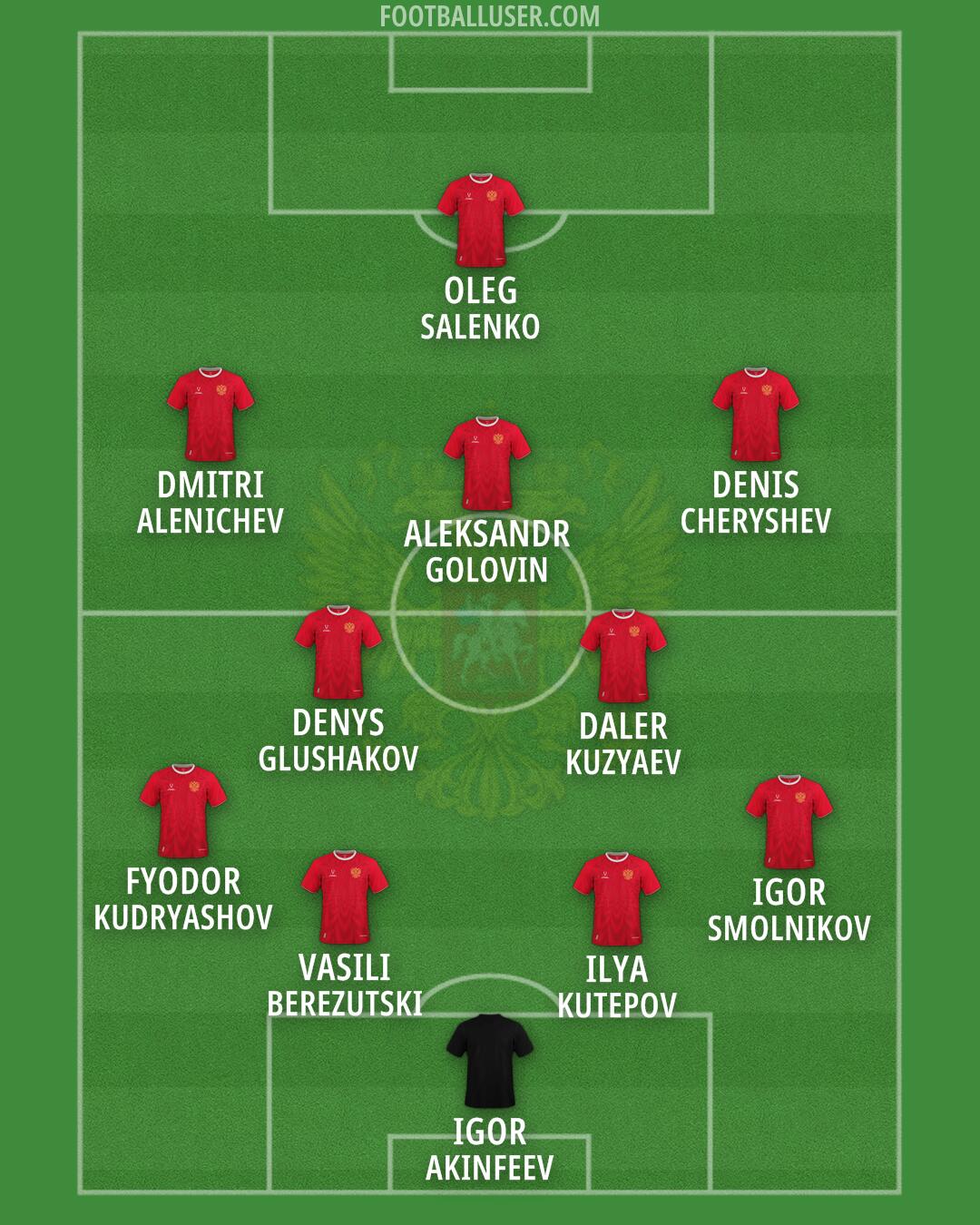

Russia National Football Team Formation
 January 16, 2026
 lucaosantos85


Starting Lineup
IGOR (AKINFEEV) · IGOR (SMOLNIKOV) · FYODOR (KUDRYASHOV) · VASILI (BEREZUTSKI) · ILYA (KUTEPOV) · DENYS (GLUSHAKOV) · DALER (KUZYAEV) · ALEKSANDR (GOLOVIN) · OLEG (SALENKO) · DMITRI (ALENICHEV) · DENIS (CHERYSHEV)High pressing and defensive compactness define the Russia lineup in this 4-5-1 formation. This system focuses on controlling the middle of the pitch and making it difficult for the opponent to pass through the center. By packing the midfield, Russia looks to win the ball back quickly and launch rapid attacks. The formation works to squeeze the space between the lines and force the opposition into wide areas where they are less dangerous.
IGOR protects the goal from the back as the starting goalkeeper. Ahead of him, a flat back four maintains a disciplined defensive line. ILYA and VASILI act as the central defenders, with ILYA playing as the right-sided center back and VASILI covering the left. IGOR holds the right flank while FYODOR operates at left back. The defenders stay close together to keep a compact block, with the center backs ready to step up to intercept passes or drop deep to cover space behind the defense.
The midfield functions as a heavy block containing five players to dominate the center. DENYS and DALER sit in the defensive midfield roles to shield the back four and intercept play. ALEKSANDR, DMITRI, and DENIS push slightly higher to connect the defense to the attack. These three central midfielders work to break the lines with their passing and provide constant cover when the team loses possession. This midfield unit can shift horizontally to track runners and block passing lanes.
Offensive movement relies on the lone striker, OLEG, who plays as the focal point. Since there are no wingers in the primary attacking line, the midfielders must provide the width and support. OLEG stays central to hold up the ball and allow the midfielders to push forward. The attackers press high to force turnovers, while the wide midfielders aim to cut inside or provide crosses into the box. This creates a central overload that forces the opposition to stay narrow.
Russia gains a significant advantage through numerical superiority in the central areas. Having five players in the midfield allows the team to crowd out the opponent and win second balls easily. The formation also allows for a high press in coordinated waves, as the midfield and OLEG can trap the opposition in their own half. When the team wins the ball, the speed of transition from the central block to the striker provides a direct way to catch the defense off guard.
This 4-5-1 formation provides a solid platform for a team that wants to control the tempo through central dominance. It is best suited for matches against opponents who rely heavily on playing through the middle of the pitch.