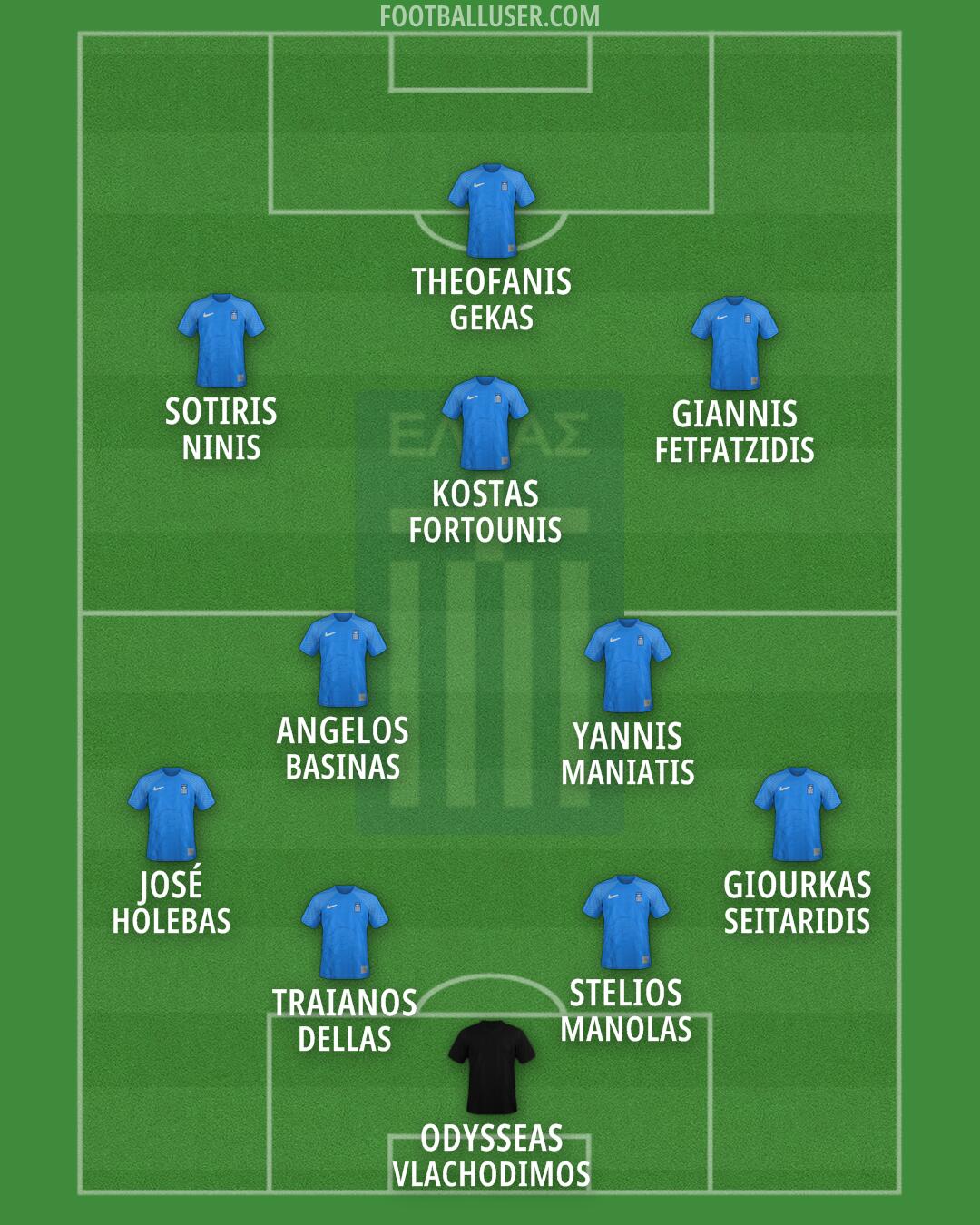

Greece National Football Team Formation
 January 17, 2026
 lucaosantos85


Starting Lineup
ODYSSEAS (VLACHODIMOS) · GIOURKAS (SEITARIDIS) · STELIOS (MANOLAS) · TRAIANOS (DELLAS) · JOSÉ (HOLEBAS) · ANGELOS (BASINAS) · YANNIS (MANIATIS) · KOSTAS (FORTOUNIS) · SOTIRIS (NINIS) · THEOFANIS (GEKAS) · GIANNIS (FETFATZIDIS)A high pressing identity defines Greece in this 4-3-3 formation. The squad seeks to win the ball high up the pitch and move vertically to catch opponents out of position. This lineup focuses on aggressive pressing and quick transitions to create scoring chances through direct play.
ODYSSEAS guards the goal and organizes the back line when the team sits deep. A flat back four consists of GIOURKAS on the right and JOSÉ on the left, while STELIOS and TRAIANOS occupy the central defender roles. GIOURKAS looks to push up and overlap to provide width, whereas JOSÉ provides balance on the opposite side. STELIOS and TRAIANOS must stay compact to cover the space behind the advancing full backs and intercept any long balls sent into the channels.
The midfield functions as a three man unit designed to control the center of the pitch. ANGELOS and YANNIS operate in the central roles to shield the defense and break the line with vertical passes. KOSTAS acts as the attacking midfielder to connect the midfield to the front three. This trio must press in unison to stop the opposition from building from the back, with KOSTAS pushing higher to support the strikers while ANGELOS and YANNIS track back to cover the gaps.
Greece employs three attackers to stretch the opposition defense. THEOFANIS leads the line as the lone striker to hold up the ball and pin the central defenders. On the flanks, SOTIRIS and GIANNIS act as wide wingers to provide width and cut inside into the half spaces. The movement of SOTIRIS and GIANNIS creates space for THEOFANIS to run into, and the forwards press heavily to force turnovers in the final third.
Several tactical advantages emerge from this 4-3-3 formation. The team can create wide overloads when GIOURKAS and GIANNIS occupy the same flank, forcing the opposition winger to track back. The presence of KOSTAS between the lines allows for numerical superiority in the attacking third. Additionally, the coordinated pressing of THEOFANIS, SOTIRIS, and GIANNIS makes it difficult for opponents to play out from the back.
The Greek national team relies on this aggressive system to dictate the tempo of the match. This formation works best against teams that struggle to play under pressure and leave space behind their midfield.