
Brazil National Football Team Formation
 January 19, 2026


Starting Lineup
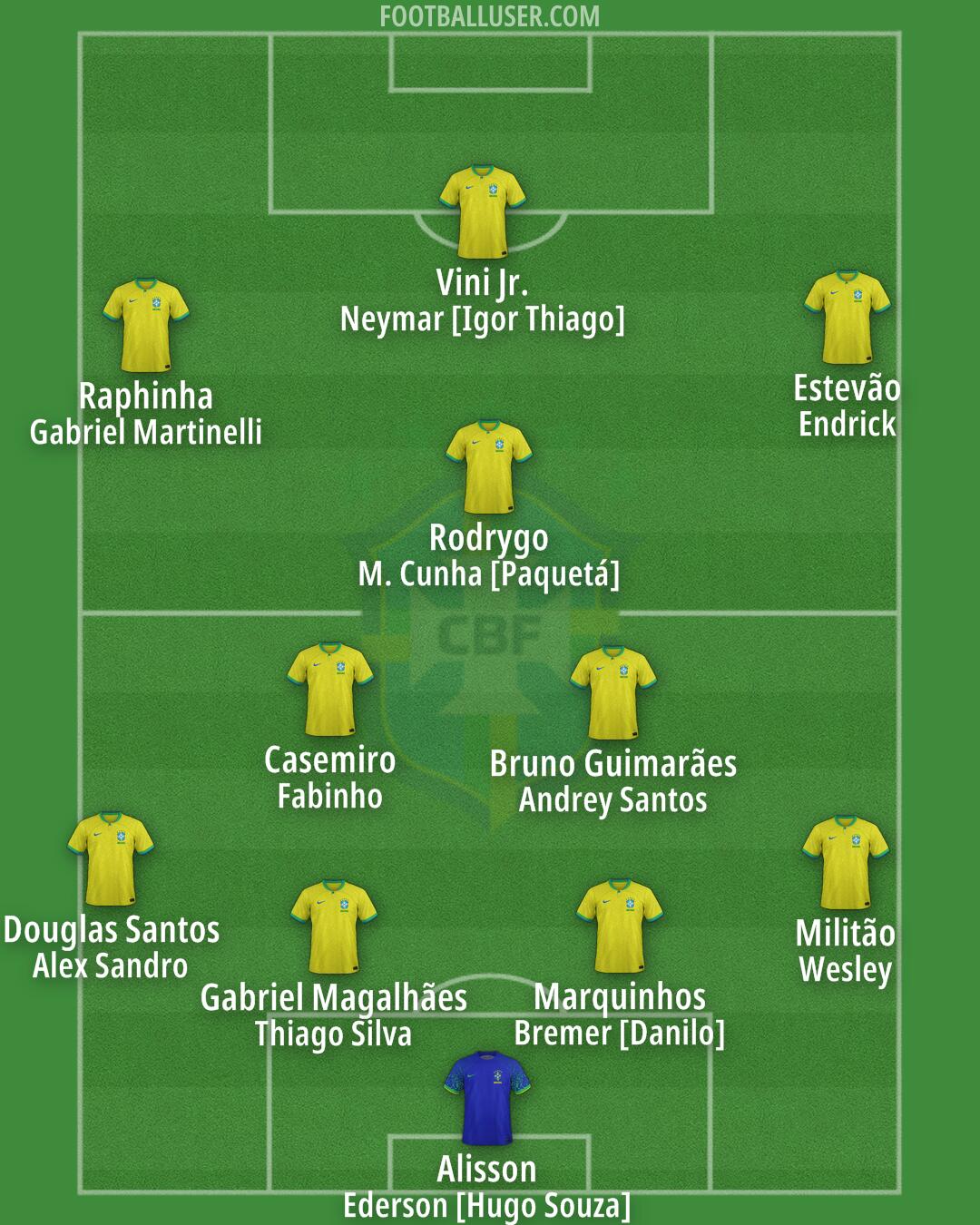
Alisson (Ederson [Hugo Souza]) · Militão (Wesley) · Marquinhos (Bremer [Danilo]) · Gabriel Magalhães (Thiago Silva) · Douglas Santos (Alex Sandro) · Casemiro (Fabinho) · Bruno Guimarães (Andrey Santos) · Raphinha (Gabriel Martinelli) · Rodrygo (M. Cunha [Paquetá]) · Estevão (Endrick) · Vini Jr. (Neymar [Igor Thiago])A high pressing and vertical style of play defines the Brazil lineup in this 4-3-3 formation. The Selecao aim to win the ball high up the pitch and quickly break the lines to catch the opposition out of position. This formation relies on aggressive movement and rapid transitions to overwhelm opponents.
Alisson sits between the posts to organize the back line and sweep up long balls behind the defense. A back four provides the foundation, with Marquinhos acting as a ball playing defender who can step up to intercept passes. Gabriel Magalhães provides aerial strength and physical presence to cover the central zone. On the flanks, Militão pushes up to support the attack, while Douglas Santos provides width by overlapping to send crosses into the box. The defensive unit works to keep a high line to squeeze the space in the middle.
The midfield functions through a combination of defensive screening and creative driving. Casemiro operates as a single pivot to shield the defense and break up play with his tackling and positioning. Bruno Guimarães links the play, driving forward to connect the defense with the attackers. Rodrygo operates in the pocket as an attacking midfielder, looking to find space between the lines and create chances. This trio ensures that the midfield remains compact when defending and provides passing options when building play.
In the final third, Brazil utilizes three attackers to stretch the opposition. Vini Jr. leads the line as the primary threat, using his dribbling and pace to run at defenders. Raphinha stays wide on the left to cut inside and create goal scoring opportunities, while Estevão occupies the right flank to provide width. These forwards press in coordinated waves to force mistakes from the opponent's back line. The movement of these players creates gaps in the defensive block for late runners to exploit.
The team benefits from several tactical advantages. The ability to press high in coordinated waves puts immediate pressure on the ball carrier. Wide overloads occur when Douglas Santos and Raphinha push forward together, creating two on one situations against the opposition full backs. Additionally, the speed of transition allows Brazil to move from a defensive block to an attacking phase in seconds, catching opponents while they are stretched.
This 4-3-3 formation represents a highly aggressive tactical identity. It is best suited for matches against teams that struggle to play out from the back under heavy pressure.