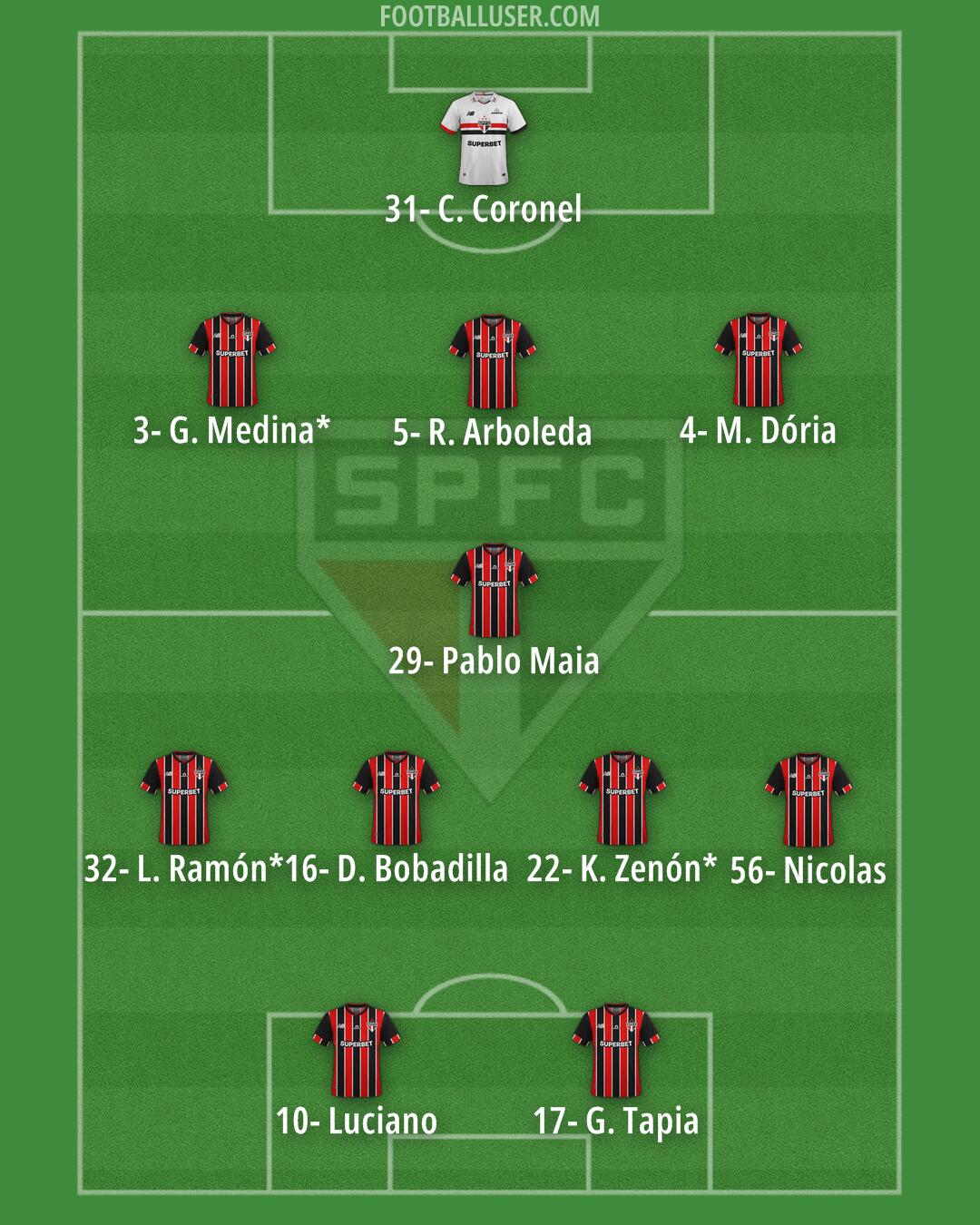

São Paulo Football Formation
 January 19, 2026


Starting Lineup
31- C. Coronel3- G. Medina*
5- R. Arboleda
4- M. Dória
29- Pablo Maia
32- L. Ramón*
16- D. Bobadilla
22- K. Zenón*
56- Nicolas
10- Luciano
17- G. Tapia
A heavy focus on controlling the center of the pitch defines the São Paulo 3-5-2. This formation aims to dominate games through a high press and central density. By crowding the middle, the lineup seeks to win the ball back quickly and launch direct attacks toward the two strikers.
In goal, C. Coronel acts as the foundation for the defensive unit. The back three consists of R. Arboleda in the center, flanked by G. Medina on the right and M. Dória on the left. Arboleda provides aerial strength and covers the space behind his teammates, while Medina and Dória work to intercept passes and step up to squeeze the opposition. This three man line stays compact to prevent through balls from breaking the defensive block.
The midfield functions as a five man unit designed to lock down the center. Pablo Maia sits in front of the defense as a single pivot to shield the back three and intercept play. Beside him, K. Zenón and D. Bobadilla occupy the central spaces to break the line with forward passes and drive the ball into the final third. On the flanks, L. Ramón and Nicolas act as wing backs who provide the necessary width, pushing high to overlap and deliver crosses into the box.
The attacking front line relies on two forwards to pressure the opposition backline. G. Tapia leads the line as the main striker, while Luciano plays as a second striker to find pockets of space. These two forwards press in coordinated waves to force mistakes. The movement of Luciano allows him to drop deeper and link play, creating space for G. Tapia to run behind the defenders or fight for headers.
One major advantage for São Paulo is the numerical superiority found in the central midfield area. With Pablo Maia, K. Zenón, and D. Bobadilla, the team can easily outnumber opponents in transition. Another strength is the ability to use L. Ramón and Nicolas to create wide overloads, which forces the opposing defense to stretch and leave gaps in the middle.
This 3-5-2 formation creates a compact and difficult unit to break down. It is best suited for matches against teams that prefer to play through the middle and rely on central playmakers.