
São Paulo Football Formation
 January 19, 2026


Starting Lineup
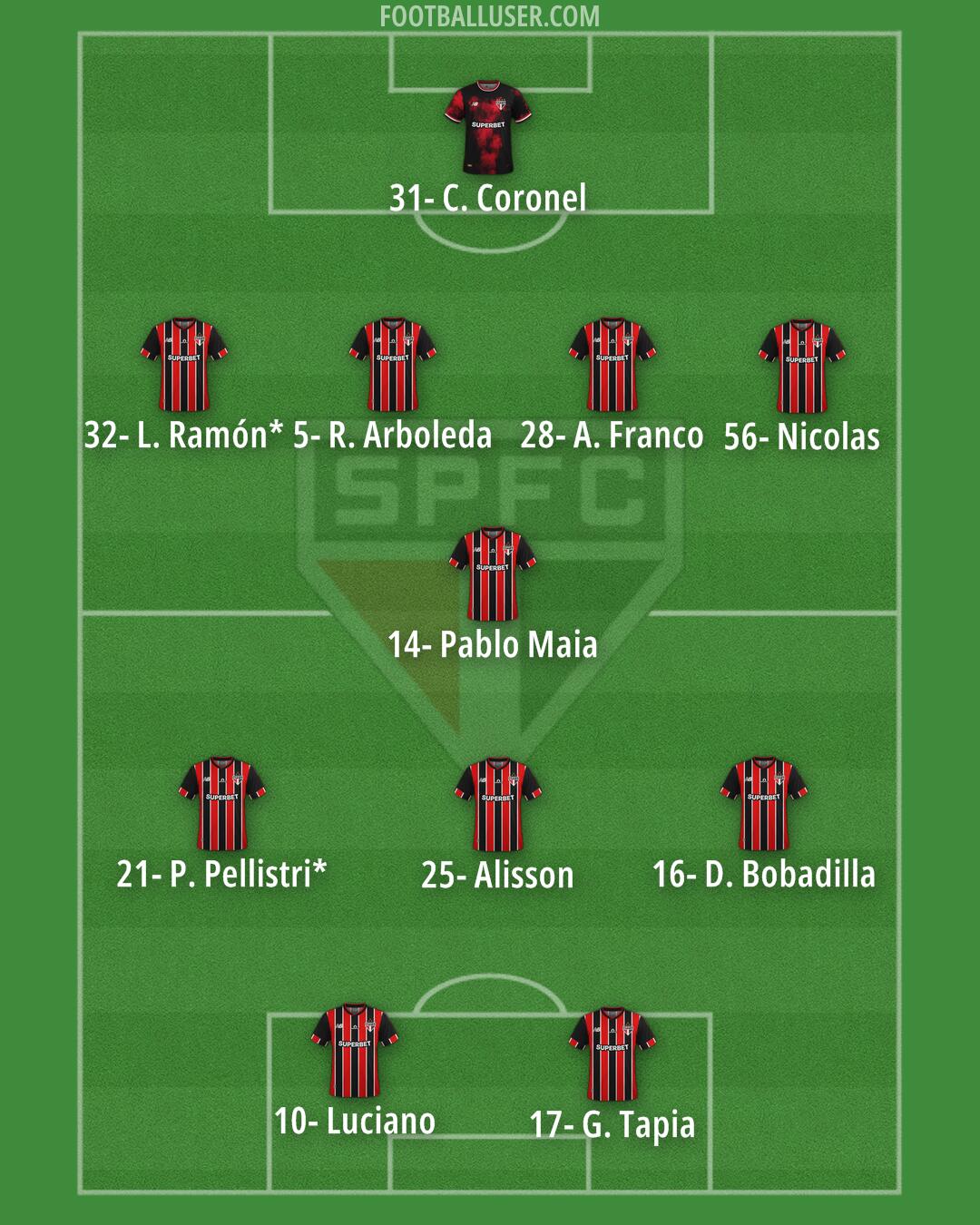
31- C. Coronel32- L. Ramón*
5- R. Arboleda
28- A. Franco
56- Nicolas
14- Pablo Maia
21- P. Pellistri*
25- Alisson
16- D. Bobadilla
10- Luciano
17- G. Tapia
Heavy emphasis on defensive solidity and rapid counter attacks defines the 5-3-2 formation chosen by São Paulo. This lineup focuses on staying compact to deny space between the lines before launching vertical passes toward the forward duo. By maintaining a low block when out of possession, the team prepares to strike quickly once they regain control of the ball.
In goal, C. Coronel acts as the last line of defense to sweep up long balls. The back three consists of Pablo Maia, R. Arboleda, and A. Franco, who work together to block shots and win aerial duels. R. Arboleda provides massive aerial strength to clear crosses, while Pablo Maia and A. Franco cover the spaces behind the wing backs. Nicolas and L. Ramón operate as the wide defenders, pushing up the flanks to provide width during transitions but tracking back quickly to form a five man line when defending.
The midfield acts as a central engine to control the middle of the pitch. D. Bobadilla and Alisson work to shield the defense, with Bobadilla often sitting deeper to intercept passes and break up play. P. Pellistri occupies the left side of the trio to help transition the ball from the defenders to the attackers. This midfield unit connects the back three to the front line by recycling possession and finding the right moment to play a ball into the channels.
Attacking the opponent requires the movement of two forwards. G. Tapia and Luciano operate as the two primary strikers, often pulling defenders out of position with their runs. Luciano can drop a little deeper to link play, while G. Tapia pushes the defensive line back. The wide wing backs, Nicolas and L. Ramón, provide the necessary width to stretch the opposition, allowing the two strikers to find space in the central areas.
São Paulo finds several tactical advantages through this setup. The three central defenders and three midfielders create a very compact block that is hard to break down through the middle. This allows the team to use the pace of the wing backs to create wide overloads during transitions. Additionally, the formation allows the team to isolate Luciano and G. Tapia in one on one situations against tired defenders once the ball moves forward.
This 5-3-2 formation provides a reliable way to frustrate opponents who dominate possession. It is best suited for matches where the team needs to sit deep and catch the opposition on the break.