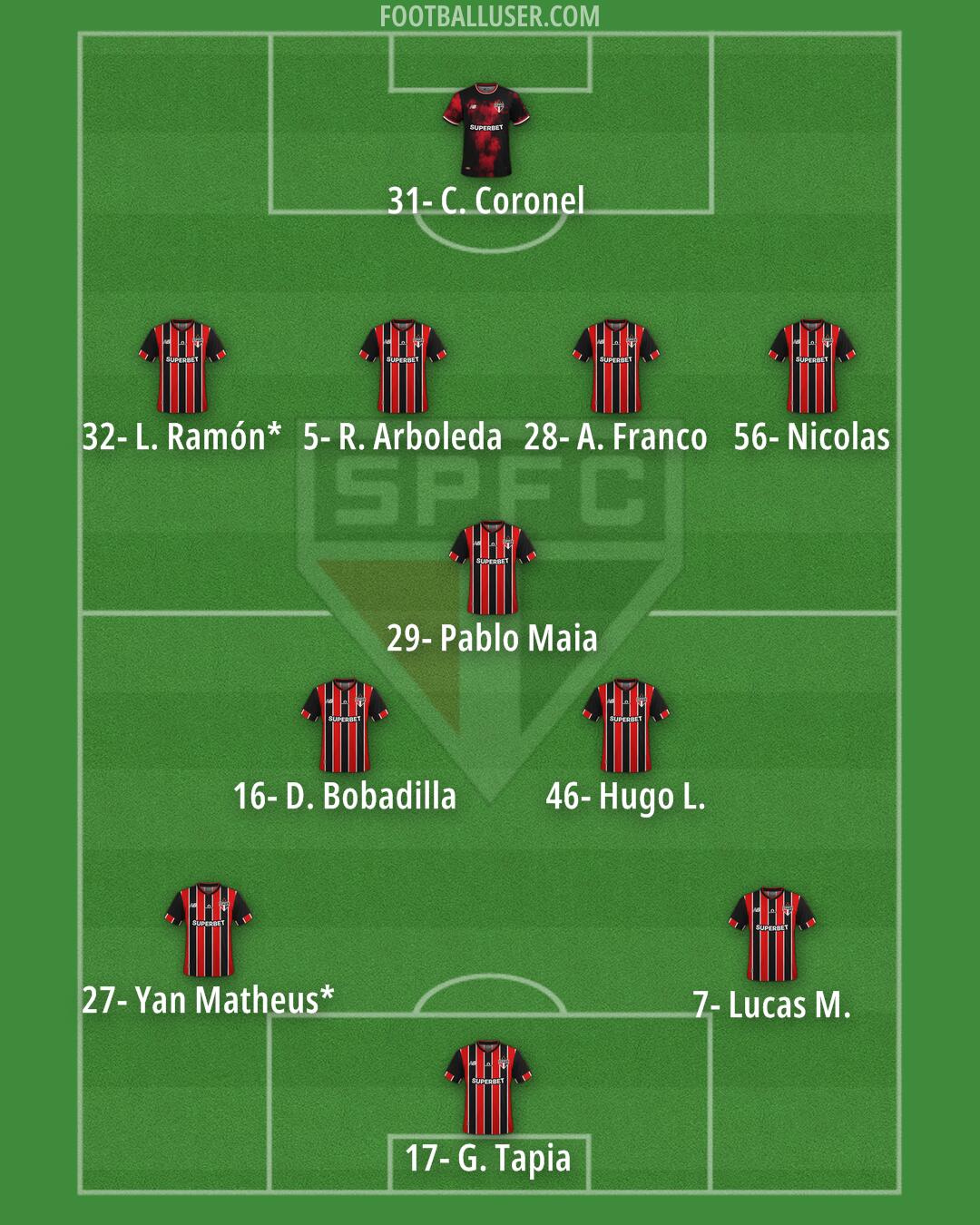

São Paulo Football Formation
 January 19, 2026


Starting Lineup
31- C. Coronel5- R. Arboleda
28- A. Franco
29- Pablo Maia
16- D. Bobadilla
46- Hugo L.
17- G. Tapia
32- L. Ramón*
56- Nicolas
27- Yan Matheus*
7- Lucas M.
Prioritizing directness and high pressing, São Paulo operates within a 4-3-3 formation. This lineup focuses on aggressive ball recovery and quick transitions to catch opponents out of position. By pushing the lines high, the team intends to control the tempo through forward verticality rather than slow build up play.
C. Coronel acts as the last line of defense in goal. Ahead of him, a flat back four holds the defensive line. R. Arboleda and A. Franco serve as the central pairing, where Arboleda uses his aerial strength to win headers and Franco covers the space behind. On the flanks, L. Ramón and Nicolas provide width. L. Ramón pushes up to overlap in the final third, while Nicolas maintains the defensive line or steps up to intercept passes.
The midfield functions as a single pivot system with supporting runners. Pablo Maia sits in front of the defense to shield the back four and intercept play. Beside him, D. Bobadilla and Hugo L. act as the engine. Bobadilla works to break the line with his runs, while Hugo L. connects the defensive unit to the attack. This trio ensures the team remains compact when the opponent has the ball.
In the attacking third, São Paulo employs three forwards to stretch the opposition. G. Tapia acts as the lone striker, tasked to hold up the ball and pin the defenders. Lucas M. operates as an inverted winger on the left, looking to cut inside and create chances, while Yan Matheus occupies the right wing to provide width. These attackers press high to force turnovers near the opponent's goal.
One major advantage of this São Paulo lineup is the ability to press high in coordinated waves. When the front three push up, the midfield trio steps up to close the passing lanes, creating a suffocating block. Another strength is the wide overload potential when L. Ramón overlaps to support Yan Matheus. This creates one on one situations for the wingers to exploit.
This 4-3-3 formation relies on intense pressing and quick vertical passing to dominate territory. It is best suited for matches against teams that struggle to play out from the back under pressure.