Arsenal Football Formation
 January 20, 2026


Starting Lineup
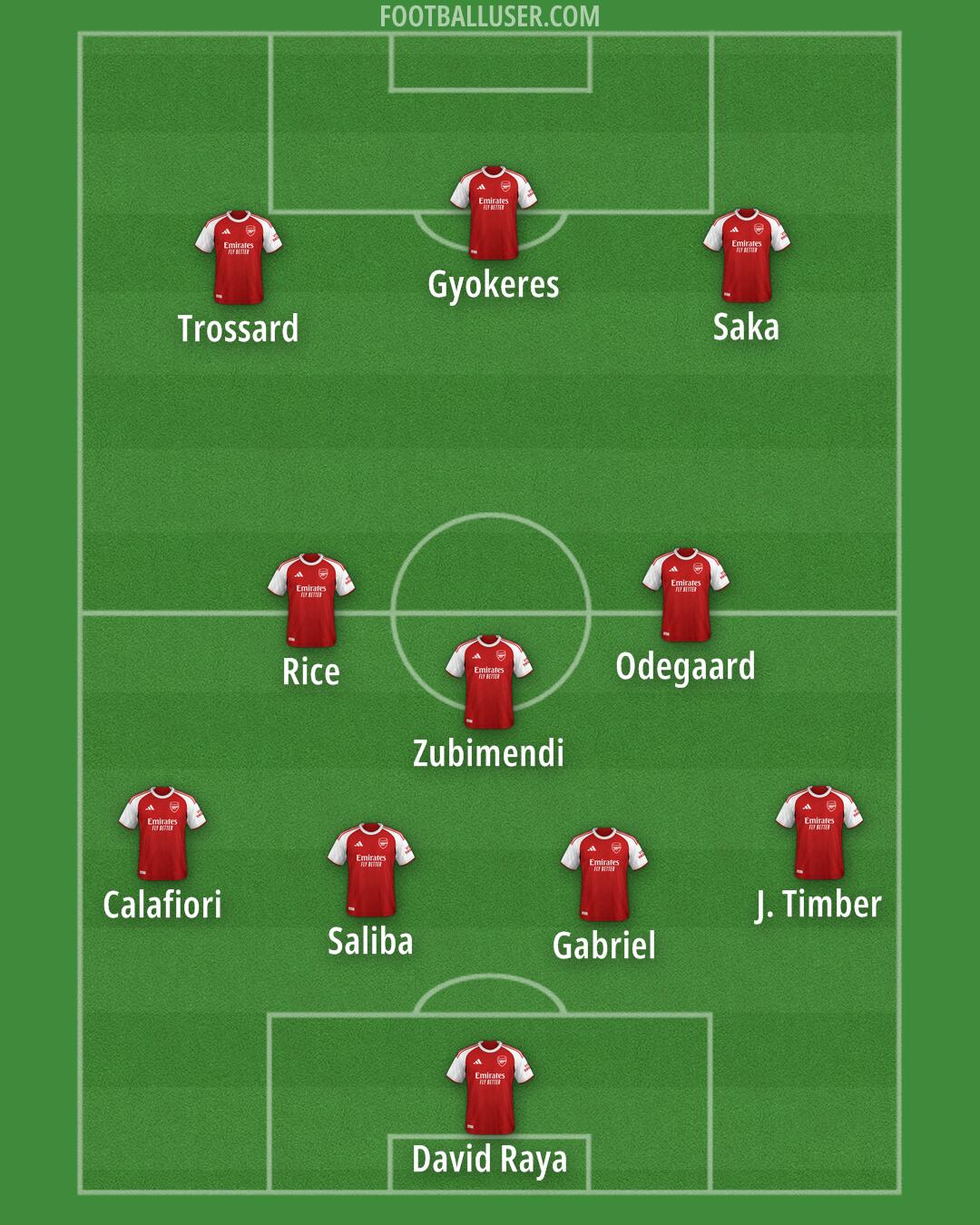
David Raya · Saliba · Gabriel · J. Timber · Calafiori · Zubimendi · Rice · Odegaard · Gyokeres · Saka · TrossardHigh pressing and controlled possession define the Arsenal lineup in this 4-3-3 formation. The Gunners want to control the ball and squeeze opponents into their own half. This system builds from the back to dominate the middle of the pitch and force turnovers through relentless pressure. It is a system built to suffocate teams that struggle to play out from deep under heat.
David Raya starts in goal to distribute the ball from the back with short and long passes. Ahead of him, the back four functions with a high line to keep the distances between units small. Gabriel provides aerial strength and physical presence as the right sided central defender, while Saliba acts as the covering defender to intercept long balls and sweep up behind the press. J. Timber pushes high to provide width on the right, and Calafiori moves into central areas or overlaps to offer a different angle for the buildup.
The midfield acts as a single pivot with Zubimendi sitting deep to shield the defense and break the lines with his passing range. Alongside him, Rice drives forward to win second balls and push the team into the attacking third. Martin Odegaard (C) operates as the creative hub, finding pockets of space to connect the midfield to the front three. The captain uses his vision to switch play and find the forwards when the opposition sits deep.
Arsenal utilizes three attackers to stretch the opposition defense. Gyokeres acts as the lone striker to hold up the ball and lead the press from the front. On the wings, Saka cuts inside from the right to create goal scoring opportunities, while Trossard occupies the left flank to drift into half spaces. This movement creates central presence and allows the attackers to pull defenders out of position.
This formation offers significant tactical advantages through its ability to press high in coordinated waves. Arsenal can create wide overloads when J. Timber and Saka work together to pin the opposition wing back. Additionally, the midfield group provides compactness when defending, making it difficult for teams to pass through the center. The speed of transition allows the team to move from a defensive block to a direct attack in seconds.
The 4-3-3 lineup focuses on controlling space and dominating the ball through high intensity. This system is best suited for matches against teams that try to play a possession based game or struggle with intense physical pressure.