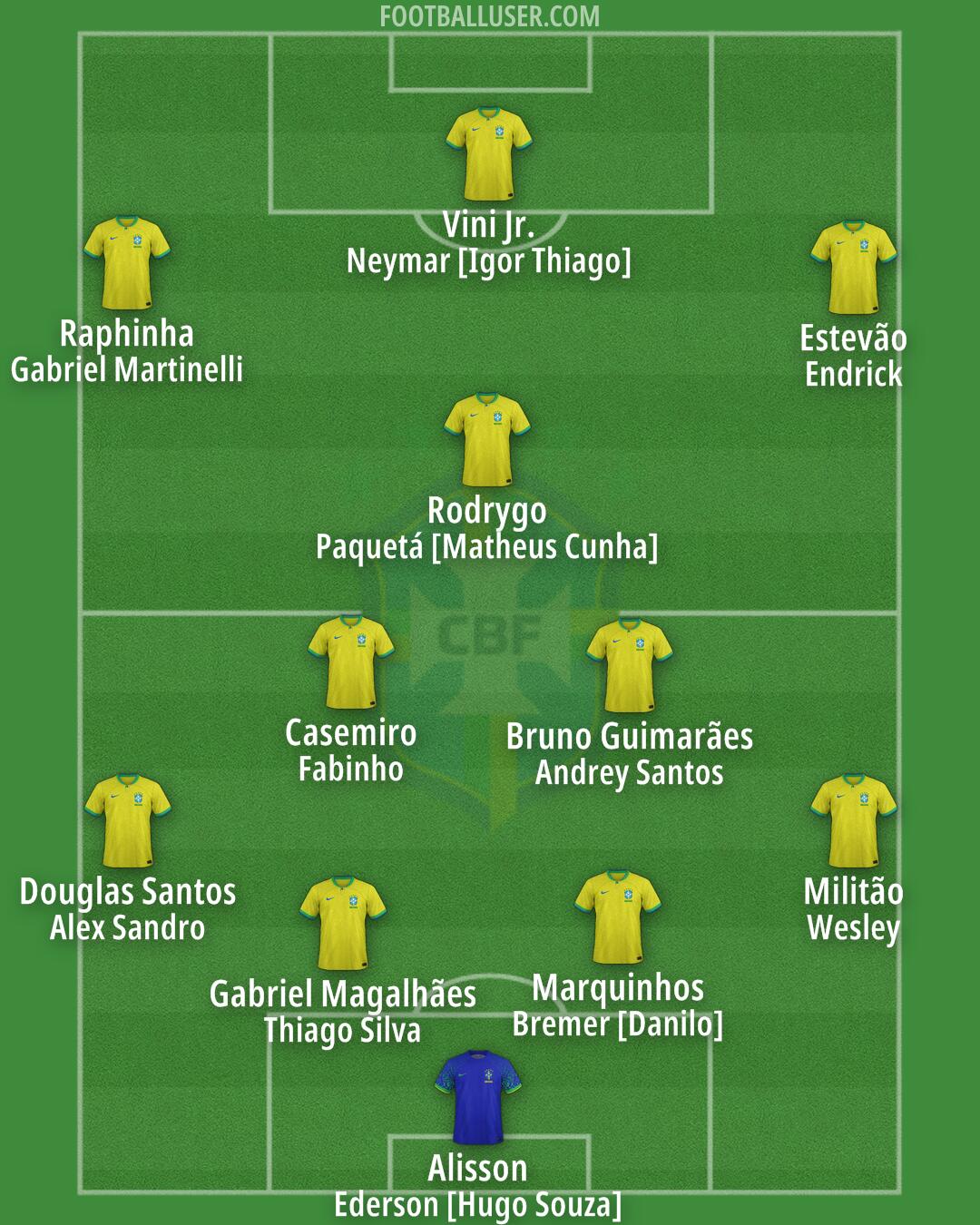

Brazil National Football Team Formation
 January 20, 2026


Starting Lineup
Alisson (Ederson [Hugo Souza]) · Militão (Wesley) · Douglas Santos (Alex Sandro) · Casemiro (Fabinho) · Bruno Guimarães (Andrey Santos) · Raphinha (Gabriel Martinelli) · Estevão (Endrick) · Vini Jr. (Neymar [Igor Thiago]) · Rodrygo (Paquetá [Matheus Cunha]) · Marquinhos (Bremer [Danilo]) · Gabriel Magalhães (Thiago Silva)High intensity pressing and rapid verticality define Brazil in a 4-3-3. This formation aims to dominate the ball in the final third while using aggressive pressing to win it back immediately. The Selecao focuses on quick transitions to exploit space behind the opposition defense.
Alisson starts the buildup from the back, acting as a sweep keeper with great distribution. A flat back four provides the foundation, with Militão and Marquinhos acting as the central pairing. Marquinhos provides aerial strength and positional intelligence, while Gabriel Magalhães covers the left channel. Douglas Santos pushes up the left flank to provide width, while Militão can overlap or tuck in to help the center. The defensive unit stays compact to block passing lanes and keep the line high.
The midfield relies on a combination of ball retention and defensive coverage. Casemiro sits in the pivot to shield the back four, using his tackling and ability to intercept play to break up attacks. Bruno Guimarães operates alongside him, driving forward to connect the lines and switch play with his passing range. Rodrygo plays in the attacking midfield role, finding pockets of space between the opponent's midfield and defense to create chances.
A potent front three drives the attacking movement. Vini Jr. leads the line as the striker, often drifting wide to use his dribbling and pace to beat defenders. Raphinha operates on the left wing, looking to cut inside and shoot or provide crosses. Estevão stays wide on the right to stretch the defense. This attacking lineup presses high in waves, forcing mistakes from the opponent.
Numerical superiority in the middle of the pitch is a key advantage for Brazil. By having Rodrygo push high, the team can overload the central areas. The team also benefits from wide overloads when Douglas Santos and Raphinha occupy the same side, creating situations where they can isolate Estevão in one on one battles on the opposite flank. The speed of transition remains a major threat.
This 4-3-3 formation creates a relentless attacking force that thrives on chaos. It is best suited for games against opponents who play a high line or struggle to track runners in the half spaces.