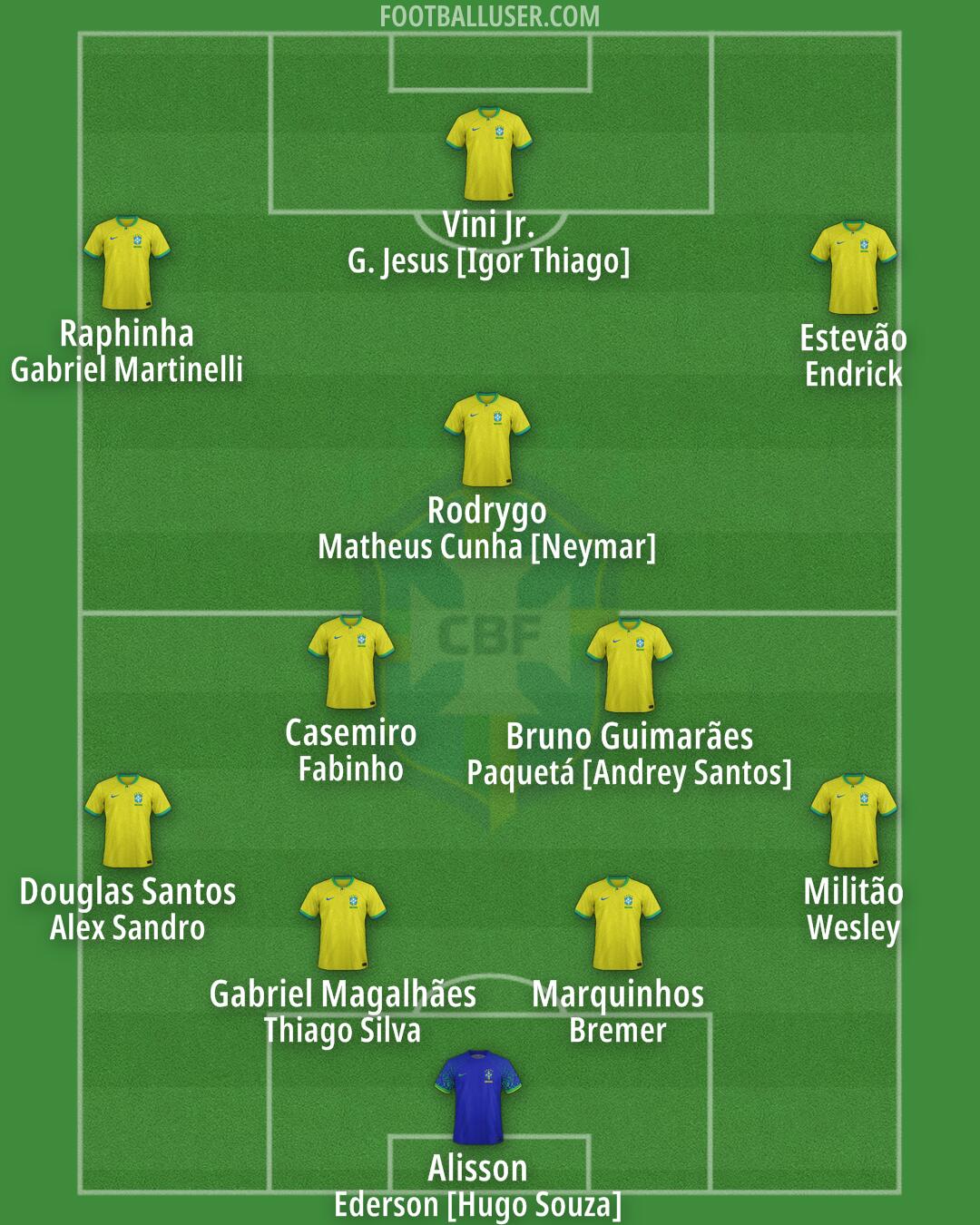

Brazil National Football Team Formation
 January 21, 2026


Starting Lineup
Alisson (Ederson [Hugo Souza]) · Militão (Wesley) · Douglas Santos (Alex Sandro) · Casemiro (Fabinho) · Bruno Guimarães (Paquetá [Andrey Santos]) · Raphinha (Gabriel Martinelli) · Estevão (Endrick) · Vini Jr. (G. Jesus [Igor Thiago]) · Rodrygo (Matheus Cunha [Neymar]) · Marquinhos (Bremer) · Gabriel Magalhães (Thiago Silva)A high press and rapid transition identity defines Brazil and their 4-3-3 formation. This lineup seeks to dominate the ball and push opponents deep into their own half through aggressive pressing. By utilizing wide areas and central creativity, the Selecao aim to break lines frequently with vertical passes.
Alisson acts as the foundation from the goal, providing sweeping coverage when the defense pushes up. A flat back four contains the opposition, with Marquinhos and Gabriel Magalhães operating as central defenders. Marquinhos shows great composure when playing out from the back, while Gabriel Magalhães provides aerial strength in defensive duels. On the flanks, Militão stays tight to the winger to defend the wide areas, while Douglas Santos pushes up to provide width and overlapping runs to support the attack.
The midfield operates with a single pivot and two more advanced players to control the central zone. Casemiro sits in front of the back four to shield the defense, using his tackling and interception skills to break up play. Bruno Guimarães connects the defense to the attack, driving forward to carry the ball into the final third. Rodrygo operates in the space between the lines as an attacking midfielder, looking to find pockets of space and provide key passes to the forwards.
The attacking front line focuses on high intensity and movement to create chances. Vini Jr. leads the line as the striker, often cutting inside from wide positions to use his dribbling style and pace. Raphinha occupies the left wing, looking to cut inside or deliver crosses into the box. Estevão plays on the right wing to provide much needed width and directness. These three forwards press in unison to force turnovers high up the pitch.
Brazil gains a significant advantage through the speed of transition once the ball is won in midfield. The combination of Casemiro and Bruno Guimarães allows the team to shift from a defensive block to an attacking phase in seconds. Another strength lies in the wide overloads created when Douglas Santos overlaps Raphinha, forcing the opposition defense to shift and leave gaps in the center. This creates space for Rodrygo to exploit.
This 4-3-3 formation creates a heavy presence in both central and wide areas to overwhelm the opponent. It is a formation best suited for matches where Brazil can control the tempo and exploit high lines through quick, direct movements.