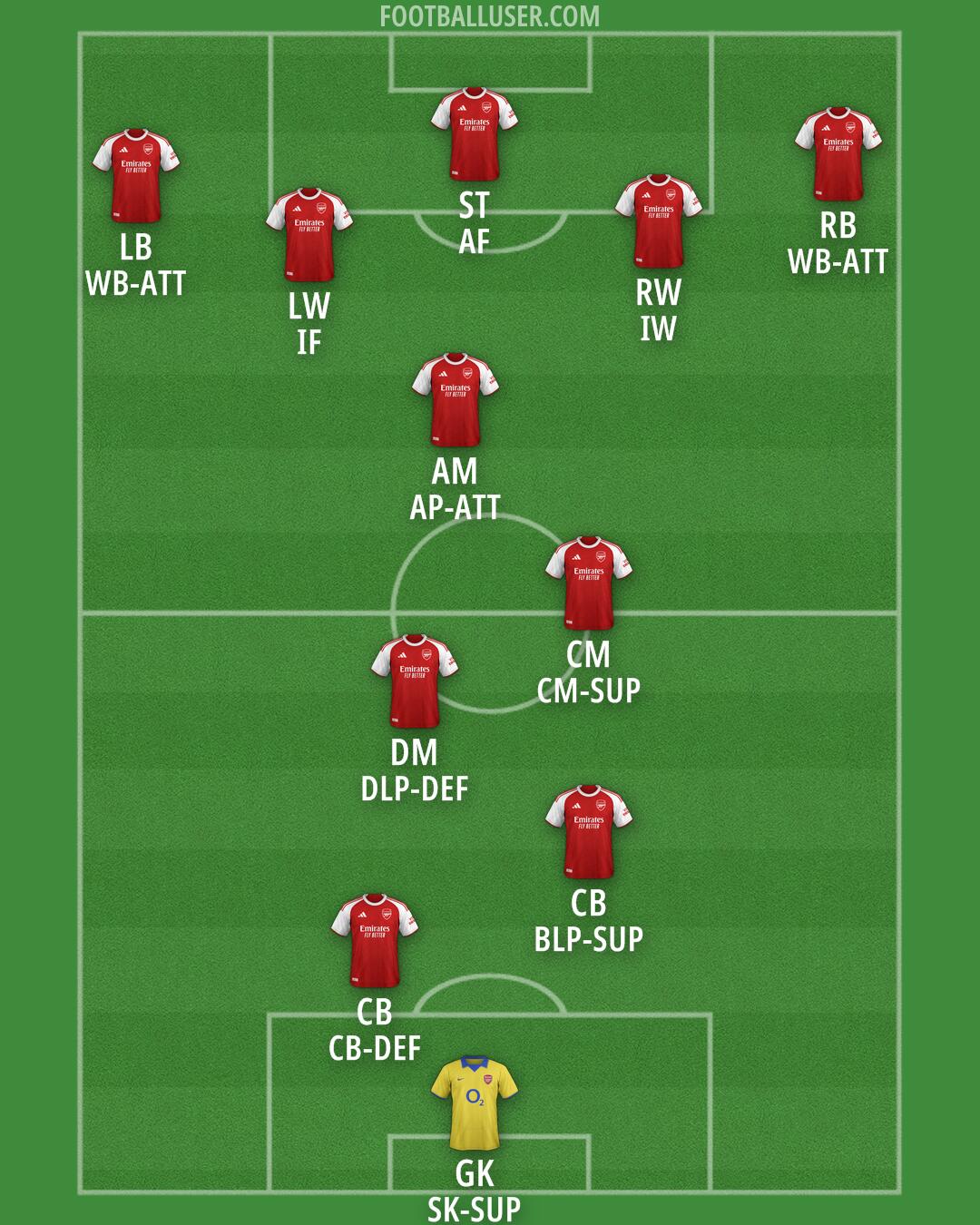
Arsenal Football Formation
 January 22, 2026


Starting Lineup
ST (AF) · RW (IW) · LW (IF) · AM (AP-ATT) · CM (CM-SUP) · DM (DLP-DEF) · RB (WB-ATT) · LB (WB-ATT) · CB (BLP-SUP) · CB (CB-DEF) · GK (SK-SUP)Heavy emphasis on high pressing and ball control defines Arsenal in a 4-3-3 formation. This lineup seeks to control the tempo through short passing and aggressive positioning to win the ball back quickly in the final third. The team aims to dominate territory by keeping the ball in the opponent half and looking for vertical passes to break lines.
GK acts as the last line of defense, starting the build up from the back. The back four functions with CB (LB) and CB (RCB) forming a central pairing that focuses on intercepting passes and covering space. To provide width, CM (RB) and LB (LW) push high up the pitch, acting as overlapping full backs to stretch the opposition. The defense must stay compact to prevent counter attacks while the rest of the team pushes up the pitch.
The midfield operates with a single pivot role held by AM (DM) to shield the back line. Moving forward from this position are LW (LCM) and RW (RCM), who act as the engines connecting the defense to the attack. These players must track back when possession is lost and drive the ball forward during transitions. By controlling the center, the midfield ensures Arsenal can switch play quickly to the flanks.
In the attacking phase, the team utilizes a three player front line featuring LB (LW), RB (RW), and ST (ST). The wide players like LB (LW) and RB (RW) act as inverted wingers, often cutting inside to create goal scoring opportunities or making runs into the box. ST (ST) stays central to hold up the ball and provide a focal point for crosses. This movement creates space for the midfielders to make late runs into the area.
One major advantage for Arsenal is the ability to create wide overloads when the full backs overlap the wingers. This forces the opposition defense to shift and leaves gaps in the middle. The team also finds success by pressing high in coordinated waves, using the front three to force errors near the opponent goal. This pressure allows for quick transitions and immediate shots on target.
This 4-3-3 formation provides a dominant presence in both possession and defensive pressing. It is best suited for games against teams that sit deep and struggle to handle high intensity pressure.