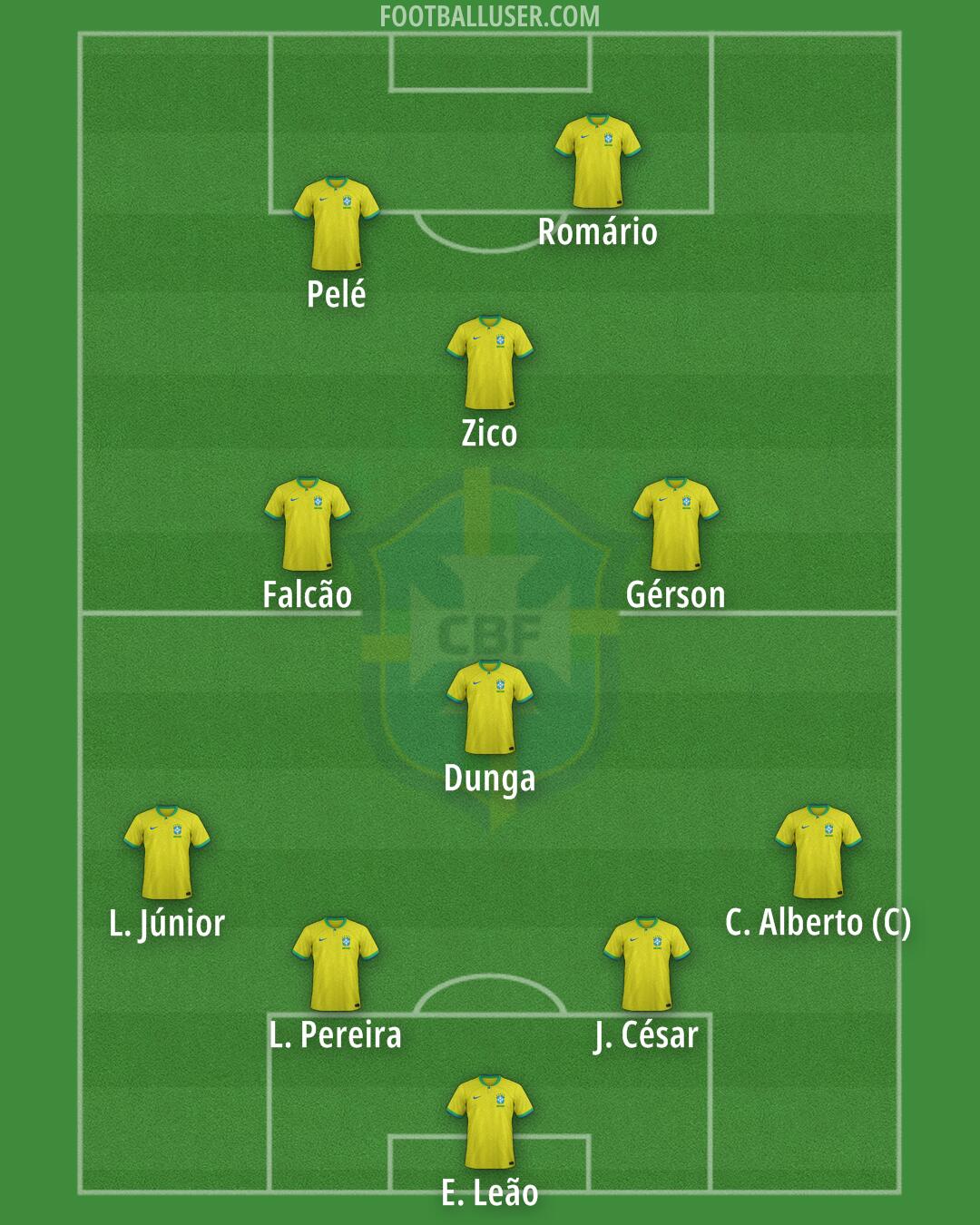

Brazil National Football Team Formation
 January 24, 2026


Starting Lineup
E. Leão · J. César · L. Pereira · C. Alberto (C) · L. Júnior · Dunga · Gérson · Falcão · Zico · Pelé · RomárioA focus on defensive solidity and rapid transitions defines this Brazil lineup in a 5-3-2 formation. This selection relies on a strong core to absorb pressure before quickly releasing the ball to the forward line. The team seeks to control the center of the pitch while using the wings to stretch the opposition, making it a very vertical formation designed to punish teams on the break.
E. Leão guards the goal as the last line of defense for Brazil. The back five consists of three central defenders with Dunga sitting in the middle to command the area. J. César sits on the right side of the central trio while L. Pereira occupies the left, providing height and strength to win aerial duels. On the flanks, C. Alberto (C) acts as the right wing back to provide width and energy, while L. Júnior operates as the left wing back. These wide defenders push high to support the attack but must track back quickly to maintain the defensive block.
The midfield functions as a three man unit that connects the defense to the attackers. Gérson and Falcão operate in the central roles to control the tempo and cover ground, while Zico plays as an attacking ten behind the two forwards. Zico uses his renowned passing range and set piece delivery to break the lines and find the strikers. Gérson and Falcão work to intercept passes and shield the back five, ensuring the team stays compact when the opposition has the ball.
Up front, the team employs two prolific strikers in Pelé and Romário. They operate as a dual threat, with Pelé using his clinical finishing and movement to find space in the box while Romário holds up the ball to bring others into play. This duo does not stay static, often dropping deep to pull defenders out of position or making runs into the channels. The width provided by the wing backs allows these two to stay central and focus on scoring.
This formation offers several tactical advantages, specifically the ability to create numerical superiority in the central areas. By having three central midfielders and three central defenders, the team can easily overload the middle of the pitch to stop attacks. The team also benefits from the speed of transition when the wing backs like L. Júnior or C. Alberto (C) carry the ball forward. This allows the front two to exploit gaps left by an advancing opposition defense.
The 5-3-2 formation provides a heavy defensive base that protects the middle of the park. It is best suited for matches against high pressing teams where Brazil can sit deep and launch quick strikes through the strikers.