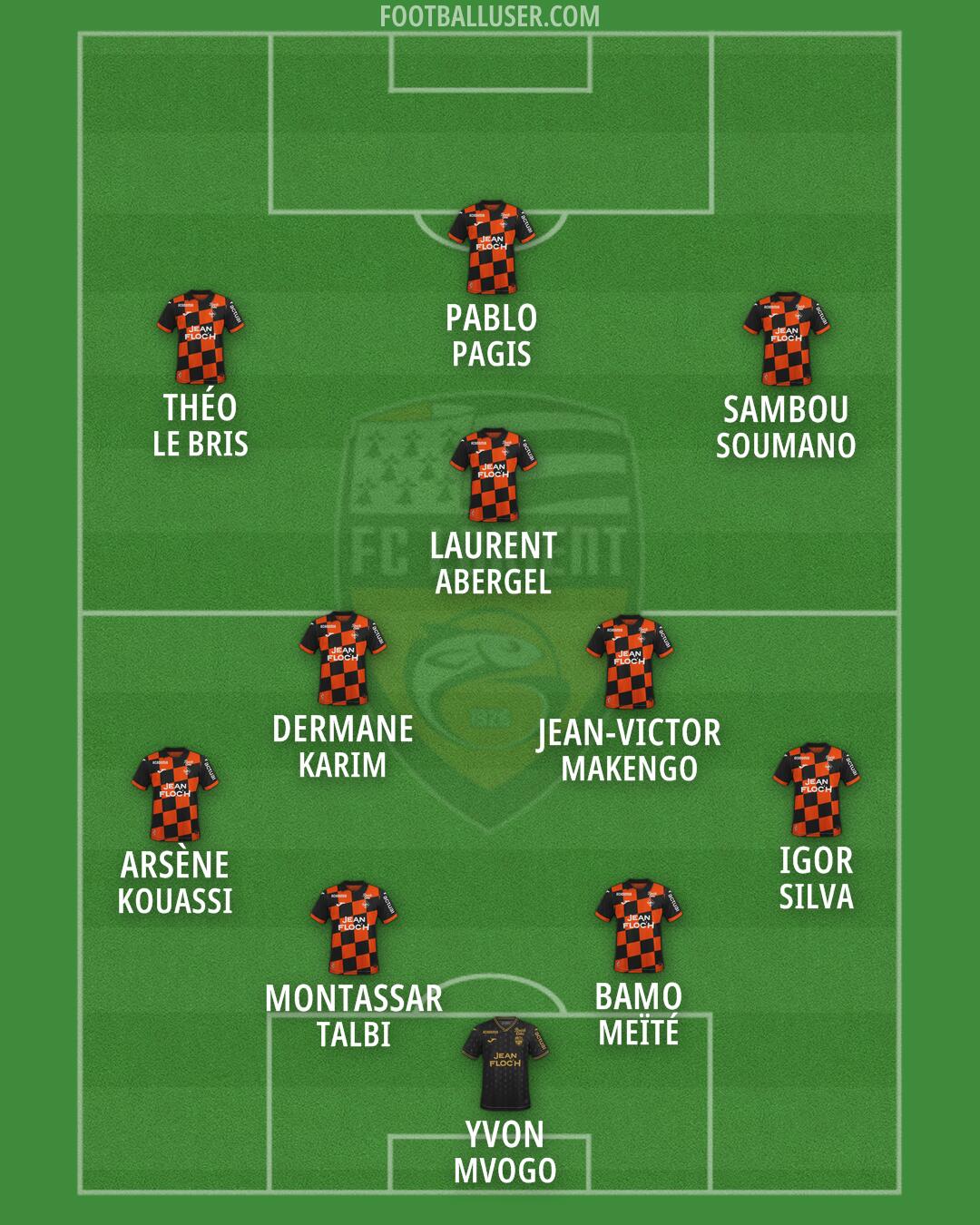

Lorient Football Formation
 January 24, 2026
 lucaosantos85


Starting Lineup
YVON (MVOGO) · IGOR (SILVA) · BAMO (MEÏTÉ) · MONTASSAR (TALBI) · ARSÈNE (KOUASSI) · DERMANE (KARIM) · LAURENT (ABERGEL) · JEAN-VICTOR (MAKENGO) · THÉO (LE BRIS) · SAMBOU (SOUMANO) · PABLO (PAGIS)High pressing and rapid verticality define this Lorient lineup, which operates within a 2-5-3 formation. This system seeks to dominate the middle of the pitch and pin the opposition in their own half through aggressive ball recovery. By committing so many players forward, Lorient aims to overwhelm opponents in the final third and force turnovers high up the field.
YVON acts as the lone man at the back, serving as the final line of defense. Ahead of him, MONTASSAR and BAMO form a narrow pair of central defenders who must remain alert to long balls and counter attacks. These two central defenders are tasked with holding their ground and stepping up to intercept passes before they reach the striker. Because there are no wide defenders in the back line, they must rely on the midfield to track back and cover the flanks when the team loses possession.
The midfield serves as the engine room for this Lorient formation, packed with five players who control the center. ARSÈNE and IGOR sit as a double pivot to shield the two central defenders and break up play. In front of them, JEAN-VICTOR and DERMANE occupy the half spaces to connect the defensive layer to the attack. LAURENT operates as the attacking midfielder, finding pockets of space to drive forward and deliver final balls to the front line.
The attacking unit utilizes three forwards to maintain constant pressure on the opposing back line. THÉO and SAMBOU act as wide attackers, stretching the defense by hugging the touchlines or cutting inside to create goal scoring chances. PABLO leads the line as the lone striker, tasked with holding up the ball and making runs to break the line. This front three works in unison to press the opposition defenders, forcing hurried clearances and quick turnovers.
This formation offers significant tactical advantages through its massive midfield presence. The five midfielders can often create numerical superiority in the center, making it difficult for opponents to pass through the middle. Additionally, the positioning of THÉO and SAMBOU creates wide overloads that force the opposing defense to shift constantly. This congestion in the middle and pressure on the wings allows the team to win the ball back quickly in advanced areas.
The 2-5-3 formation provides a heavy offensive presence that focuses on suffocating the opponent in their own half. It is best suited for matches against teams that sit deep and struggle to manage high intensity pressing.