
Austria National Football Team Formation
 January 29, 2026


Starting Lineup
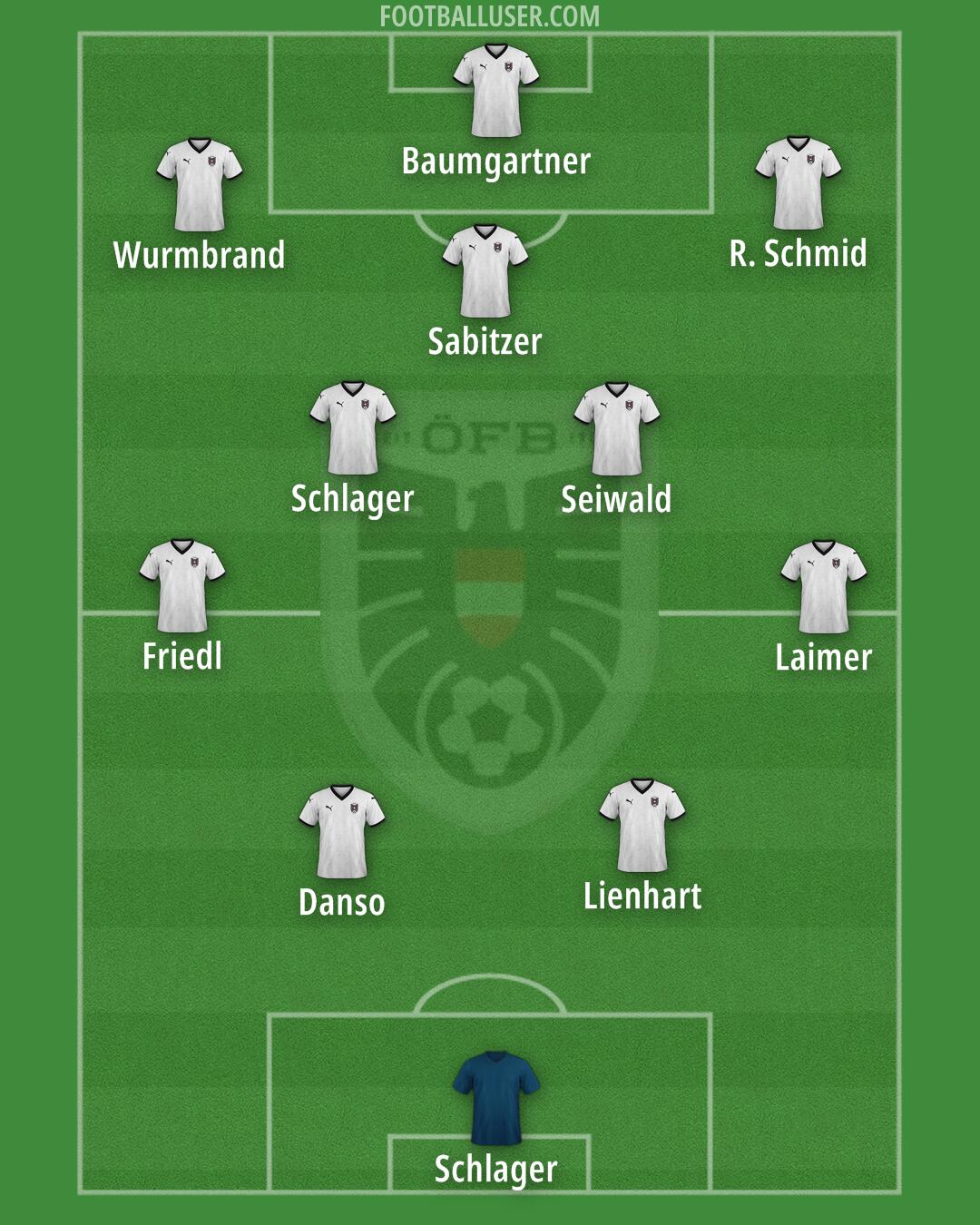
Friedl · Danso · Lienhart · Laimer · Baumgartner · Seiwald · Schlager · Sabitzer · R. Schmid · Wurmbrand · SchlagerA high pressing and vertical style defines this Austria lineup in a 2-5-3 formation. This system seeks to dominate the middle of the pitch and force turnovers high up the field to catch opponents off guard. The team aims to control the tempo by quickly moving the ball forward through a crowded midfield. By committing so many players into central areas, the Austrian national team can suffocate opposition playmakers and move the ball toward the goal with great speed.
Schlager stays between the posts to provide the final line of defense. Ahead of him, the defensive unit consists of a central pair in Danso and Lienhart. These two central defenders act as a high line to compress the playing area. Danso uses his aerial strength to clear crosses, while Lienhart works to cover space behind the midfield. Because there are only two dedicated defenders, they must step up aggressively to intercept passes and prevent runners from breaking the line.
The midfield is the engine room of this 2-5-3 formation, utilizing a five man unit. Laimer and Friedl act as the double pivot to shield the back line and intercept play. Seiwald and Schlager occupy the central spaces to connect the defense to the attack, with Schlager working to break the line with his passing. Sabitzer operates as the attacking midfielder, looking to find pockets of space between the opposition lines to create chances. This crowded central area allows the team to win the ball back quickly through immediate pressure.
An aggressive front line drives the attacking intent. Baumgartner leads the way as the lone striker, tasked to hold up the ball and press the opposing defenders. On the flanks, Wurmbrand and R. Schmid act as wide attackers to provide width. They look to cut inside or stretch the defense to create room for the central players. The movement of these three attackers forces the opposing back line to drop deep, which opens up passing lanes for the midfield to exploit.
Several tactical advantages emerge from this heavy central concentration. The team gains numerical superiority in the middle of the pitch, making it difficult for opponents to pass through the center. Austria can also implement coordinated waves of pressing, using the five midfielders and three attackers to trap the ball in the final third. This setup creates high speed of transition, allowing the players to move from a defensive block to a goal scoring opportunity in seconds.
This formation relies on intense physical output and aggressive ball recovery. It is best suited for games where the opponent struggles to play out from the back under pressure.