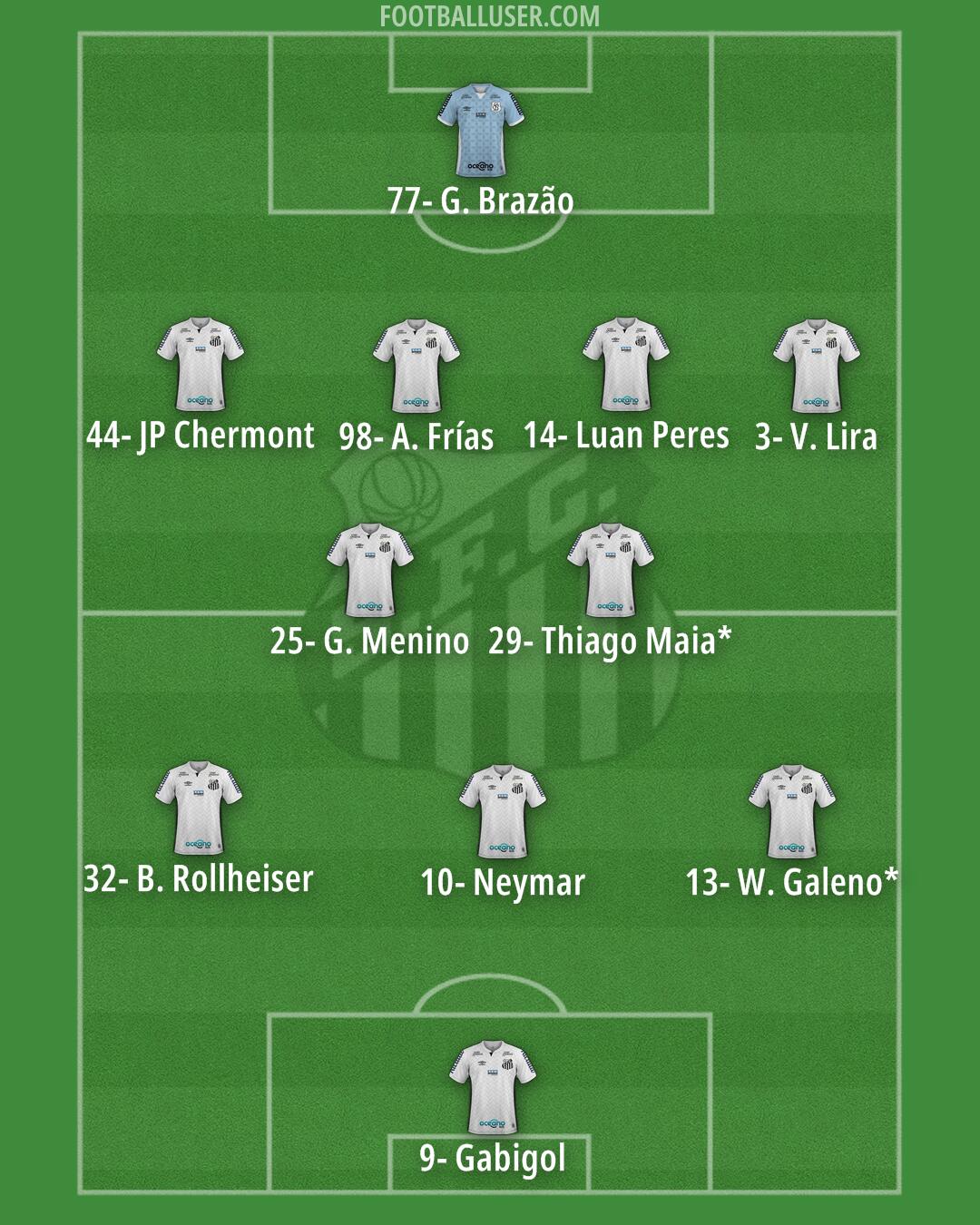

Santos Football Formation
 January 31, 2026


Starting Lineup
77- G. Brazão44- JP Chermont
98- A. Frías
14- Luan Peres
3- V. Lira
25- G. Menino
29- Thiago Maia*
10- Neymar
9- Gabigol
32- B. Rollheiser
13- W. Galeno*
A high press and rapid transition identity defines Santos in this 4-5-1 formation. This lineup is built to win the ball back quickly in the opponent half and drive straight toward the goal. By concentrating players in the middle, the team looks to control the tempo before launching vertical attacks.
G. Brazão sits between the posts to command the defensive unit. A flat back four protects the area, with V. Lira and JP Chermont acting as wide defenders who push up to support the midfield. Luan Peres and A. Frías occupy the center, where they must hold their position and cover the space behind the full backs. The defensive block stays compact to prevent passes through the middle, forcing the opposition to play wide where they can be pressed.
The midfield works as a central engine to bridge the gap between defense and attack. Thiago Maia acts as the single pivot to shield the back line, while G. Menino stays close to provide additional protection. Moving into more advanced roles, W. Galeno and B. Rollheiser occupy the half spaces to link play. Neymar operates in the center of the formation to create chances, using his renowned dribbling and passing range to break lines and find the forward.
An attacking focus centers around a lone striker, Gabigol, who leads the line. He is tasked to hold up the ball and wait for the midfielders to join the break. Instead of relying on traditional wingers, the width comes from the overlapping runs of the full backs. Neymar and the other central midfielders push into the box to create a central overload, while Gabigol makes runs to pull defenders out of position.
One major advantage for Santos is the ability to create numerical superiority in the central zones. By packing the middle with players like Neymar and W. Galeno, the team can dominate possession and intercept passes. Another strength lies in the speed of transition, where the team can move from a defensive block to a direct attack in seconds. This allows the players to isolate defenders in one on one situations once the ball reaches the final third.
This 4-5-1 formation relies on a heavy central presence to dictate the rhythm of the match. It is best suited for games where the team needs to dominate the ball or strike quickly against a sitting defense.