Chelsea Football Formation
 January 31, 2026


Starting Lineup
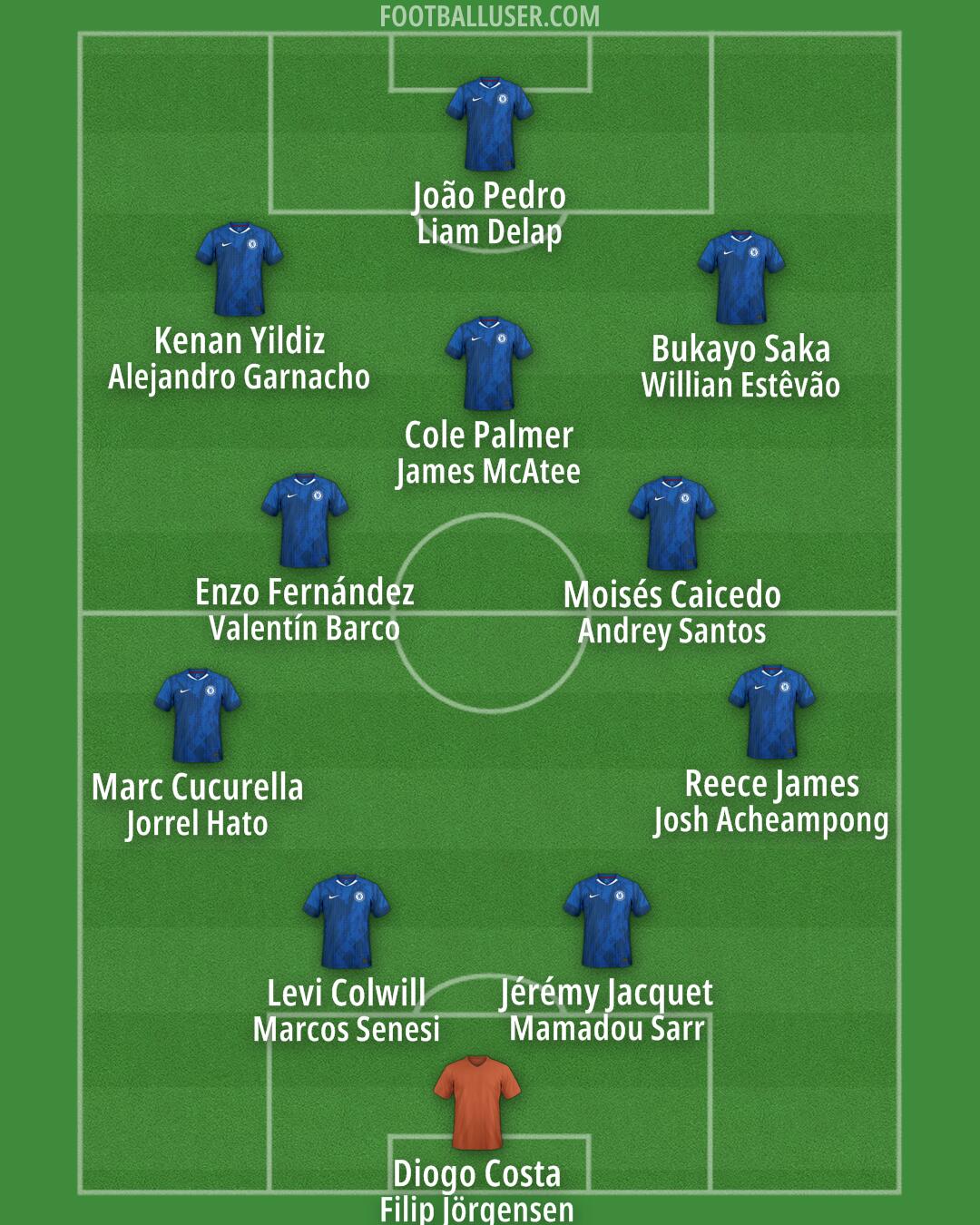
João Pedro (Liam Delap) · Kenan Yildiz (Alejandro Garnacho) · Bukayo Saka (Willian Estêvão) · Cole Palmer (James McAtee) · Enzo Fernández (Valentín Barco) · Moisés Caicedo (Andrey Santos) · Reece James (Josh Acheampong) · Marc Cucurella (Jorrel Hato) · Jérémy Jacquet (Mamadou Sarr) · Levi Colwill (Marcos Senesi) · Diogo Costa (Filip Jörgensen)A high pressing and aggressive identity defines Chelsea in this 2-5-3 formation. The lineup focuses on controlling the pitch by pushing bodies high up the field to squeeze the opponent in their own half. This system aims to win the ball back quickly through intense pressure and direct attacking movements.
Diogo Costa operates between the posts to start the build up from the back. He sits behind a narrow pair of central defenders consisting of Levi Colwill and Jérémy Jacquet. Colwill provides composure on the ball while Jacquet covers the space behind. Because there are only two defenders, the wide midfielders must track back and cover the flanks to prevent the opposition from exploiting the wide areas.
The midfield core is the engine room of this Chelsea side. A central block of four provides massive presence in the middle of the pitch. Moisés Caicedo and Enzo Fernández act as the primary controllers, with Caicedo working to intercept passes and break up play while Fernández uses his wide passing range to switch play. Marc Cucurella and Reece James occupy the lateral roles in the midfield, acting as defensive screens that can push forward or drop back to protect the two center backs. Ahead of them, Cole Palmer operates as the attacking playmaker to link the midfield to the front three.
Up front, the team uses three attackers to stretch the opposition. João Pedro leads the line as the lone striker, tasked to hold up the ball and turn defenders. On the flanks, Bukayo Saka and Kenan Yildiz act as wide wingers to provide width. Saka likes to cut inside onto his left foot to create shooting opportunities, while Yildiz moves between the lines to find space. This trio presses the opposition back line to force turnovers high up the pitch.
This formation offers significant advantages in central areas. The presence of four midfielders allows the team to create numerical superiority in the middle, making it difficult for opponents to pass through the center. Furthermore, the front three can isolate wide players in one on one situations if the wingers receive the ball in space. The coordinated press from the forwards and midfielders creates waves of pressure that can overwhelm a defensive block.
This 2-5-3 formation prioritizes dominance and ball recovery in the final third. It is best suited for matches against teams that struggle to play out from the back under intense pressure.