
Portugal National Football Team Formation
 January 31, 2026


Starting Lineup
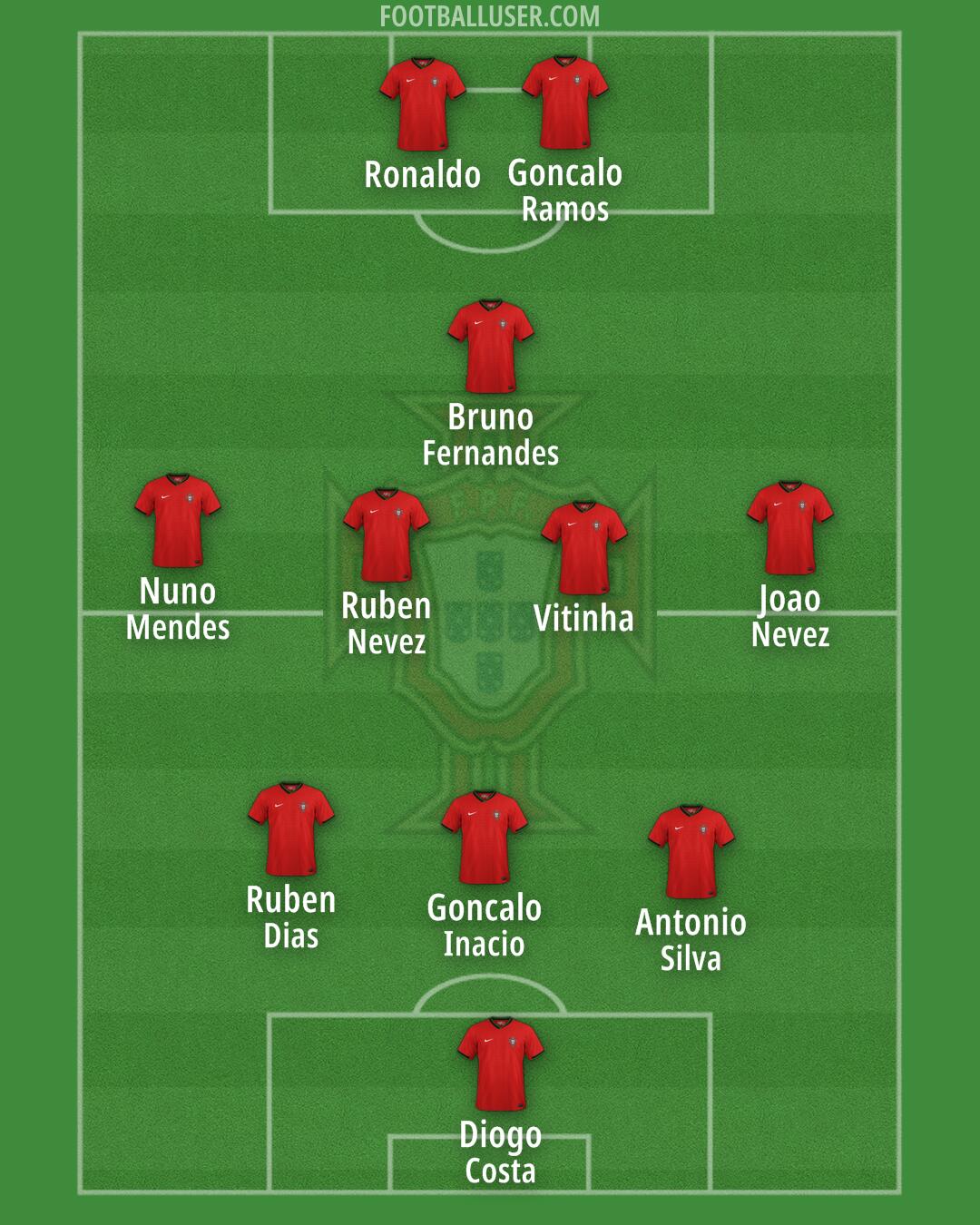
Ronaldo · Goncalo (Ramos) · Bruno (Fernandes) · Joao (Nevez) · Vitinha · Nuno (Mendes) · Ruben (Nevez) · Ruben (Dias) · Goncalo (Inacio) · Antonio (Silva) · Diogo (Costa)A high pressing and heavy attacking identity defines this Portugal lineup, which operates in an aggressive 2-4-4 formation. The team seeks to overwhelm the opposition by flooding the final third and maintaining constant pressure on the ball. This selection focuses on rapid transitions and heavy offensive numbers to break lines quickly.
Goncalo guards the goal as the lone goalkeeper while the defensive unit stays very compact. The back line consists of only two central defenders, Ronaldo and Bruno, who must stay disciplined to prevent long balls from bypassing them. Because there are no full backs, Ronaldo and Bruno must track runners and cover the wide spaces when the opposition launches counter attacks. This high line requires both defenders to step up and intercept passes early to keep the game in the opponent half.
Control in the middle of the pitch relies on a central pair, Ruben and Vitinha, who act as the engine room. These two players must work hard to shield the two defenders and win second balls. Vitinha and Ruben work to connect the defense to the attack by playing vertical passes. On the flanks, Nuno and Joao push high to act as wide midfielders, providing width to prevent the center from becoming too crowded. This midfield group must shift quickly to block passing lanes when the ball is lost.
The attacking front line is massive, utilizing four players to pin back the opposition defense. Antonio and Ruben occupy the wide channels as wingers, looking to cut inside or cross the ball into the box. In the center, Goncalo and Diogo act as the two forwards, tasked with holding up the ball and making runs behind the line. This group presses in waves, with Antonio and Ruben forcing defenders into mistakes to feed the two central strikers.
Portugal gains a massive advantage through numerical superiority in the attacking third. The wide presence of Nuno and Joao creates overloads on the flanks, making it hard for opposing full backs to mark both the winger and the wide midfielder. Additionally, the team can press high in coordinated waves, using the four forwards to trap opponents in their own half. This setup allows for rapid switches of play to isolate attackers in one on one situations.
This aggressive formation creates a constant threat through sheer numbers in the box. It is best suited for matches where Portugal needs to break down a team sitting deep in a low block.