
Argentina National Football Team Formation
 February 1, 2026


Starting Lineup
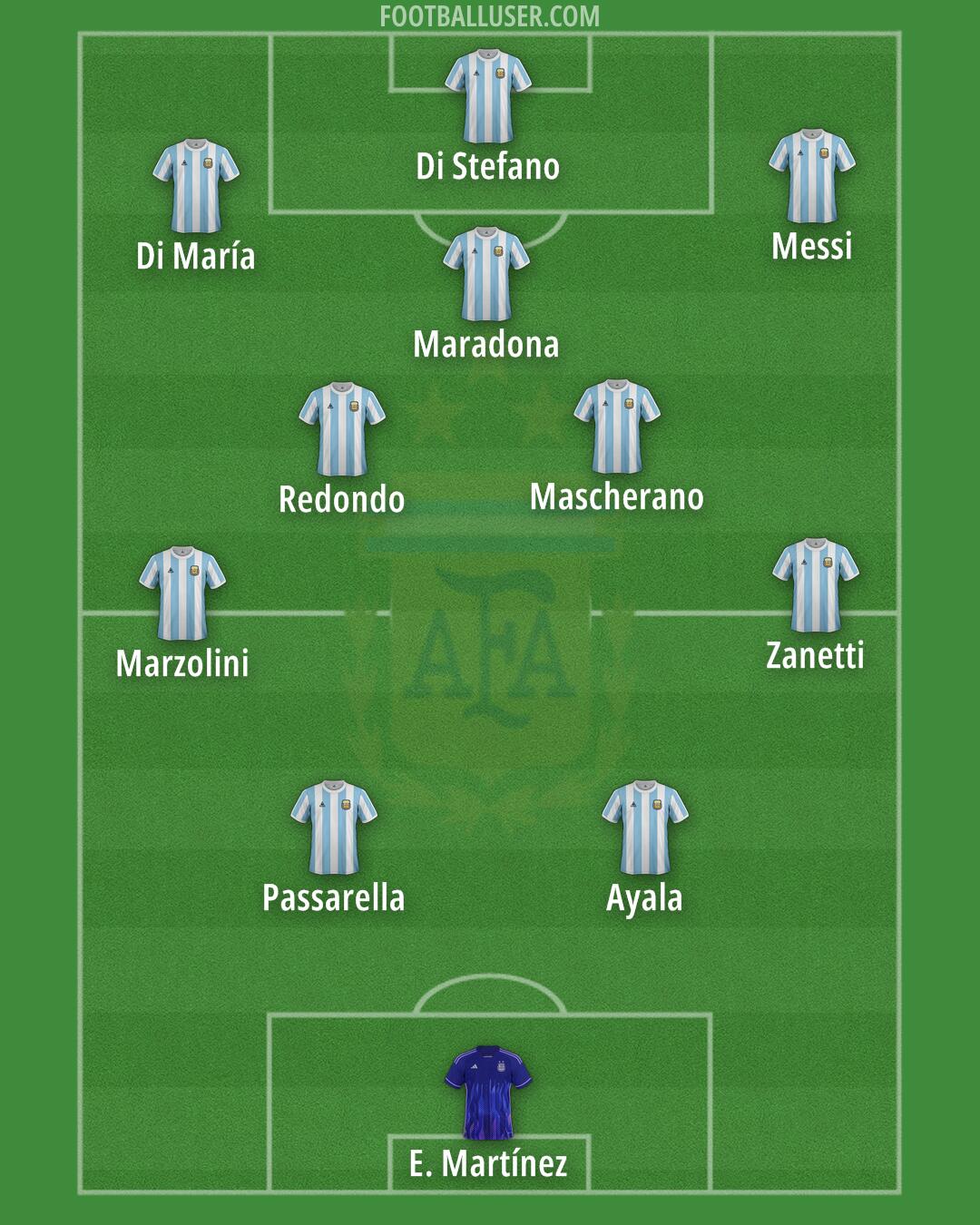
Di Stefano · Di María · Maradona · Messi · Redondo · Mascherano · Zanetti · Passarella · Ayala · Marzolini · E. MartínezA heavy focus on controlling the middle and overwhelming the opposition defines Argentina in this 2-5-3 formation. This lineup seeks to dominate through high possession and a crowded central corridor to suffocate opponents. By packing the center of the pitch, the team aims to dictate the tempo and use technical superiority to break lines.
E. Martínez stands between the posts to command the area. Ahead of him, a compact back two consisting of Passarella and Ayala provides the foundation. Passarella acts as a ball playing defender to start attacks, while Ayala provides aerial strength and physical presence to block runs. Because there are only two central defenders, the team relies on a high line to squeeze the space between the defense and the midfield.
The midfield is the engine room of Argentina, organized as a five man unit that controls every zone. Redondo and Mascherano work to shield the defense and intercept passes, with Redondo using his passing range to connect the back line to the attack. Marzolini and Zanetti occupy the wider areas of the midfield to provide width and cover the flanks. Maradona operates as the attacking ten, driving forward to create chances and link the midfield to the front three.
In the attacking third, the team employs three forwards to stretch the opposition. Di Stefano acts as the lone striker to hold up the ball and occupy the center backs. Di María stays wide on the left to provide crosses, while Messi cuts inside from the right to use his dribbling style and create goal scoring opportunities. This front line presses high to force turnovers in dangerous areas.
One major advantage of this lineup is the massive numerical superiority in the central zones, which makes it very hard for opponents to play through the middle. The ability to pack the midfield allows Argentina to win the ball back quickly and launch immediate attacks. Furthermore, the combination of wide midfielders and inverted attackers creates constant overloads that pull defensive lines out of position.
This formation relies on a dominant midfield to control the rhythm of the match. It is best suited for games where Argentina can impose their will on the ball against a side that sits deep.