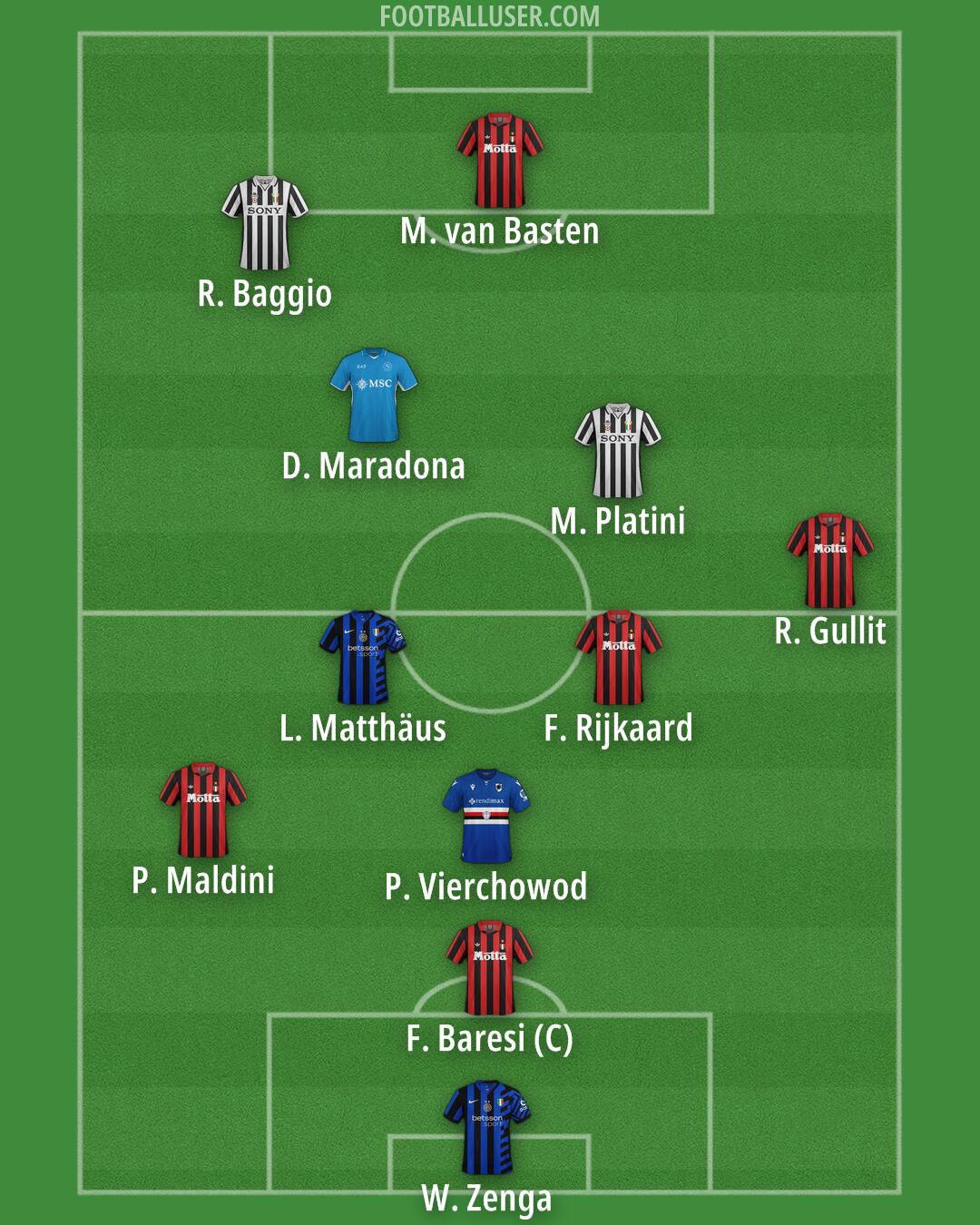
Custom Team Football Formation
 February 2, 2026


Starting Lineup
W. Zenga (Inter) · F. Baresi (C) (Milan) · P. Vierchowod (Sampdoria) · P. Maldini (Milan) · F. Rijkaard (Milan) · L. Matthäus (Inter) · R. Gullit (Milan) · M. Platini (Juventus) · D. Maradona (Napoli) · R. Baggio (Juventus) · M. van Basten (Milan)A desire to dominate the center of the pitch and control the rhythm of the game drives this lineup, which operates in a 3-5-2 formation. This team relies on a high press and quick transitions to catch opponents off guard. By controlling the central areas, the players aim to win the ball back high up the pitch and move forward with speed.
In goal, W. Zenga provides the foundation for the defensive unit. The back line consists of a narrow defensive block featuring three elite defenders. F. Baresi (C) acts as the right centre back, using his reading of the game to sweep behind the line, while P. Vierchowod holds the central position as a dominant presence in the air. P. Maldini occupies the left centre back role, capable of stepping into midfield or covering wide spaces when needed. This trio works as a single unit to defend zonally and protect the central corridor.
The midfield is built around a powerhouse engine room. L. Matthäus and F. Rijkaard operate as a double pivot, where Rijkaard shields the defence and Matthäus drives forward with the ball to break the line. Ahead of them, R. Gullit plays as a central midfielder who connects the defensive and attacking lines with his physical presence. The creative burden falls on M. Platini and D. Maradona, who operate as two tens in the half-spaces. They look to receive on the half-turn and play through the lines to find the forwards.
The attacking structure utilizes two forwards in a partnership to stretch the defence. M. van Basten acts as a clinical presence in the box, while R. Baggio plays as a second striker in the hole to link play. The team uses these two to pin the last defender and create runs in behind. When the team wins the ball, the forwards press from the front to force a long ball, allowing the midfield to regain possession. This setup creates constant movement through combinations in tight spaces.
The main strength of this formation is the numerical superiority in midfield, which allows the team to squeeze the space and control possession. The ability to transition from a compact defensive block to a vertical attack is also a key advantage. Because the midfield is so crowded, opponents often struggle to find passing lanes, which allows the team to win the second ball frequently.
This 3-5-2 formation is built for total dominance through central control and attacking variety. It is best suited for matches against teams that try to play through the middle, as the midfield can easily overwhelm them.