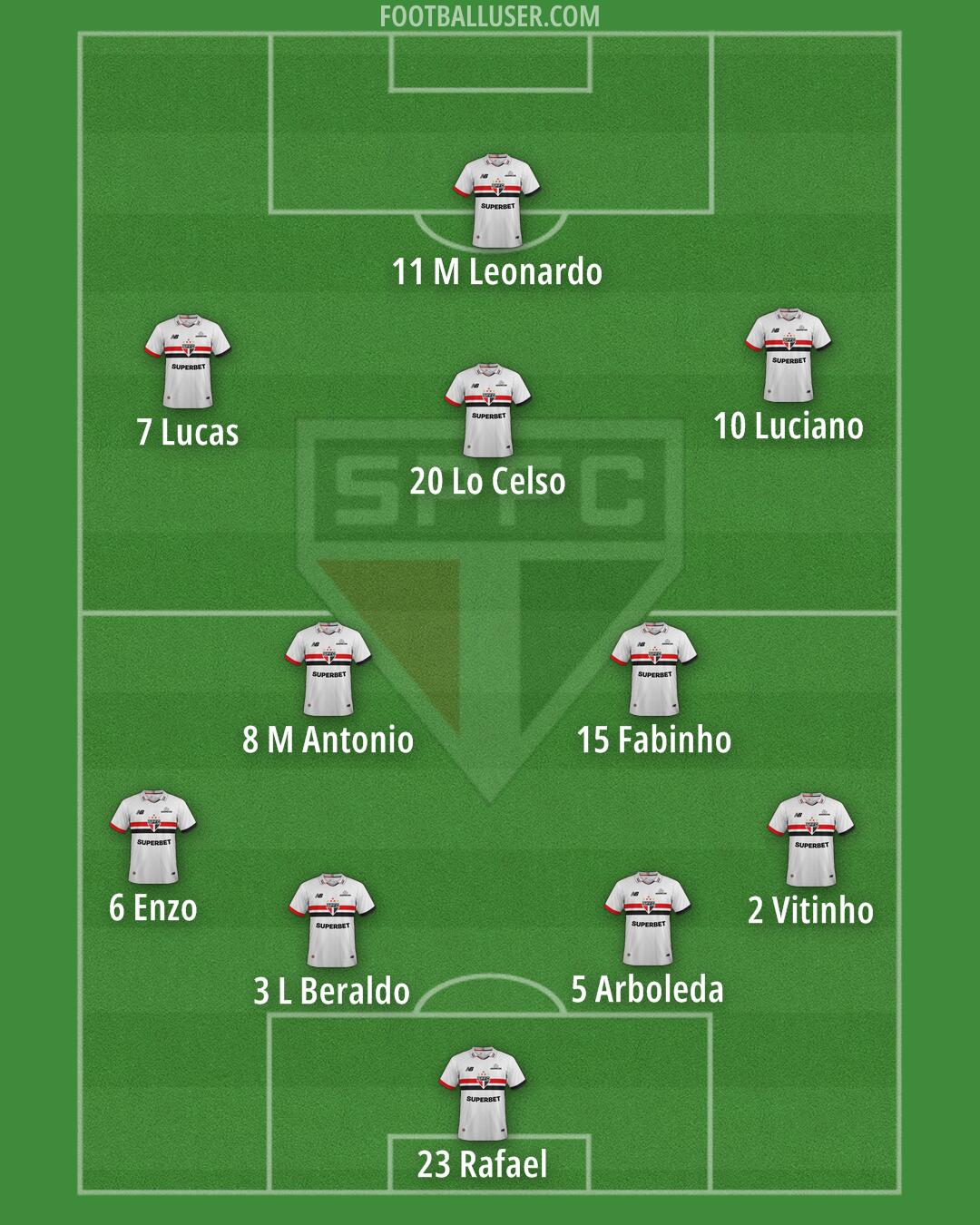

São Paulo Football Formation
 February 4, 2026
 RPLemos


Starting Lineup
23 Rafael2 Vitinho
10 Luciano
3 L Beraldo
6 Enzo
15 Fabinho
5 Arboleda
7 Lucas
20 Lo Celso
11 M Leonardo
8 M Antonio
A heavy focus on defensive solidity defines São Paulo and their 5-4-1 formation. This lineup aims to sit deep and absorb pressure before hitting teams on the break. By crowding the central areas, the team seeks to frustrate opponents and force them into wide areas where they can easily intercept passes.
M Leonardo stays between the posts to command the penalty area. A back five acts as the primary shield, featuring Fabinho and M Antonio alongside Lo Celso to cover the central zone. The three center backs must mark closely and win aerial duels to prevent crosses from finding targets. On the flanks, Luciano and Lucas act as wing backs, tasked with tracking back to defend the wide channels while looking to push up and provide width when the team wins the ball.
The midfield operates in two lines to maintain compactness. Arboleda and L Beraldo occupy the central spots, where they work to break the line of the opposition attack and shield the defense. Enzo and Vitinho stay wide in the midfield four, providing defensive cover for the wing backs and helping to congest the passing lanes. This grouping ensures that the midfield can quickly shift to cover gaps and prevent the opponent from playing through the middle.
In the final third, Rafael operates as a lone striker. He must hold up the ball to allow the rest of the team to move forward after a turnover. The attacking movement relies on the wing backs, Luciano and Lucas, making runs to support the striker. The team builds attacks by catching the opponent out of position, using the width provided by the wing backs to switch play or hit quick vertical passes into Rafael.
One major advantage for São Paulo is the ability to create a low block that is very hard to break down. The combination of a back five and a compact midfield makes it difficult for opponents to find space between the lines. Additionally, the team can launch rapid transitions by using the speed of the wing backs to overlap and stretch a retreating defense.
This formation relies on disciplined defensive work and quick transitions to succeed. It is best suited for games against teams that dominate possession, allowing the side to stay compact and strike on the counter.