
São Paulo Football Formation
 February 8, 2026


Starting Lineup
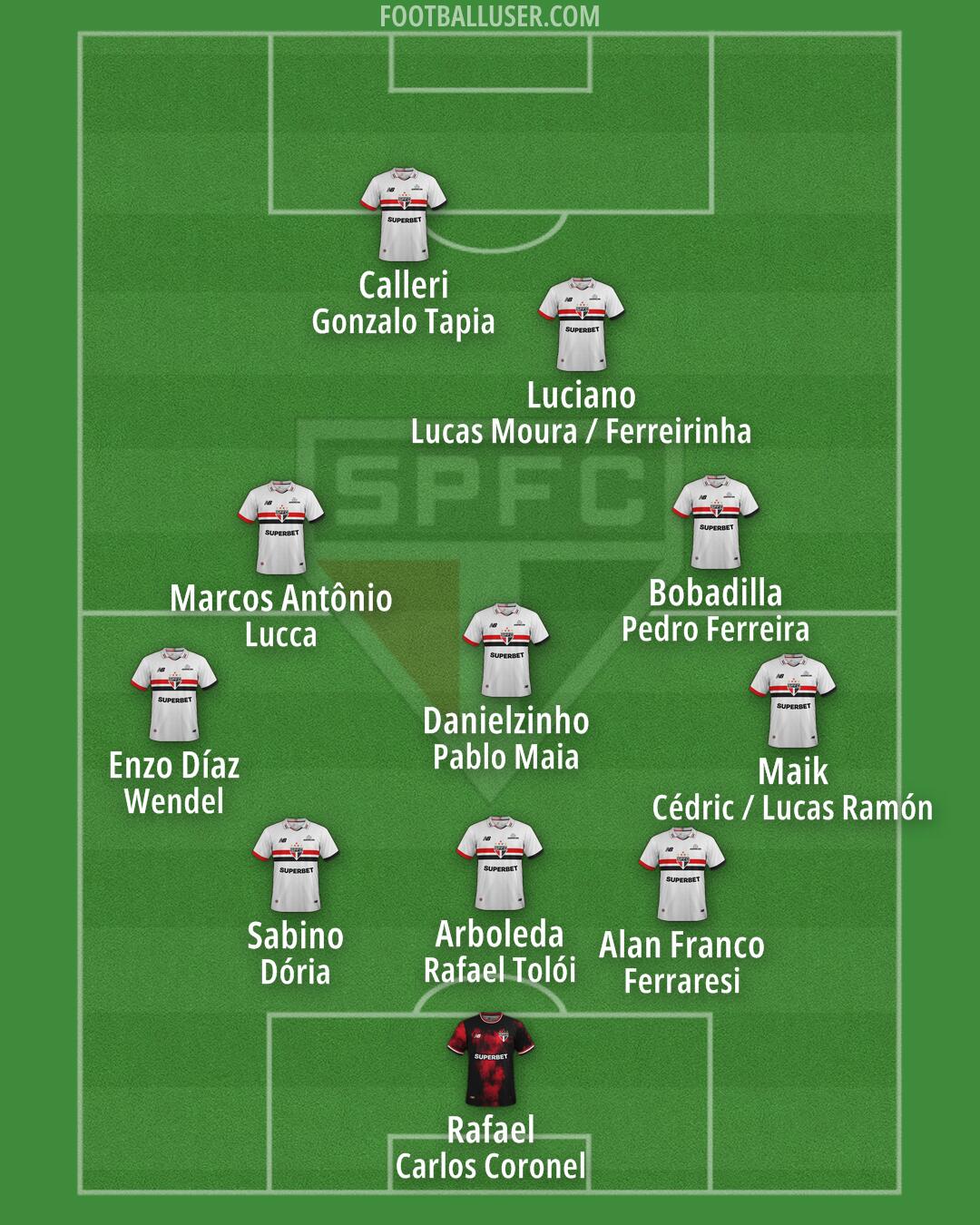
Maik (Cédric / Lucas Ramón) · Alan Franco (Ferraresi) · Arboleda (Rafael Tolói) · Sabino (Dória) · Enzo Díaz (Wendel) · Danielzinho (Pablo Maia) · Marcos Antônio (Lucca) · Bobadilla (Pedro Ferreira) · Luciano (Lucas Moura / Ferreirinha) · Calleri (Gonzalo Tapia) · Rafael (Carlos Coronel)Dominating the central zones with a heavy midfield presence, São Paulo adopts a 3-6-1 formation to control the tempo of the game. This lineup relies on high volume passing and aggressive pressing to pin opponents back. The team seeks to monopolize the ball, building attacks through a crowded middle third to overwhelm the opposition. By packing the center, São Paulo aims to dictate the rhythm and force turnovers in dangerous areas.
Rafael stays between the posts to organize the back line. A back three consisting of Alan Franco, Arboleda, and Sabino provides a solid foundation. Arboleda acts as the central anchor, using his aerial strength to clear crosses and intercept long balls. Alan Franco operates as the right center back to cover the flank, while Sabino holds the left side. This defensive unit can sit deep to protect the box or step up to squeeze the space between the lines.
The midfield is the engine of the São Paulo lineup, operating in a complex layer of six players. Maik and Enzo Díaz form a double pivot to shield the defenders and break up play. In front of them, Danielzinho, Marcos Antônio, and Bobadilla work to connect the play and drive the ball forward through the lines. Luciano operates as the attacking midfielder, looking to find pockets of space behind the opposition midfielders. This heavy midfield block ensures the team can transition quickly from defense to attack.
Leading the line is Calleri, who operates as a lone striker to hold up the ball and bring others into play. He uses his physicality to battle central defenders and create space for the late runs of the midfield. The attack is built through central combinations rather than relying on wide wingers. Luciano and the oncoming midfielders create a wave of movement that forces defenders to track back constantly. This movement allows the team to penetrate the final third through central passing lanes.
Numerical superiority in the middle of the pitch is a primary advantage of this formation. The density of players allows the team to recycle possession easily and prevent opponents from playing through the center. Another strength is the ability to press in coordinated waves, with Luciano and the midfield trio leading the hunt for the ball. This heavy pressure often forces hurried clearances or mistakes from the opposition. The compactness of the unit makes it very difficult for opponents to find passing lanes.
This 3-6-1 formation creates a suffocating central presence designed to dominate possession. It is most effective against teams that lack the midfield strength to combat such high numbers in the center of the pitch.