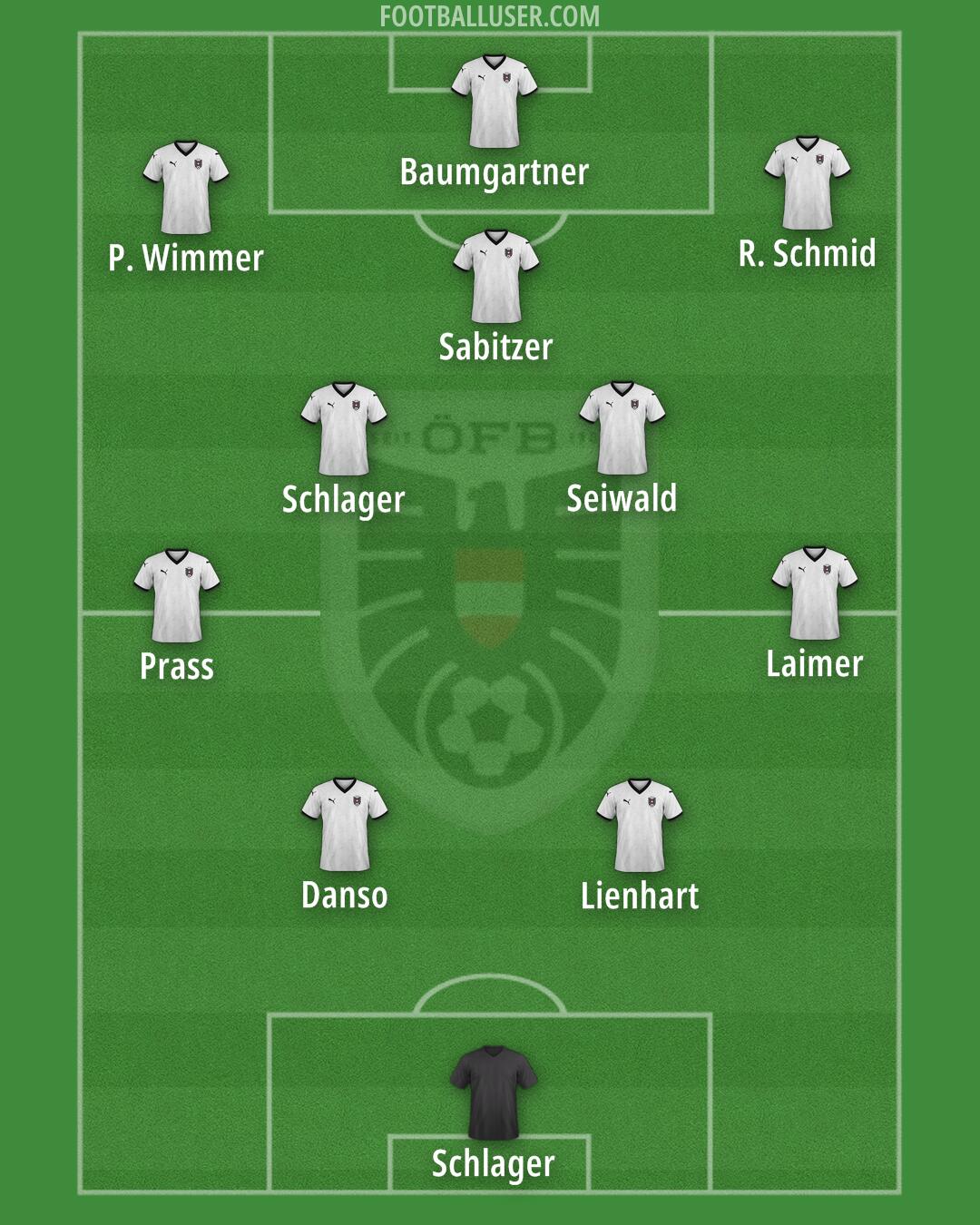

Austria National Football Team Formation
 February 8, 2026


Starting Lineup
Baumgartner · Schlager · Sabitzer · Seiwald · R. Schmid · Prass · Danso · P. Wimmer · Lienhart · Laimer · SchlagerHigh pressing and rapid verticality define the tactical identity of Austria in this 2-5-3 formation. The team seeks to win the ball high up the pitch to launch immediate attacks before the opposition can settle. This lineup is built to dominate the middle of the park and force turnovers through intense pressure in the final third.
Schlager stays between the posts to organize the defense from the back. The defensive unit relies on a central pair of Lienhart and Danso who must hold a high line to compress the pitch. Lienhart provides composure in buildup, while Danso uses his aerial strength to clear crosses and intercept long balls. Because there are only two central defenders, these players must step up to intercept passes and cover the space behind them when the midfield pushes forward.
A crowded midfield creates a dense block in the center of the pitch. Prass and Laimer act as the holding pair to shield the defense, while Schlager and Seiwald occupy the central roles to drive the ball forward and connect the lines. Sabitzer operates as the attacking ten, finding pockets of space between the lines to create chances. This five man midfield allows the team to control the tempo and pass through the center to break the opposition lines.
The attacking front three focuses on wide presence and central movement. P. Wimmer and R. Schmid act as wide attackers who can cut inside to threaten the goal or provide width for crosses. Baumgartner leads the line as the lone striker, tasked to hold up the ball and run into channels to pull defenders out of position. The forwards press in a coordinated way to prevent the opposition from building out from the back.
Austria finds significant advantages through numerical superiority in the middle of the pitch. Having five players in the midfield makes it difficult for opponents to pass through the center without facing a block. The team also gains an advantage through the ability to press high in coordinated waves, using the front three and the central midfielders to trap the opponent. This creates many chances to exploit turnovers in dangerous areas.
This 2-5-3 formation relies on aggressive pressing and a powerful midfield engine. It is best suited for matches where the team wants to suffocate the opponent and play a high intensity game.