
Racing Club Football Formation
 February 9, 2026
 Laubnt


Starting Lineup
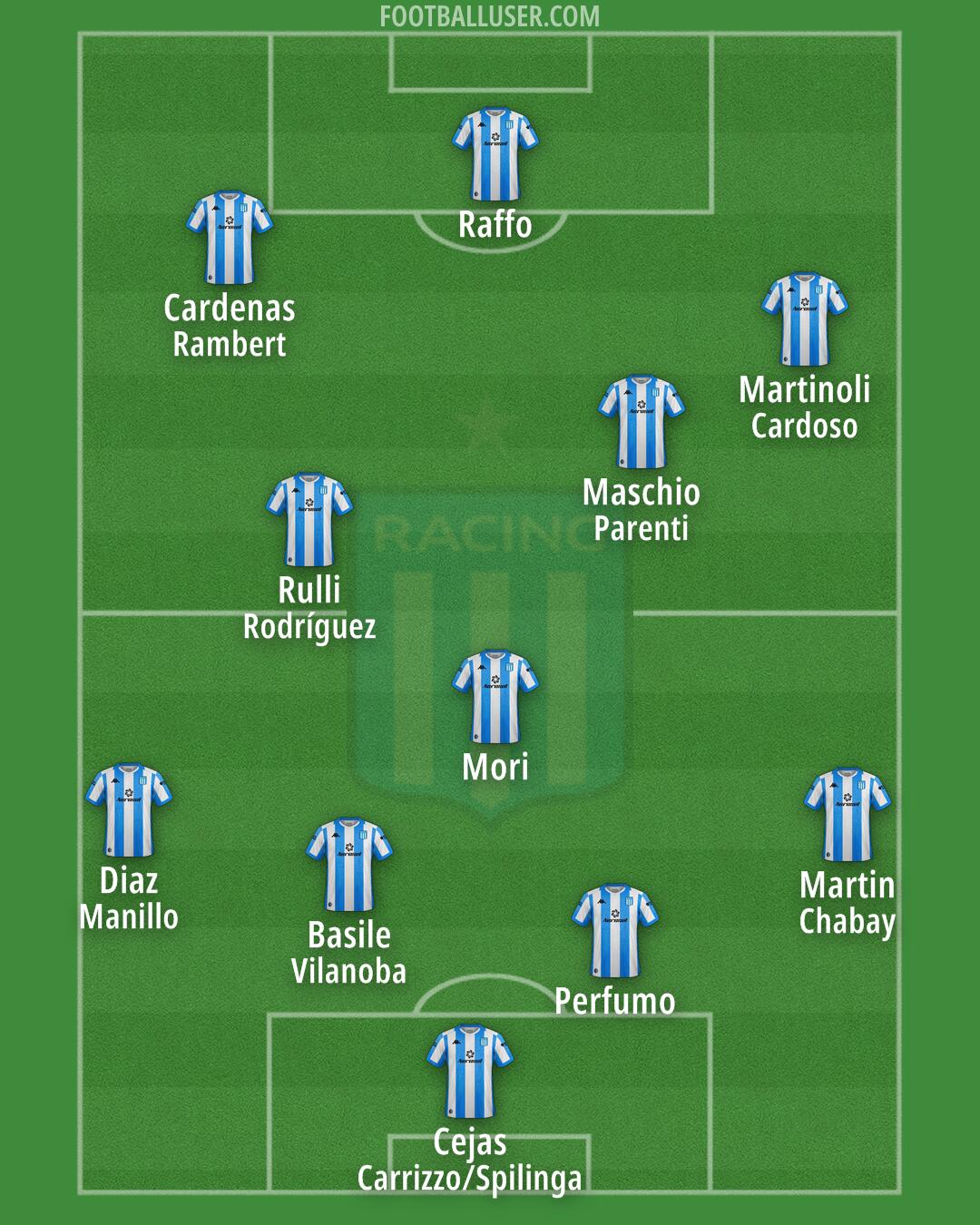
Cejas (Carrizzo/Spilinga) · Perfumo · Martin (Chabay) · Basile (Vilanoba) · Diaz (Manillo) · Mori · Rulli (Rodríguez) · Maschio (Parenti) · Martinoli (Cardoso) · Cardenas (Rambert) · RaffoA defensive mindset defines Racing Club in this 5-4-1 formation. The team aims to stay compact and wait for the right moment to strike on the break. This lineup is built to sit deep and absorb pressure while remaining difficult to break down through the middle.
Cejas acts as the last line of defense behind a sturdy back five. Mori sits in the center of the defense to hold the line and win aerial duels. To his sides, Perfumo and Basile provide extra cover to ensure the central area remains blocked. The wing backs, Martin and Diaz, are tasked with tracking back to form a flat line when defending, while also providing width when the team moves up the pitch.
The midfield operates in a narrow block to protect the center. Rulli sits in front of the defense as a single pivot to intercept passes and shield the back line. Ahead of him, Maschio and Martinoli work to control the tempo and link the play. Cardenas plays in the hole as an attacking midfielder, tasked with finding pockets of space to connect the midfield to the lone striker.
Raffo leads the line as a lone striker, tasked with holding up the ball to allow the team to move up. The attack relies on the width provided by Martin and Diaz to stretch the opposition defense. When the team wins the ball, the wingers and Cardenas push forward quickly to support the striker. This system demands that the forwards press in a coordinated way to force mistakes from the opponent.
Racing Club finds strength in their ability to create compactness when defending in a low block. The presence of five defenders makes it hard for opponents to find gaps between the lines. Additionally, the team can use the speed of transition to catch opponents out of position once the midfield wins the ball back. This setup allows for wide overloads when Martin and Diaz push forward in support of the attack.
This formation provides a solid foundation for teams looking to frustrate dominant opponents. It is best suited for matches where the side needs to protect a lead or play against a team with high attacking volume.