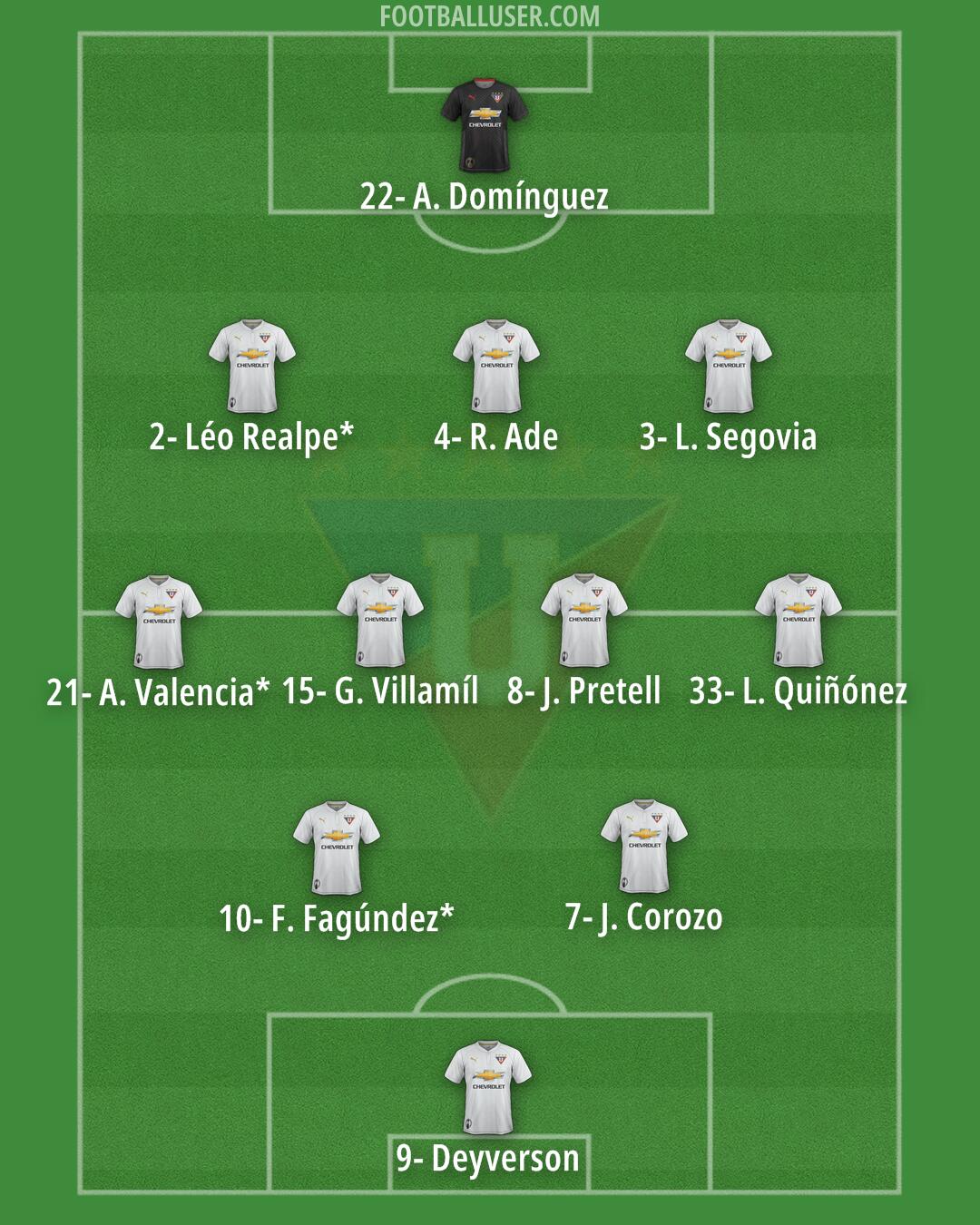

Liga de Quito Football Formation
 February 10, 2026


Starting Lineup
22- A. Domínguez2- Léo Realpe*
4- R. Ade
3- L. Segovia
9- Deyverson
7- J. Corozo
33- L. Quiñónez
15- G. Villamíl
8- J. Pretell
21- A. Valencia*
10- F. Fagúndez*
A high pressing and vertical style defines this Liga de Quito lineup in a 3-4-3. This formation focuses on quick transitions and dominating territory through aggressive positioning. The team looks to win the ball high up the pitch to catch opponents out of position. By staying compact and pressing in waves, Liga de Quito aims to control the tempo and force mistakes in the opponent's defensive third.
A. Domínguez guards the goal and organizes the defensive unit from the back. The back three consists of L. Segovia, R. Ade, and Léo Realpe, who maintain a high line to squeeze the space in midfield. L. Segovia and Léo Realpe cover the wide channels to prevent crosses, while R. Ade stays central to win aerial duels and intercept central passes. When the team loses possession, these defenders step up to block passing lanes and squeeze the play.
In the middle of the pitch, the midfield functions with a central trio of G. Villamíl, J. Pretell, and A. Valencia*. These players provide the engine to connect the defense to the attack. G. Villamíl and J. Pretell occupy the central spaces to shield the back three and break lines with direct passes. A. Valencia* acts as a left midfielder who can drop deep to help the defense or push forward to support the attack. L. Quiñónez operates on the right side to provide width and track back when needed.
The attacking unit is built around the strength of Deyverson, who works to hold up the ball and bring others into play. He leads the press from the front, forcing defenders into errors. J. Corozo and F. Fagúndez* operate as wide attackers, looking to cut inside into the half spaces to create goal scoring chances. J. Corozo pushes high on the left to stretch the defense, while F. Fagúndez* uses his movement on the right to find pockets of space between the fullback and the center back.
This formation offers significant advantages through its ability to create wide overloads and numerical superiority in the middle. The wingers and midfielders can quickly combine to bypass a low block. Additionally, the three central defenders allow for a very aggressive high press, as they can quickly cover the space behind the midfield. The speed of transition from defense to attack is a major threat, especially when J. Corozo and F. Fagúndez* exploit the flanks.
The 3-4-3 formation provides a balanced way to press high and attack with width. It is most effective against teams that struggle to play out from the back or fail to track runners in the half spaces.