
Austria National Football Team Formation
 February 10, 2026


Starting Lineup
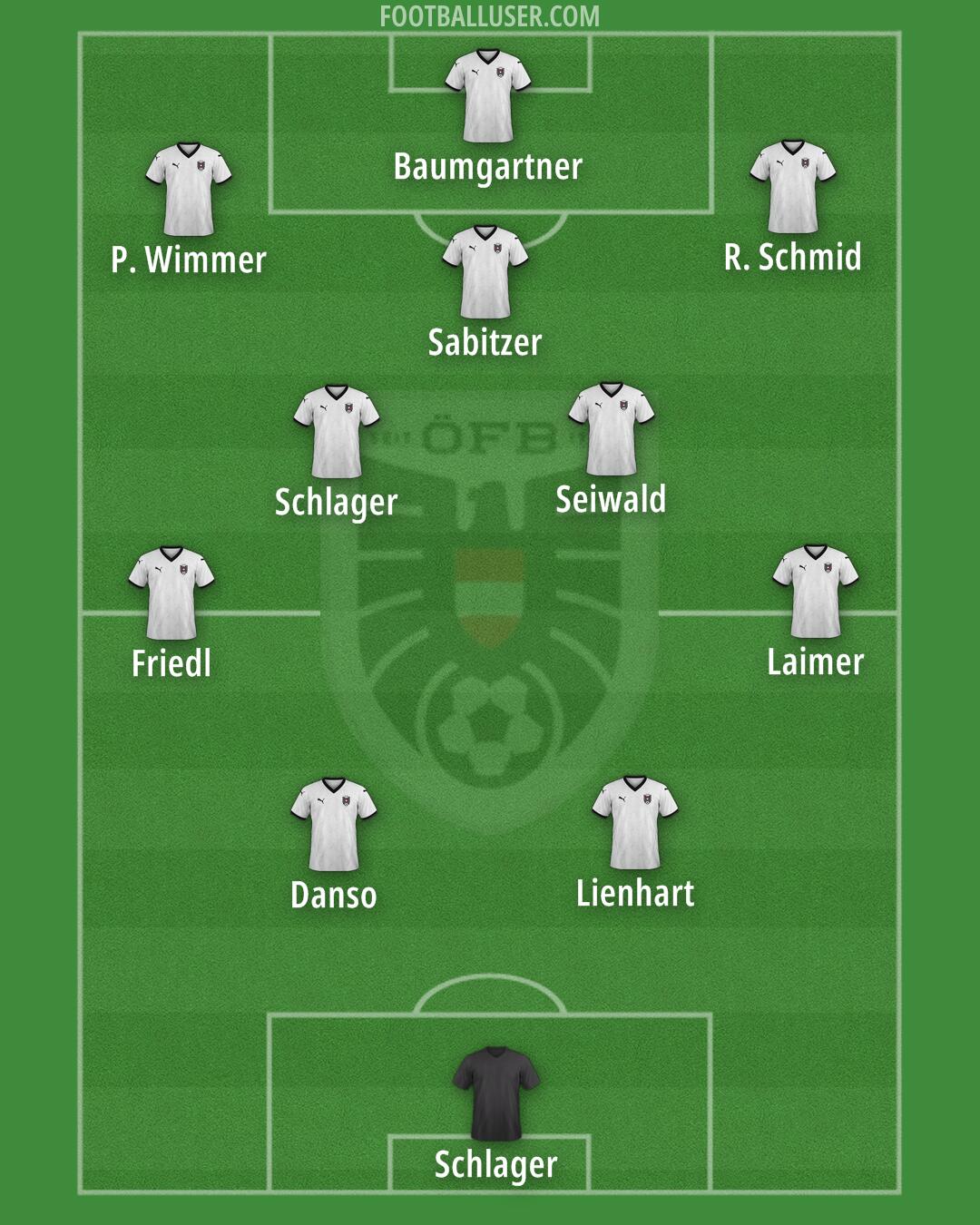
Lienhart · Danso · Friedl · Laimer · Schlager · Seiwald · Sabitzer · P. Wimmer · Baumgartner · R. Schmid · SchlagerA heavy emphasis on high pressing and verticality defines the Austria lineup in this 2-5-3 formation. The team seeks to win the ball high up the pitch and move it forward immediately to catch the opponent out of position. This setup creates a massive presence in the middle of the park, allowing the Red Devils to control the tempo and suffocate the opposition in their own half.
Schlager sits between the posts to organize the defensive unit. Ahead of him, a narrow back two consisting of Danso and Lienhart must cover vast amounts of space. These central defenders act as ball playing defenders who step up to intercept passes and engage attackers early. Because there are only two players in the back line, they rely on quick recovery runs and strong aerial strength to stop long balls.
The midfield is the engine room for Austria, operating with five players to dominate the central zones. Friedl and Laimer form a double pivot to shield the defense and break up play, while Schlager and Seiwald occupy the central spaces to drive forward and connect the lines. Sabitzer operates as the attacking ten, finding pockets of space between the lines to create chances. This dense midfield block makes it very difficult for opponents to pass through the center.
In the final third, the attack relies on three dedicated players to stretch the opposition. P. Wimmer and R. Schmid act as wide wingers, looking to cut inside or deliver crosses into the box. Baumgartner leads the line as a lone striker, tasked with holding up the ball and making runs to break the line. The wingers press high to force mistakes, ensuring the team maintains constant pressure on the opposing goal.
This formation provides significant tactical advantages, particularly through its ability to press high in coordinated waves. By crowding the middle, the team creates numerical superiority in the center of the pitch, often forcing opponents to play wide where they can be trapped. The speed of transition is also a major factor, as the short distances between Sabitzer, the midfielders, and the forwards allow for rapid attacking movements once the ball is won.
Austria relies on this aggressive 2-5-3 to overwhelm teams that struggle with high pressure. It is a formation best suited for matches where the goal is to dictate play and force the opponent into defensive errors.