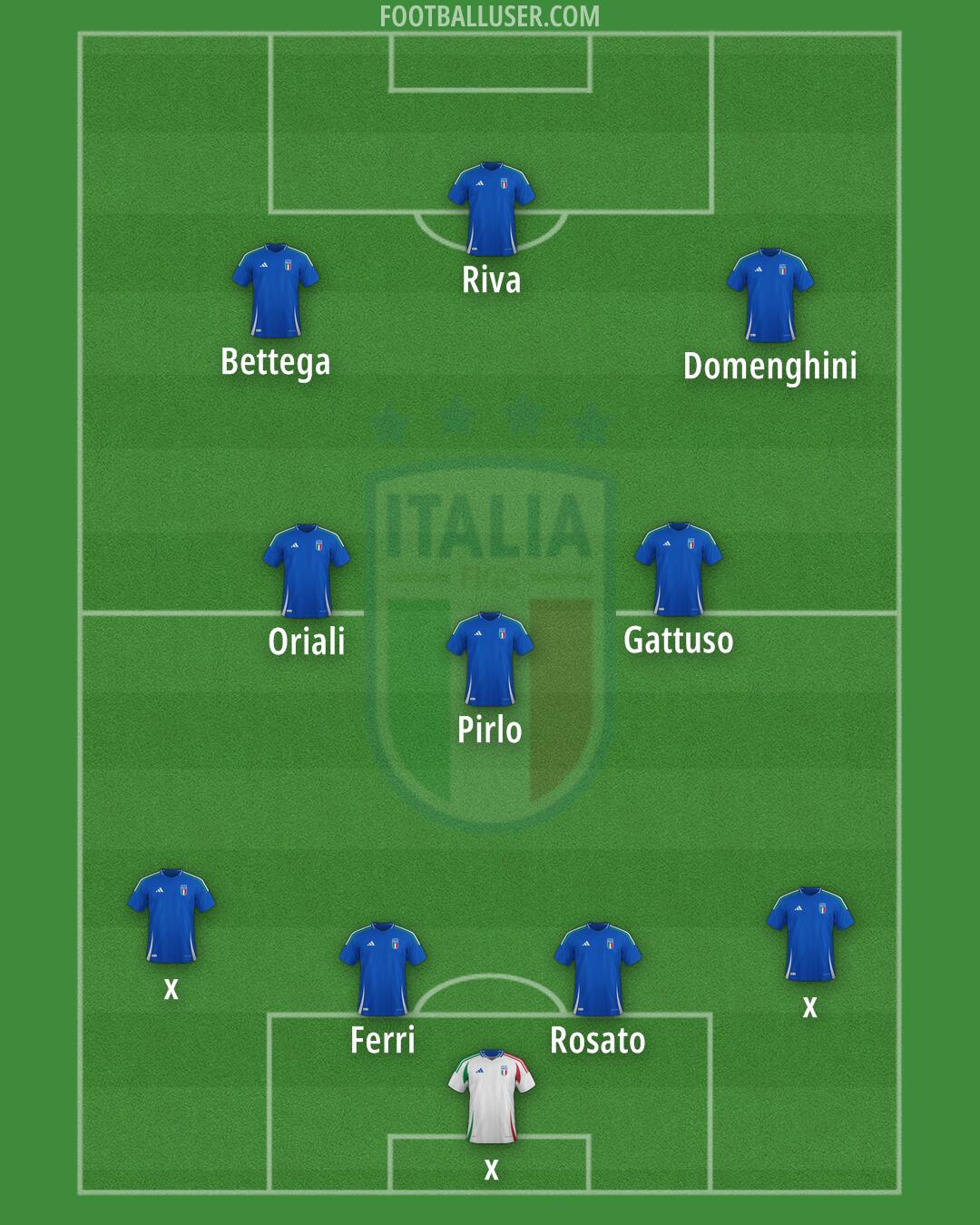

Italy National Football Team Formation
 February 12, 2026


Starting Lineup
Riva · Bettega · x · Oriali · Pirlo · Gattuso · Domenghini · Ferri · Rosato · x · xDominating the pitch through controlled possession and tactical discipline, Italy operates with a 4-3-3 formation. This lineup aims to control the tempo of the game by dictating play through a central midfield engine. The team looks to dominate the ball and move opponents out of position before delivering vertical passes to the front three.
In goal, x keeps watch over the back line. The defensive unit functions as a flat back four where Rosato occupies the right side of the center while Ferri covers the left. The wide defenders must track back to cover the flanks and support the central pairing. Rosato and Ferri need to hold their ground to stop direct runs, while the full backs push up to provide width.
The midfield relies on a single pivot system to manage the game. Pirlo sits deep as the playmaker, using his famous passing range to switch play and break the line. To his sides, Oriali and Gattuso provide the energy required to protect the defense and drive the ball forward. Gattuso brings high pressing intensity to disrupt opposition play, while Oriali helps to connect the defense to the attacking trio.
Leading the attack is Riva as a lone striker who stays central to hold up the ball and challenge for crosses. On the flanks, Bettega and Domenghini act as wide attackers to stretch the opposing defense. Bettega can cut inside to create space, while Domenghini pushes high to provide service. This front line is designed to press the opposition back and create chances through quick combinations.
A major advantage for Italy is the numerical superiority and control found in the central area. The combination of Pirlo, Oriali, and Gattuso allows the team to keep the ball in tight spaces and control the rhythm. Another strength is the ability to use the wide players to create overloads, forcing the opposition to choose between marking the wingers or staying compact in the middle.
This 4-3-3 formation makes the team highly effective at controlling games through central dominance. It is best suited for matches against opponents that struggle to track runners in the half spaces or cannot handle high pressure.