
Austria National Football Team Formation
 February 13, 2026


Starting Lineup
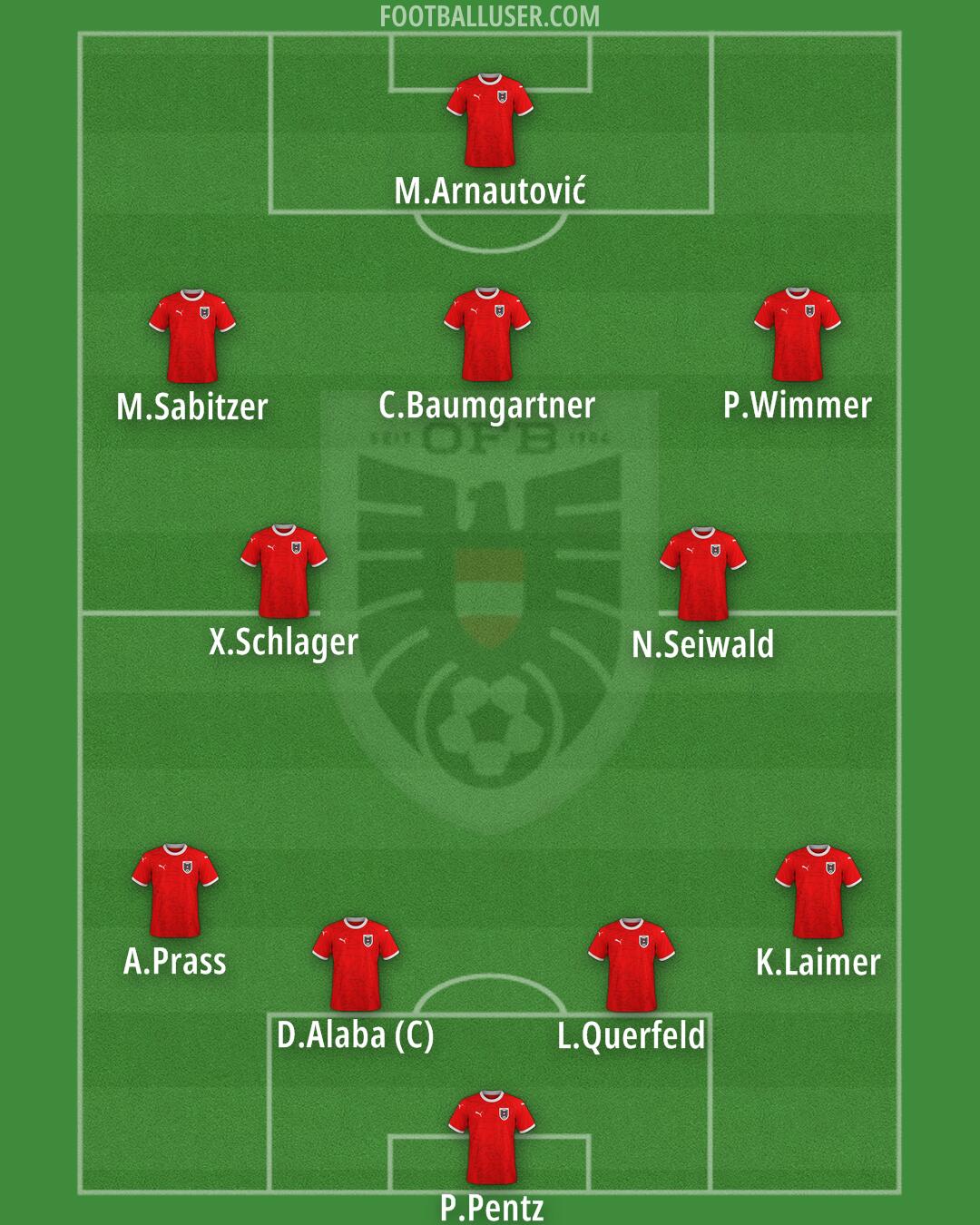
P.Pentz · D.Alaba (C) · L.Querfeld · M.Arnautović · X.Schlager · N.Seiwald · A.Prass · K.Laimer · M.Sabitzer · C.Baumgartner · P.WimmerA high pressing and vertical identity defines Austria in this 4-2-4 formation. The lineup focuses on winning the ball high up the pitch to launch immediate attacks. This system is built to overwhelm opponents through sheer offensive volume and rapid transitions.
P.Pentz stands between the posts to organize the back line. A back four features K.Laimer on the right and A.Prass on the left, both tasked with providing width and overlapping to support the attack. In the center, L.Querfeld and the captain D.Alaba form the defensive core. D.Alaba uses his experience to lead the line, while L.Querfeld provides physical presence and covers space behind the high line. The unit works to stay compact and step up together to squeeze the playing area.
The midfield operates as a double pivot to provide a layer of protection for the defense. N.Seiwald and X.Schlager work to control the center of the pitch. N.Seiwald focuses on intercepting passes and breaking up play, while X.Schlager helps to connect the defense to the attack. These two players must cover significant ground to prevent the opposition from playing through the middle and to ensure the team is not caught out during turnovers.
An aggressive front line utilizes two central forwards and two wide attackers to pin back the opposition. M.Arnautović and C.Baumgartner act as the central duo, with M.Arnautović often working to hold up the ball and C.Baumgartner making runs into the channels. On the flanks, M.Sabitzer and P.Wimmer act as inverted wingers who cut inside to create goal scoring chances. This front four is designed to press the opponent's defenders relentlessly to force mistakes.
Austria gains significant advantages through this aggressive lineup. The team can create wide overloads when the full backs push high to join the wingers. Another strength is the ability to press high in coordinated waves, using the four attackers to trap the opponent in their own half. This creates high turnovers that allow the team to attack a disorganized defense.
The 4-2-4 formation establishes a heavy attacking presence designed to dominate through pressure and speed. This setup is best suited for matches where the team needs to force a high tempo against an opponent that struggles to play out from the back.