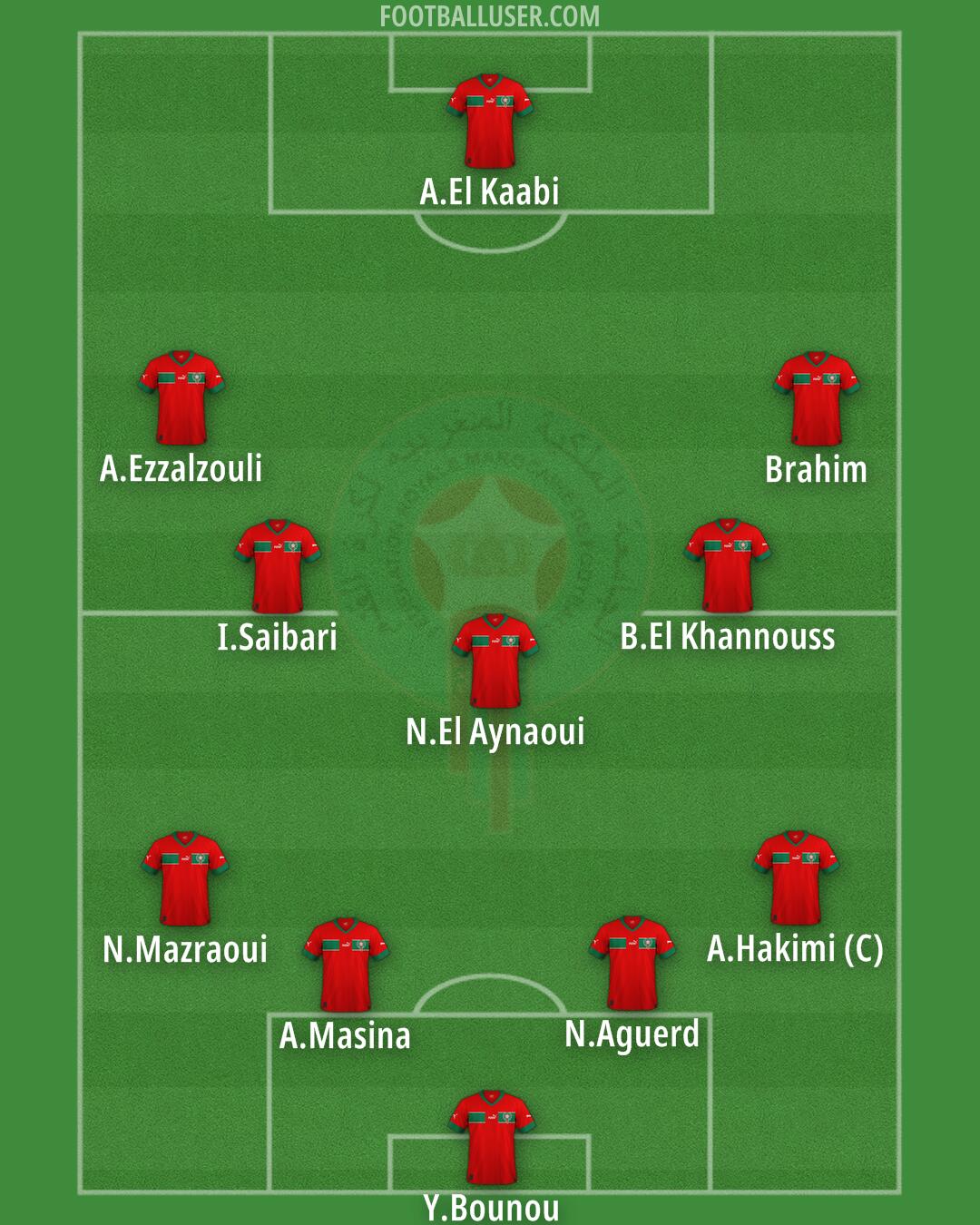

Morocco National Football Team Formation
 February 14, 2026


Starting Lineup
Y.Bounou · N.Aguerd · A.Hakimi (C) · A.Masina · N.Mazraoui · N.El Aynaoui · I.Saibari · B.El Khannouss · A.Ezzalzouli · Brahim · A.El KaabiA high pressing and rapid transition style defines Morocco as they operate in a 4-5-1 formation. This lineup relies on winning the ball in advanced areas to catch opponents out of position. By controlling the central areas while maintaining width through the wide midfielders, the team can quickly switch play to exploit space.
Yassine Bounou guards the goal as the last line of defense. In front of him, the back four maintains a high line to compress the space in the middle. Achraf Hakimi (C) pushes high from right back to provide attacking width, while Noussair Mazraoui acts as a left back who can tuck in or overlap. On the right side of the central defense, Nayef Aguerd uses his aerial strength and ability to read the game to intercept passes. Alongside him, Achraf Masina covers the left side, ensuring the defensive unit stays compact when the team sits deep.
The midfield functions as a five man unit designed to control the tempo and disrupt play. Nemanja El Aynaoui sits as the single pivot to shield the defense and break up opposition attacks. Ahead of him, Ismael Saibari and Bilal El Khannouss operate in the central roles to connect the defense to the attack by breaking lines with quick passes. Brahim and Anass Ezzalzouli operate in the half spaces, providing the link between the midfield and the lone striker.
Morocco employs a lone striker in Ayoub El Kaabi to lead the line. El Kaabi focuses on holding up the ball and making runs into the channels to pull defenders out of position. Brahim and Ezzalzouli act as attacking midfielders who can cut inside to create goal scoring chances. This attacking structure creates constant movement, with the wide midfielders often dropping back to help the midfield or pushing high to pin the opposition full backs.
This formation offers significant tactical advantages, particularly the ability to press high in coordinated waves. The presence of Hakimi allows for wide overloads when he joins the attack, forcing the opposition to shift heavily to one side. Morocco also benefits from compactness when defending, making it difficult for opponents to find gaps between the lines. The speed of transition from the midfield to the front line remains a primary threat.
The 4-5-1 formation allows Morocco to be both defensively solid and lethal on the break. This lineup is best suited for matches against dominant teams where controlling central space and exploiting wide areas is vital.