
Japan National Football Team Formation
 February 14, 2026


Starting Lineup
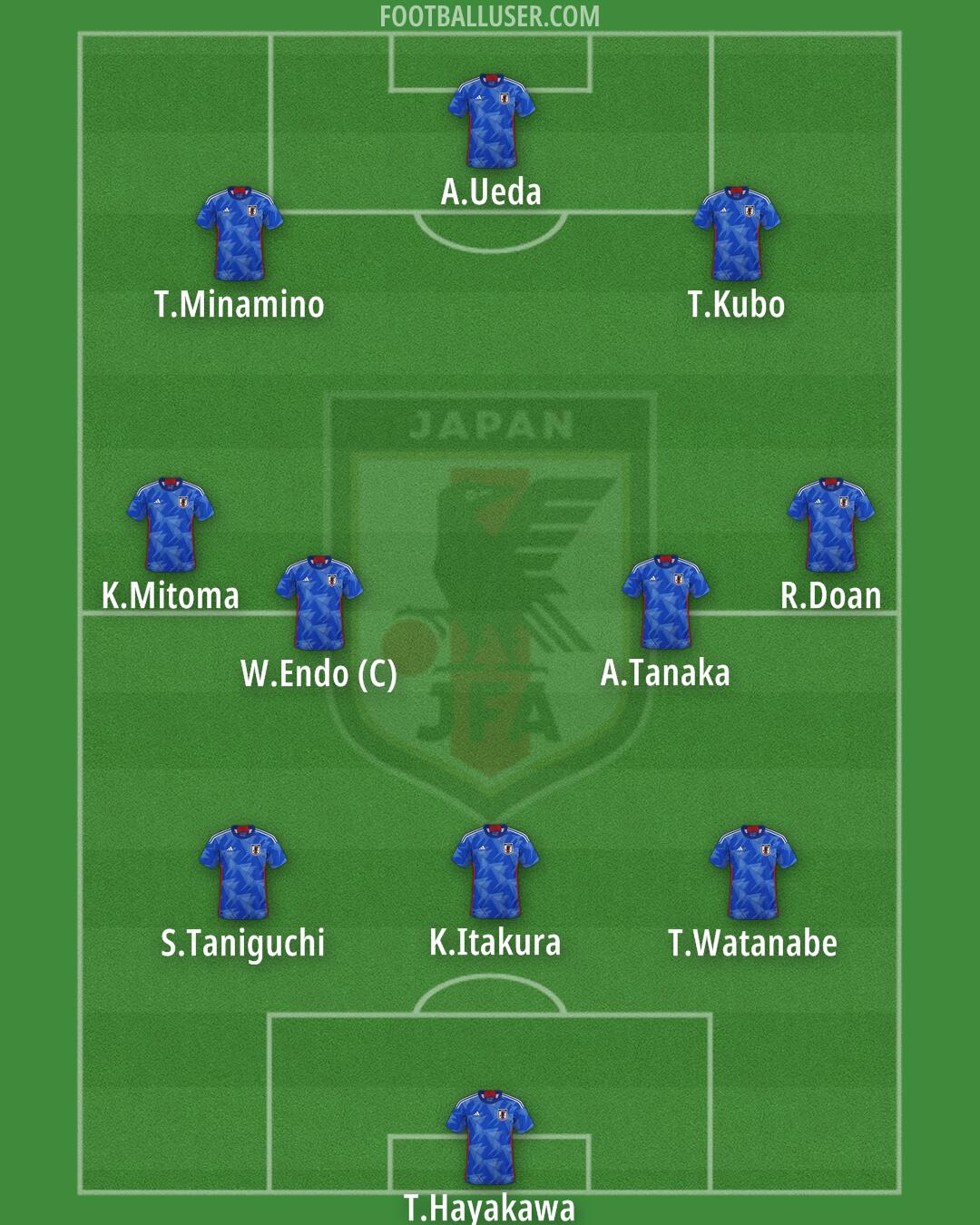
T.Hayakawa · T.Watanabe · S.Taniguchi · K.Itakura · R.Doan · A.Tanaka · W.Endo (C) · K.Mitoma · A.Ueda · T.Minamino · T.KuboA high press and rapid transition style defines Japan in this 3-4-3 formation. This lineup focuses on squeezing the opponent in their own half and quickly moving the ball forward to exploit gaps between the lines. The team seeks to dominate through verticality and intense pressure.
T.Hayakawa stands between the posts to organize the back three. K.Itakura holds the center of the defense, acting as the primary ball playing defender to initiate play from the back. S.Taniguchi and T.Watanabe operate on either side of him, providing cover and maintaining a high line to keep the distance between the defensive unit and the midfield tight. These defenders must be ready to step up and intercept passes or drop back to cover space if the press is bypassed.
The midfield operates as a central engine designed to control the tempo and link play. Captain W.Endo sits as a deep pivot to shield the defense and recycle possession, while A.Tanaka drives forward to break the lines with his movement. On the flanks, K.Mitoma and R.Doan act as wide midfielders who provide both width and defensive support. K.Mitoma uses his dribbling style to beat men on the wing, while R.Doan helps to lock down the wide areas when the team sits deep.
In the final third, Japan employs three attackers to stretch the opposition. A.Ueda leads the line as a lone striker, working to hold up the ball and bring teammates into the game. T.Kubo and T.Minamino operate as inverted wingers on the flanks. T.Kubo looks to cut inside to create chances, while T.Minamino makes runs into the box to finish moves. This front three presses heavily to force mistakes high up the pitch.
This formation offers several tactical advantages, particularly the ability to press high in coordinated waves. By using the wide midfielders to pin the opponent, Japan can create numerical superiority in the central zones. The setup also allows for quick switches of play to the wingers, isolating wide players in one on one situations. When defending, the three central defenders and the midfield block create a compact wall that is hard to penetrate.
Japan relies on this 3-4-3 formation to suffocate opponents through relentless energy and speed. This tactical identity is best suited for matches against teams that struggle to play out from the back under pressure.