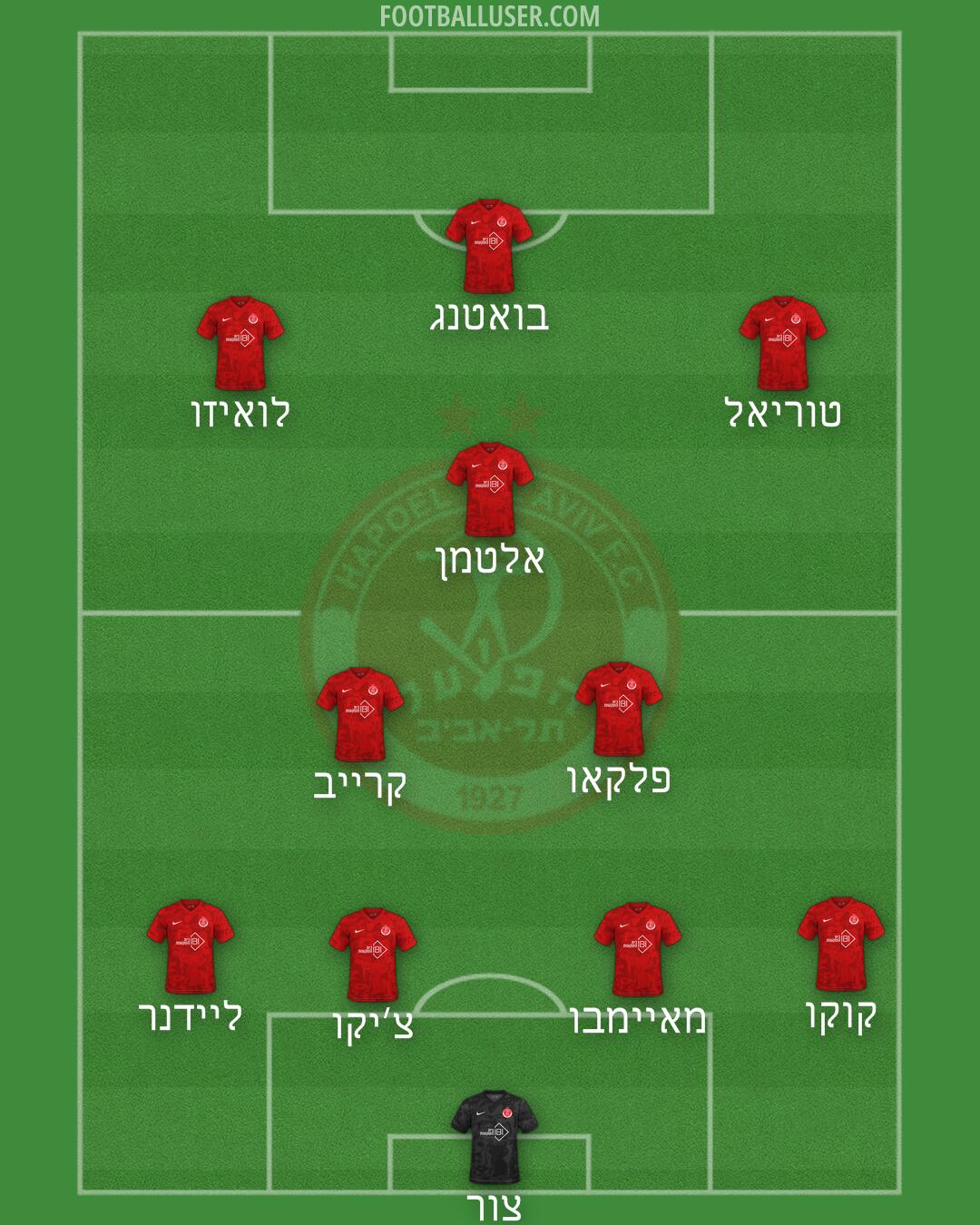

Hapoel Tel-Aviv Football Formation
 February 14, 2026


Starting Lineup
צור · קוקו · מאיימבו · צ׳יקו · ליידנר · פלקאו · קרייב · אלטמן · טוריאל · לואיזו · בואטנגA heavy focus on high pressing and verticality defines Hapoel Tel-Aviv in this 4-3-3. This lineup is built to win the ball back quickly and force the opposition into mistakes deep in their own half. By maintaining a high line, the team intends to squeeze the pitch and limit the time opponents have to look up and pass.
The defensive unit begins with צור in goal, acting as the last line of defense. A back four holds the line, featuring צ׳יקו and מאיימבו as the central defenders. צ׳יקו covers space while מאיימבו uses his physical presence to win aerial duels. On the flanks, ליידנר and קוקו occupy the full back positions, ready to push up and overlap to provide width. The whole defensive group must stay compact to prevent long balls from breaking the line.
The midfield functions as a trio that connects the defensive block to the attack. קרייב and פלקאו operate in the central roles to shield the defense and intercept passes. They provide the necessary cover to allow אלטמן to push higher. As an attacking midfielder, אלטמן works to break the line with forward runs and find pockets of space between the opposition midfield and defense. This midfield unit ensures Hapoel Tel-Aviv can switch play rapidly when the ball is won back.
Attacking moves involve three forwards working in unison to stretch the opposition. בואטנג leads the line as a lone striker, tasked to hold up the ball and bring others into play. On the wings, לואיזו and טוריאל act as wide attackers who look to cut inside and threaten the goal. The team builds the attack through quick combinations, with the wingers making diagonal runs to pull defenders out of position. This movement creates space in the middle for late runners.
Hapoel Tel-Aviv gains a significant advantage through their ability to press high in coordinated waves. This creates immediate chances from turnovers in the final third. Another strength is the wide overloads provided by ליידנר and קוקו, which forces the opposition wingers to track back and leaves them fatigued. These constant runs and heavy pressure make the team very difficult to play against in transition.
This 4-3-3 formation relies on intense physical energy and quick ball movement. It is a setup best suited for facing teams that try to build play from the back.