
Vasco da Gama Football Formation
 February 19, 2026


Starting Lineup
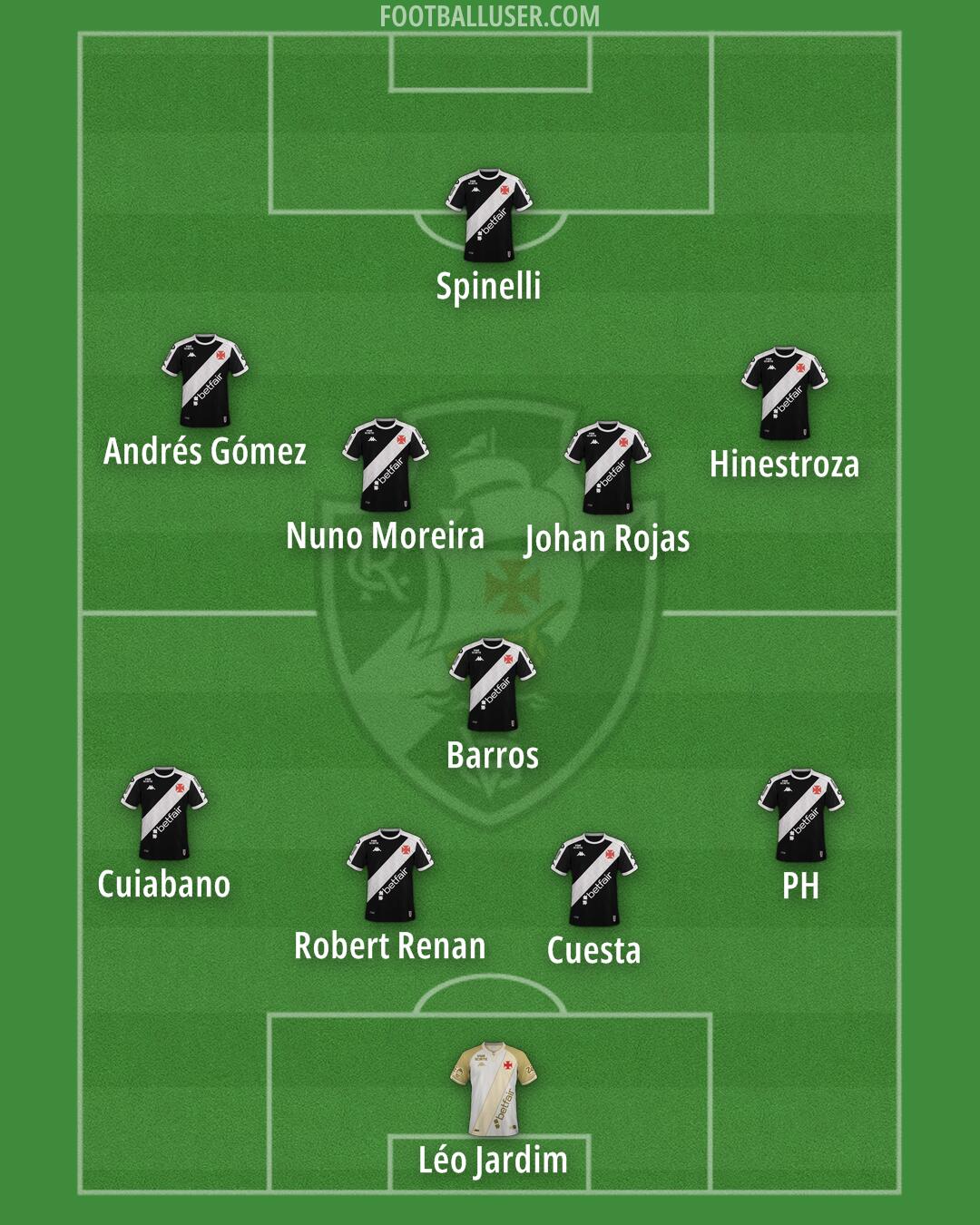
PH · Cuesta · Robert Renan · Cuiabano · Barros · Johan Rojas · Nuno Moreira · Andrés Gómez · Hinestroza · Spinelli · Léo JardimA focus on defensive solidity defines the 5-4-1 lineup of Vasco da Gama. This formation aims to sit deep and absorb pressure before launching quick transitions. The team works to stay compact and limit space between the lines, making them difficult to break down. This specific setup is built to play a reactive style of football where defensive discipline remains the priority.
Léo Jardim protects the goal as the last line of defense. In front of him, the defensive unit consists of three central defenders with Barros, Robert Renan, and Cuesta. Barros holds the center while Cuesta and Robert Renan cover the spaces to their sides. The wing backs, PH and Cuiabano, provide the width. PH pushes up to support the flank while Cuiabano tracks back to help the back three when the team loses the ball. This five man line remains very difficult to penetrate through the middle.
The midfield operates in two banks of two to maintain compactness. Nuno Moreira and Johan Rojas occupy the central spaces to shield the defense and intercept passes. They work to connect the defensive unit to the rest of the team. On the flanks, Hinestroza and Andrés Gómez provide the wide presence. These players must track back to help the wing backs while looking to drive forward when the team wins possession.
Vasco da Gama relies on a lone striker, Spinelli, to lead the attack. The front line relies on Spinelli to hold up the ball and bring the wide players into the game. Since the team plays with width from Hinestroza and Andrés Gómez, the attack often moves from the wings toward the center. The forwards press as a unit to force errors, but the primary goal is to create space for Spinelli to run into during a break.
One major advantage for Vasco da Gama is the ability to create wide overloads when PH and Cuiabano overlap into the attacking third. This formation also offers great compactness when defending deep, making it hard for opponents to find passing lanes. The team can also use the speed of transition to catch opponents out of position when they commit too many players forward.
This 5-4-1 formation creates a very difficult block that is hard to break down through central play. It is best suited for games against dominant teams where the side needs to sit deep and exploit space on the counter.