Portland Soccer Formation
 February 19, 2026


Starting Lineup
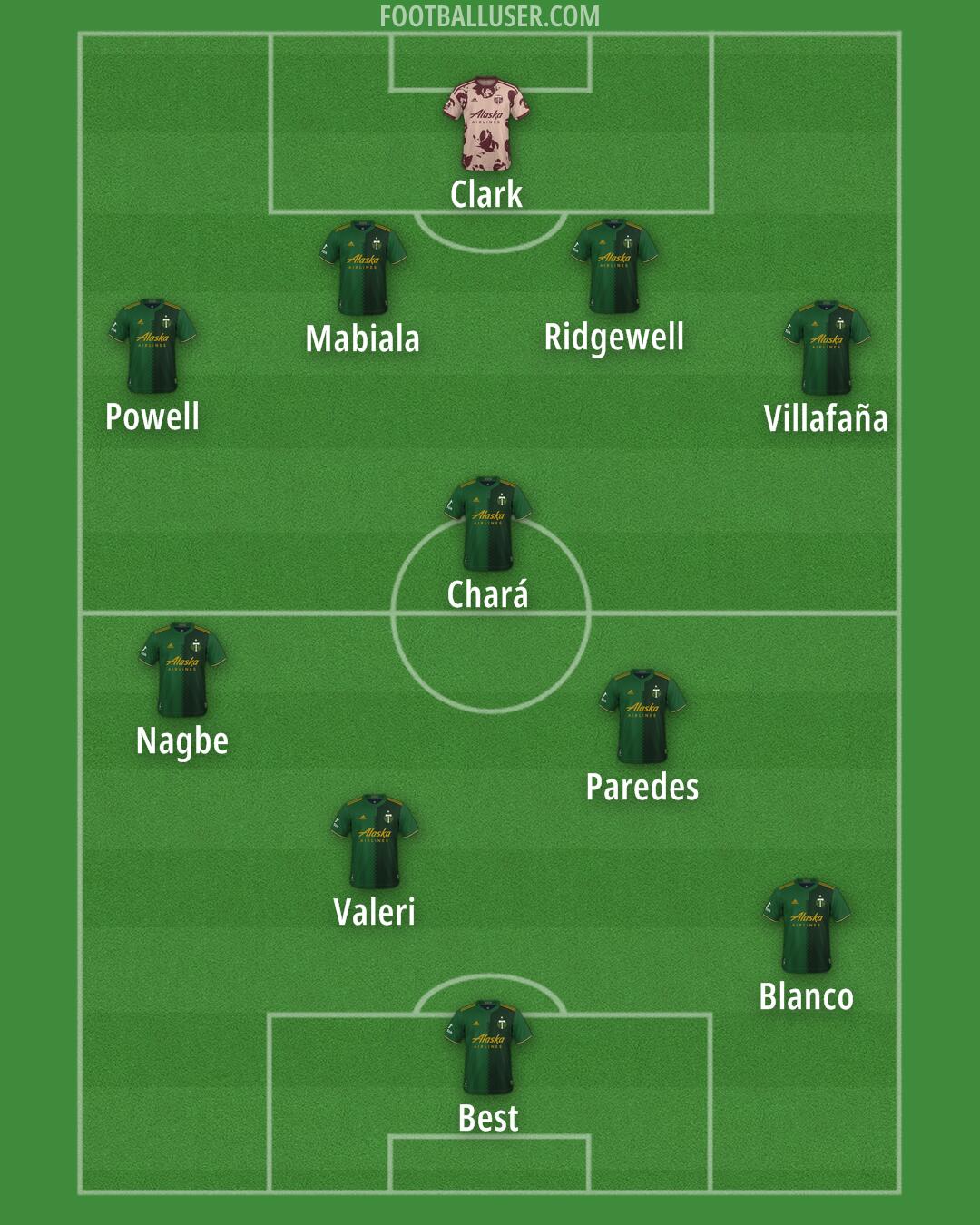
Clark · Mabiala · Ridgewell · Powell · Villafaña · Chará · Nagbe · Blanco · Best · Valeri · ParedesPrioritizing a compact defensive block and quick transitions, Portland operates within a 4-5-1 formation. This lineup is built to stay hard to beat in a mid block before looking to exploit spaces behind the opposition defense. The team relies on defensive discipline to force turnovers in central areas, using the narrow midfield to congest the passing lanes.
Clark stays between the posts to anchor the defensive unit. Behind a flat back four, Mabiala and Ridgewell act as the central pairing, where Mabiala provides aerial strength and Ridgewell covers the space behind. The wide defenders, Powell and Villafaña, must balance their duties by staying close to the center backs to prevent being bypassed, though they will push up to overlap when the ball moves wide.
A crowded midfield serves as the engine room for Portland. Chará sits in front of the back line as a single pivot to shield the defense and intercept passes. Nagbe and Paredes occupy the central spaces to control the tempo and connect the defensive unit to the higher lines. On the flanks, Valeri and Blanco operate in the half spaces, ready to press high or drop back to help the midfield maintain its density.
The attack centers around a lone striker, Best, who must hold up the ball to allow the midfielders to push forward. Because the formation relies on a single forward, the wide players like Blanco and Valeri must cut inside to support the central presence. This creates a way to build the attack through the middle or switch play to the wings to find room for a cross into the box.
One major advantage of this 4-5-1 is the ability to create numerical superiority in the center of the pitch. By packing the midfield, Portland can crowd out the opponent and make it difficult for them to break the lines. Additionally, the team can transition very quickly once Chará or Nagbe wins the ball, sending runners forward to catch the opposition out of position.
Portland relies on defensive compactness and central control to dictate the rhythm of the game. This formation is best suited for matches against teams that dominate possession, allowing the team to sit deep and strike on the break.