Celtic Football Formation
 February 21, 2026


Starting Lineup
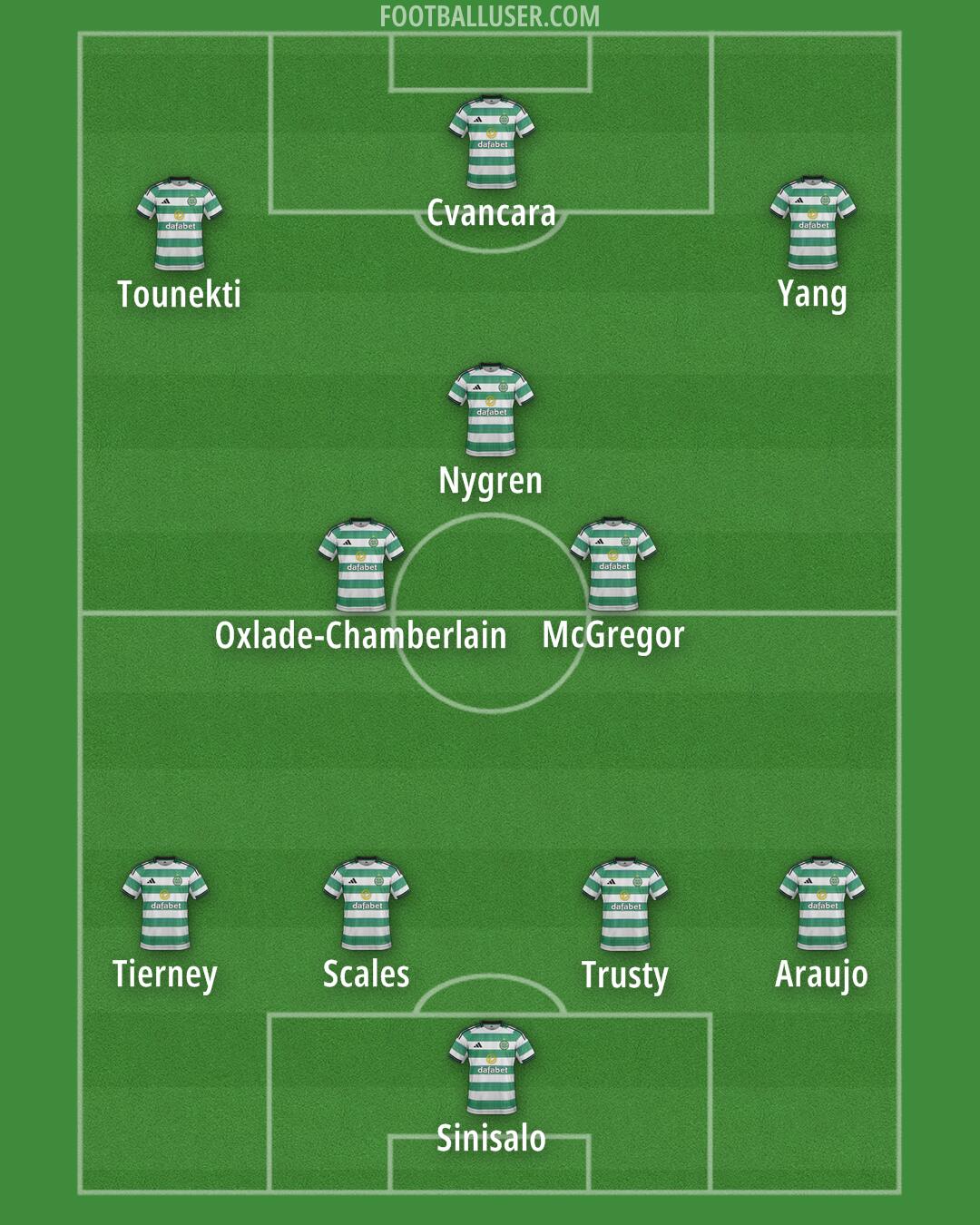
Sinisalo · Araujo · Trusty · Scales · Tierney · McGregor · Oxlade-Chamberlain · Nygren · Yang · Tounekti · CvancaraA high pressing identity defines Celtic and their 4-3-3 formation. This lineup aims to win the ball back quickly in the opponent half to drive the team forward through vertical passing. By pushing the lines high, the team looks to suffocate the opposition and control the rhythm of the game through constant pressure.
Sinisalo starts in goal to organize the back four. A flat back four consists of Araujo at right back and Tierney at left back, both tasked with pushing high to provide width. Trusty and Scales operate as the central defenders, where Scales provides aerial strength while Trusty acts as a ball playing defender to start attacks from the deep. This defensive unit works to stay compact and step up together to keep the play in the opposition territory.
In the middle of the pitch, a midfield three manages the transition from defense to attack. McGregor acts as the engine, driving forward to break the line with his ball carrying and passing range. Oxlade-Chamberlain operates in the left central role to link play, while Nygren plays as the attacking midfielder to press high and find pockets of space between the lines. This midfield trio works to shield the back four while ensuring there is always a passing option to move the ball into the final third.
The attack relies on three players to stretch the opposition defense. Cvancara leads the line as a lone striker, tasked to hold up the ball and pin the central defenders. On the flanks, Tounekti and Yang act as wide wingers who look to cut inside and create goal scoring opportunities. Their movement forces the opposition full backs to drop deep, which opens up space in the center for the midfielders to make runs into the box.
Celtic gains a major advantage through their ability to press high in coordinated waves. The front three and Nygren work together to force turnovers in dangerous areas, often isolating wide players in one on one situations when the opposition tries to play out from the back. This creates immediate chances before the opponent can settle into a defensive block.
This 4-3-3 formation relies on high intensity and quick transitions to dominate the ball. It is most effective against teams that struggle to play under pressure and leave large spaces behind their midfield.