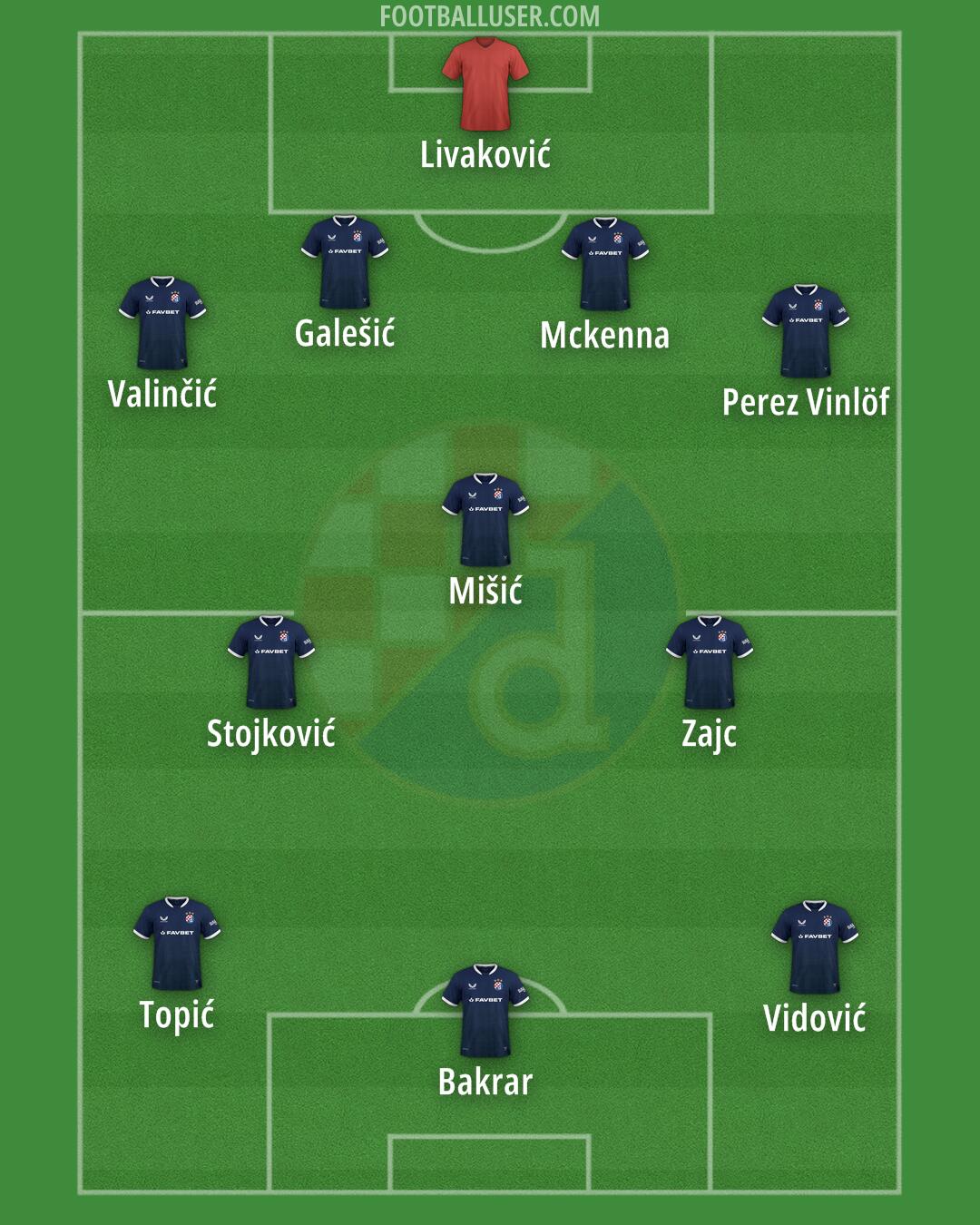

Dinamo Football Formation
 February 25, 2026


Starting Lineup
Livaković · Valinčić · Galešić · Mckenna · Perez Vinlöf · Stojković · Mišić · Zajc · Topić · Bakrar · VidovićA high pressing and direct style of football defines Dinamo in this 4-3-3 formation. This lineup aims to win the ball high up the pitch and quickly transition into attacking phases to catch the opposition out of position. The team seeks to control the tempo through central dominance while maintaining enough verticality to punish teams that sit too deep.
Livaković starts in goal and acts as the foundation for the defensive unit. The back line operates with a flat back four, consisting of Valinčić on the right and Perez Vinlöf on the left. Galešić and Mckenna act as the central defenders, where Galešić provides aerial strength and Mckenna covers the space behind the full backs. Valinčić and Perez Vinlöf are expected to push up the flanks to support the attack, requiring them to track back quickly when possession is lost.
The midfield functions as a single pivot system with three specialized roles. Mišić sits in front of the defense to shield the back line and intercept passes. Beside him, Zajc and Stojković occupy the central areas to drive forward and connect the defense to the attack. Zajc uses his passing range to switch play, while Stojković works to press opponents and win the ball back in the middle third. This trio ensures the team stays compact and can quickly move the ball from the defensive zone into the final third.
In the attacking third, Dinamo employs three attackers to stretch the opposition. Bakrar operates as a lone striker, tasked to hold up the ball and make runs into the channels. On the wings, Topić and Vidović act as wide wingers, looking to cut inside or beat their markers to deliver crosses. This front line is designed to press high in unison, forcing defenders into mistakes near their own goal.
This formation offers several tactical advantages for Dinamo. The presence of Zajc and Mišić allows for numerical superiority in the center of the pitch, making it difficult for opponents to play through the middle. Additionally, the width provided by Topić and Vidović creates wide overloads when the full backs overlap. This movement isolates defenders in one on one situations, allowing the wingers to exploit space.
The 4-3-3 formation creates a cohesive unit built for high intensity and quick transitions. It is best suited for matches against teams that play a high line or struggle to maintain possession under pressure.