
Heidenheim Football Formation
 February 27, 2026
 peter.vicey


Starting Lineup
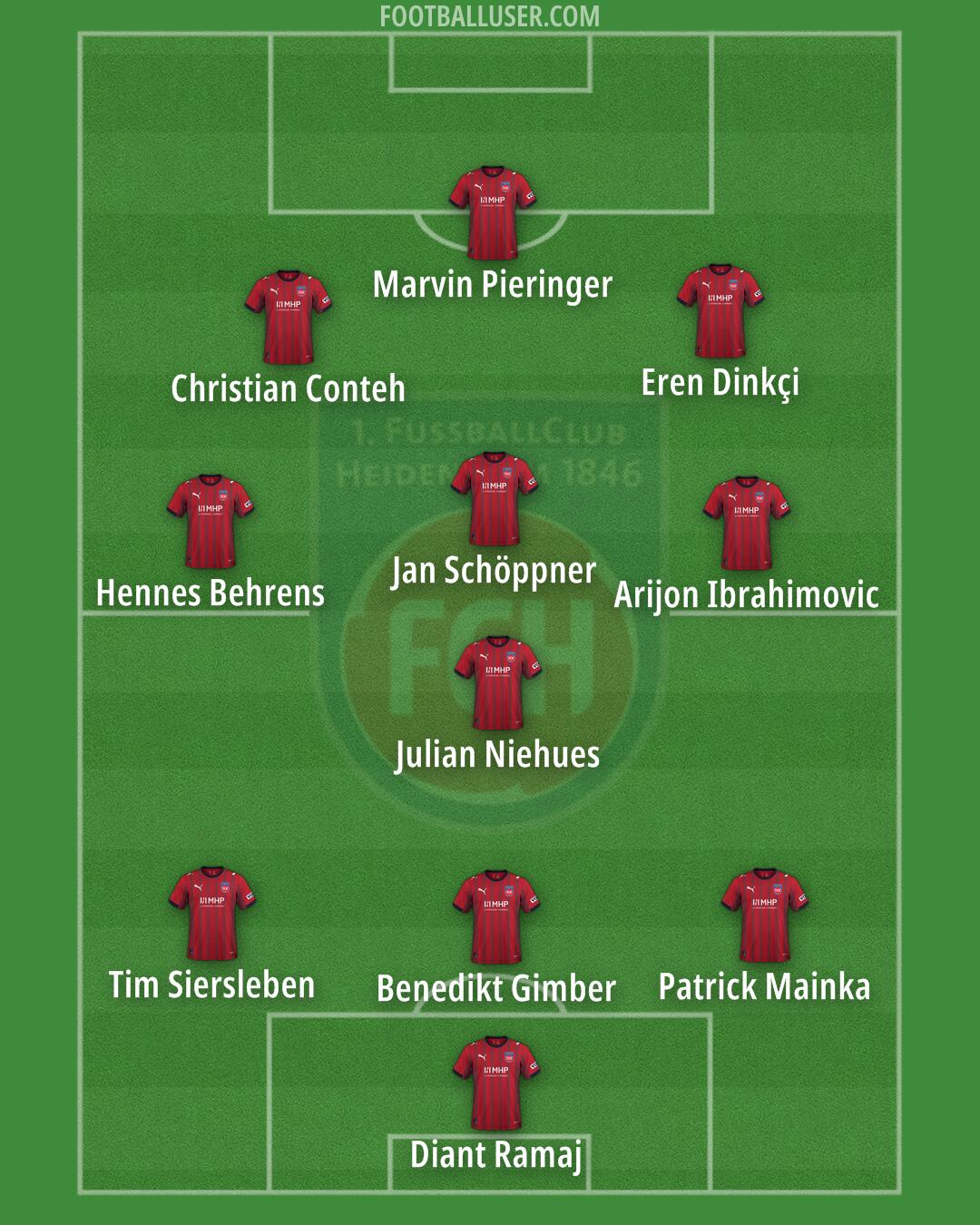
Diant Ramaj · Patrick Mainka · Tim Siersleben · Benedikt Gimber · Arijon Ibrahimovic · Julian Niehues · Jan Schöppner · Eren Dinkçi · Hennes Behrens · Marvin Pieringer · Christian ContehA high pressing and vertical style defines the Heidenheim lineup in this 3-4-3. The team aims to win the ball high up the pitch and move it quickly toward the goal to catch the opposition off guard. This formation works to overwhelm opponents through direct play and constant movement. Heidenheim focuses on quick transitions to exploit gaps in the defensive lines.
Diant Ramaj stands between the posts to organize the defensive unit. A back three consisting of Tim Siersleben, Benedikt Gimber, and Patrick Mainka provides the foundation. Siersleben and Mainka cover the wide areas of the defense and must mark any runners coming from the flanks. Gimber sits central to command the area and intercept crosses or long balls. The defenders step up to squeeze the space and shift as a unit to cover any gaps left by the midfielders.
The midfield operates with a central block to control the center of the pitch. Julian Niehues acts as the pivot to shield the defense and collect the ball from the back three. Beside him, Jan Schöppner, Arijon Ibrahimovic, and Hennes Behrens occupy the middle areas to drive forward and connect the lines. These players must track back to defend when the ball is lost and switch play to find the wingers. This group works to break the line with direct passes to the front three.
Attacking thrust comes from a front three of Christian Conteh, Marvin Pieringer, and Eren Dinkçi. Conteh and Dinkçi act as wide wingers who look to cut inside and create chaos in the half spaces. Pieringer sits as the lone striker to hold up the ball and bring others into play. The wingers push high to support the midfield, creating a wide presence that forces the opposition defense to stretch. They press the opposing full backs to win the ball back quickly.
Heidenheim finds success by creating numerical superiority in the central areas. With four players in the middle, the team can often outnumber opponents and control the ball through short passes. They also use the width provided by the wingers to isolate defenders in one on one situations. The speed of transition allows the team to go from a defensive block to an attacking wave in seconds. This allows the players to push forward quickly after a tackle or interception.
This 3-4-3 formation relies on high energy and intense pressing to disrupt the rhythm of the opposition. It is best suited for matches against teams that struggle to play out from the back under pressure.