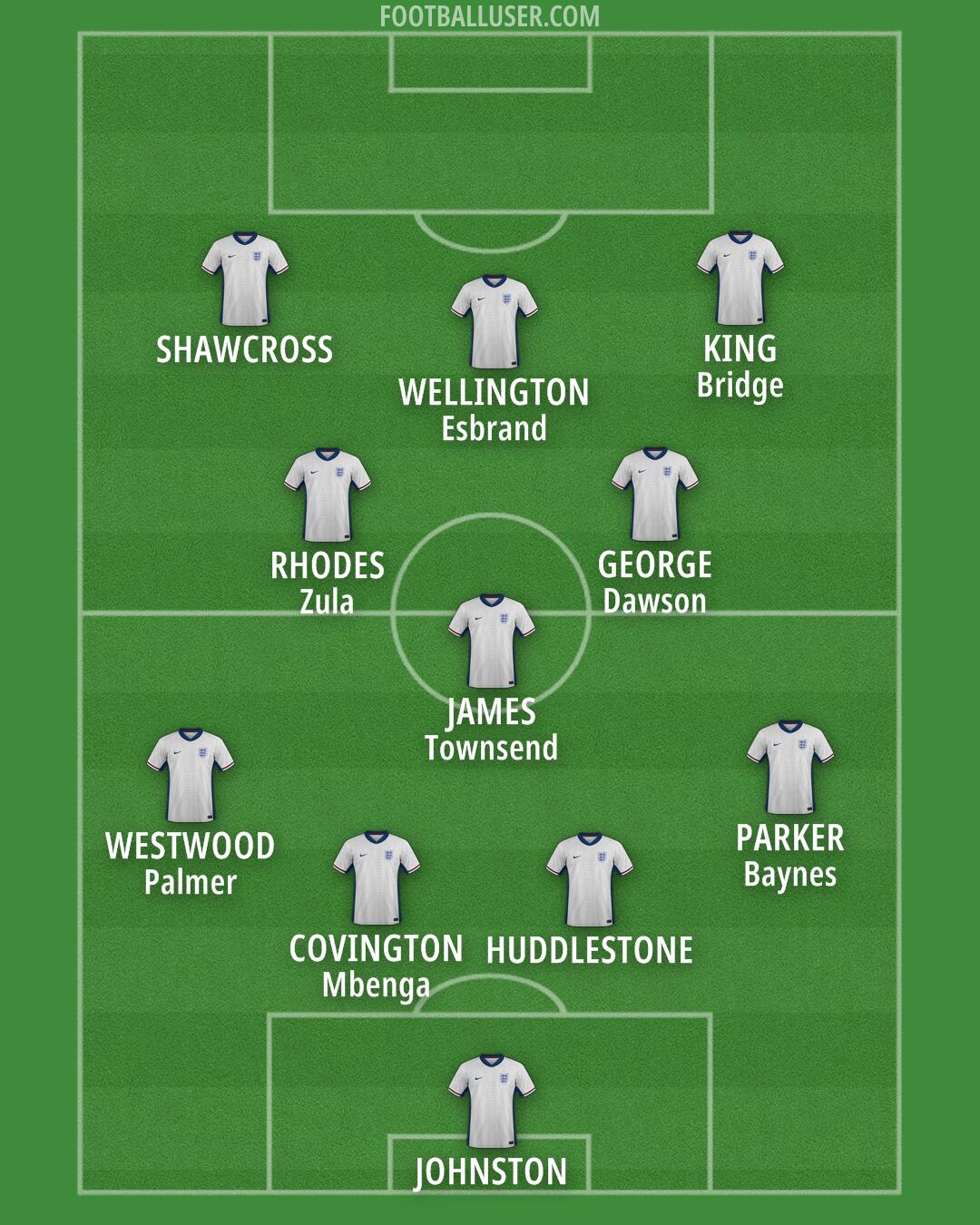
England National Football Team Formation
 March 5, 2026


Starting Lineup
JOHNSTON · HUDDLESTONE · COVINGTON (Mbenga) · PARKER (Baynes) · WESTWOOD (Palmer) · JAMES (Townsend) · RHODES (Zula) · GEORGE (Dawson) · KING (Bridge) · SHAWCROSS · WELLINGTON (Esbrand)A heavy emphasis on defensive solidity and quick transitions defines this England lineup, which operates in a 5-2-3 formation. The team looks to sit deep when out of possession and then move the ball forward rapidly to catch the opponent off guard. This formation builds a compact unit that is difficult to break down through the middle.
In goal, Johnston stays between the posts to organize the back line. The defensive unit consists of a back three featuring James, Covington, and Huddleston. James acts as the central pillar to command the area and cover space behind his teammates. Covington and Huddleston provide width within the three, while the wing backs, Parker and Westwood, are tasked with providing width during attacks. Parker and Westwood must track back quickly to form a five man line when the team loses the ball to prevent crosses.
The midfield relies on a double pivot to control the central zone. Rhodes and George work to shield the defense and break up play before the opposition can reach the final third. These two midfielders must stay close together to prevent opponents from playing through the center. Rhodes and George act as the link between the defense and the attack, looking to win the ball and immediately find the wide players or the striker.
Three attackers lead the front line to stretch the opposition. Wellington operates as a lone striker, tasked to hold up the ball and bring others into play. Shawcross and King act as wide forwards, positioned to cut inside or push wide to create crossing opportunities. Shawcross and King also lead the first line of the press, forcing the opposing defenders to make hurried passes.
England creates tactical advantages through its ability to shift between a back five and a back three during the attacking phase. The wide runs from Parker and Westwood often create overloads on the flanks, leaving the opposition wingers out of position. This formation also allows the team to maintain extreme compactness when defending, making it very hard for opponents to find passing lanes between the lines.
This 5-2-3 formation prioritizes defensive stability and rapid verticality. It is most effective against teams that dominate possession and leave space behind their high defensive line.