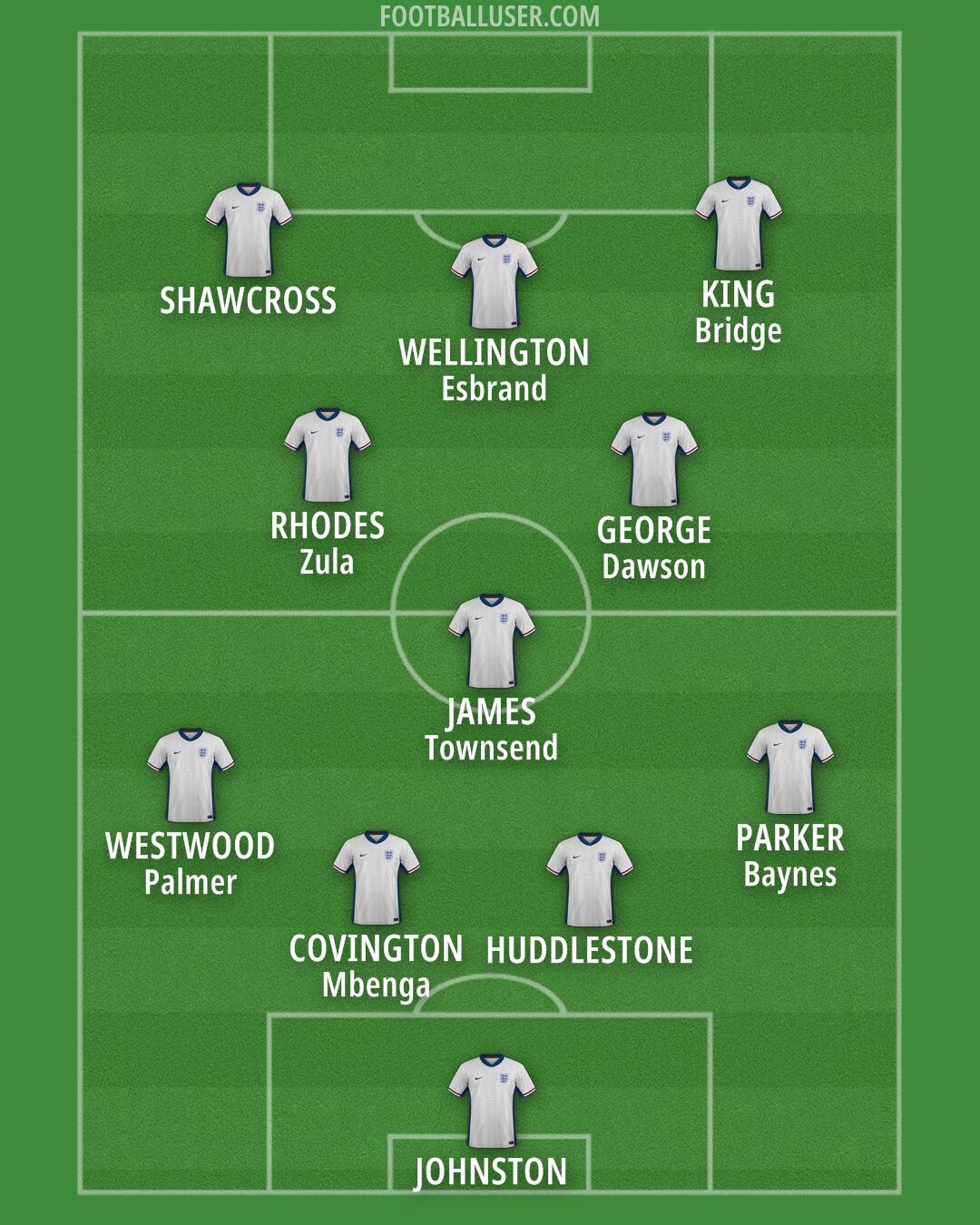
England National Football Team Formation
 March 5, 2026


Starting Lineup
JOHNSTON · HUDDLESTONE · COVINGTON (Mbenga) · PARKER (Baynes) · WESTWOOD (Palmer) · JAMES (Townsend) · RHODES (Zula) · GEORGE (Dawson) · KING (Bridge) · SHAWCROSS · WELLINGTON (Esbrand)A high pressing and vertical style defines this England lineup in a 5-2-3 formation. This setup seeks to regain the ball quickly in the final third to launch rapid attacks. The goal is to control games through aggressive movement and quick transitions rather than slow buildup.
In goal, Johnston protects the goal while the defensive unit operates with a back three. James leads the center of the defense, providing coverage for the other defenders. Huddlestone acts as the right center back to intercept passes, while Covington holds the left center back position. The wing backs, Parker on the right and Westwood on the left, push high up the pitch to provide width. These players must track back quickly to form a five man line when the opposition gains possession.
The midfield consists of a double pivot with George and Rhodes controlling the center of the pitch. George operates as the right central midfielder to drive forward and break the line with his runs. Rhodes sits in the left central midfield role to shield the back three and connect the defense to the attackers. They must stay compact to prevent the opposition from playing through the middle.
Attacking movements rely on a front three of Shawcross, Wellington, and King. Shawcross occupies the left wing to cut inside and create chances, while King works the right flank to stretch the opposition. Wellington acts as the lone striker, tasked to hold up the ball and lead the press from the front. This trio works to push the opposition back and create space for the advancing wing backs.
England can gain a massive advantage through wide overloads when Parker and Westwood overlap their respective wingers. This creates many one on one situations for the attackers. The formation also allows the team to press high in coordinated waves, making it difficult for opponents to build from the back. When defending, the compactness of the back five makes the middle very hard to penetrate.
This 5-2-3 formation is built for high intensity and rapid counter attacks. It is best suited for matches against teams that play with a high line and leave space behind their defenders.