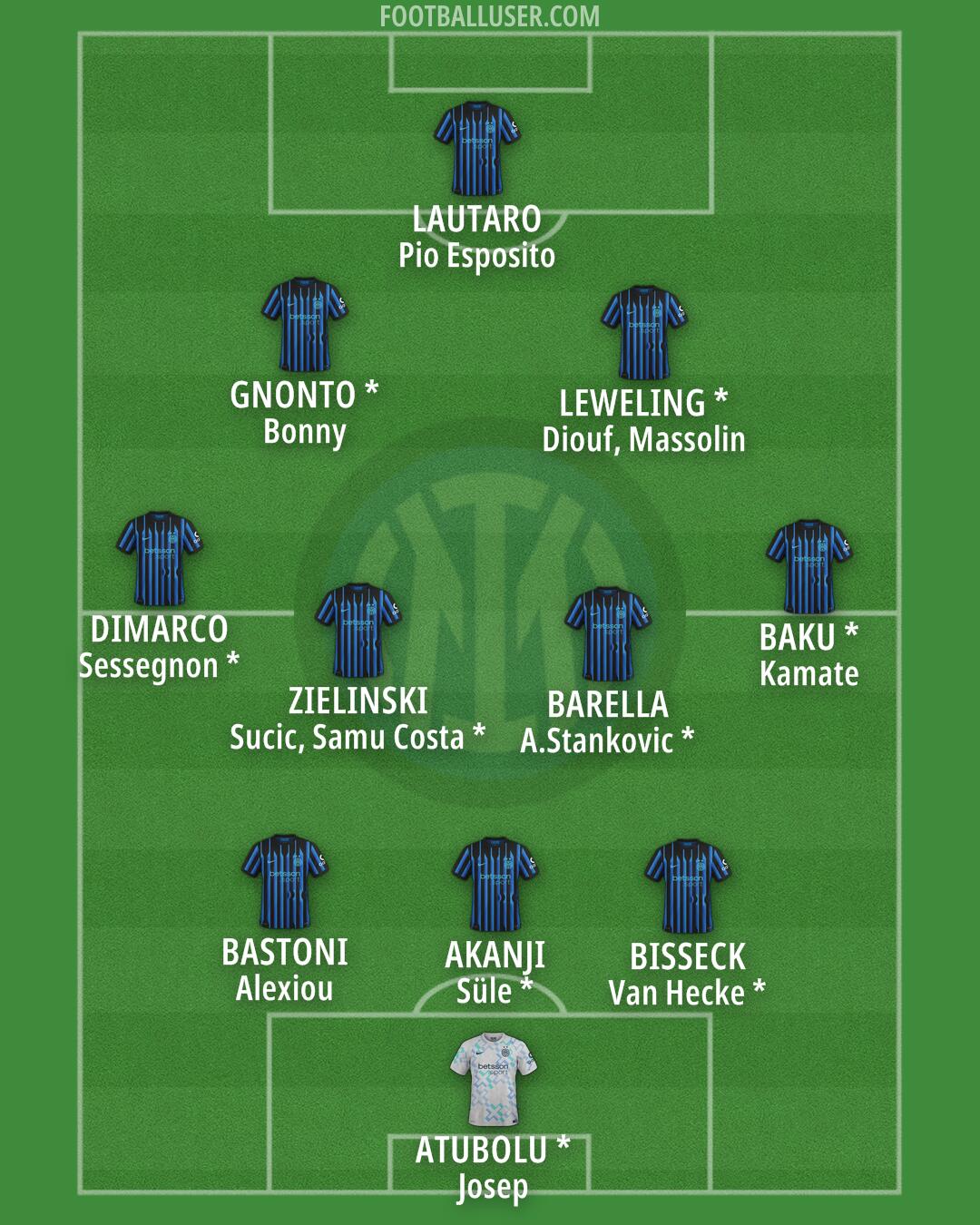

Inter Football Formation
 March 9, 2026


Starting Lineup
LAUTARO (Pio Esposito) · GNONTO * (Bonny) · LEWELING * (Diouf, Massolin) · DIMARCO (Sessegnon *) · BAKU * (Kamate) · ZIELINSKI (Sucic, Samu Costa *) · BARELLA (A.Stankovic *) · BASTONI (Alexiou) · AKANJI (Süle *) · BISSECK (Van Hecke *) · ATUBOLU * (Josep)A high press and aggressive verticality define Inter as they operate in a 3-4-3 formation. This lineup seeks to dominate the pitch by squeezing the opponent in their own half and winning the ball back quickly. The team is built to play direct football that exploits spaces behind the opposition defense through rapid transitions.
At the back, Atubolu starts between the posts to organize the defensive unit. The back three consists of Bisseck, Akanji, and Bastoni, who work to maintain a high line to keep the team compact. Akanji acts as a central anchor to block passing lanes, while Bisseck and Bastoni cover the wide areas of the defensive line. The wide players, Dimarco and Baku, function as wing backs who must track back to support the defenders when the team loses possession.
The midfield relies on a central pair to control the tempo and link play. Barella and Zielinski occupy the central roles, where they are expected to drive forward and break the lines with their passing. Barella provides energy to press in the middle, while Zielinski looks to create chances from deep positions. Dimarco and Baku provide the necessary width in the middle third, allowing the central players to focus on controlling the ball and shifting play to the flanks.
Leading the line, Lautaro acts as the lone striker, often dropping deep to hold up the ball and bring others into play. He is supported by two wide attackers, Leweling and Gnonto, who act as inverted wingers to cut inside and threaten the goal. These three forwards press in coordination, forcing errors from the opposition defenders. The movements of Leweling and Gnonto create space for the wing backs to overlap and provide crosses into the box.
Inter gain significant advantages through their ability to create wide overloads. When Dimarco or Baku push forward, they combine with the wingers to isolate defenders in one on one situations. The team also benefits from a coordinated high press that uses the front three to trap the opponent. This creates a heavy volume of chances through quick transitions and numerical superiority in the final third.
This 3-4-3 formation serves a team that wants to dictate the rhythm through pressing and rapid forward movements. It is best suited for matches against opponents who struggle to play out from the back under pressure.