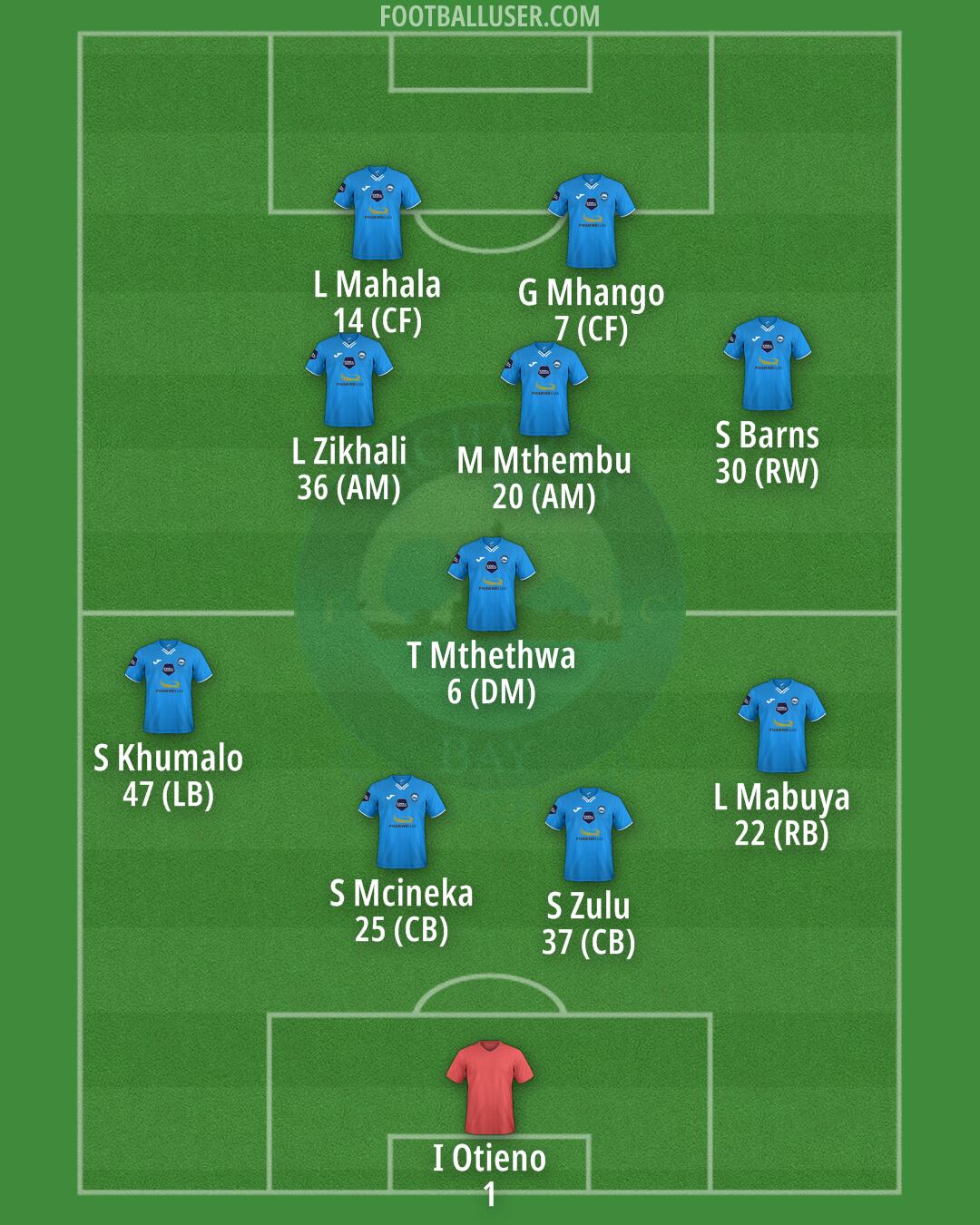

Richards Bay Soccer Formation
 March 11, 2026
 Matshwaro


Starting Lineup
I Otieno (1) · S Zulu (37 (CB)) · S Mcineka (25 (CB)) · S Khumalo (47 (LB)) · L Mabuya (22 (RB)) · T Mthethwa (6 (DM)) · L Zikhali (36 (AM)) · M Mthembu (20 (AM)) · S Barns (30 (RW)) · L Mahala (14 (CF)) · G Mhango (7 (CF))A defensive solidity and a preference for rapid transitions define Richards Bay in this 5-3-2 formation. This lineup aims to sit deep and absorb pressure before catching opponents on the break. By packing the central areas, the team creates a difficult block for opposing attackers to penetrate, making it a very hard unit to break down.
In goal, I Otieno acts as the last line of defense for Richards Bay. The defensive unit consists of a back three formed by T Mthethwa, S Mcineka, and S Zulu, who provide physical presence and aerial strength in the middle. L Mabuya and S Khumalo operate as the wing backs, tasked with providing width and covering the entire flanks. These wing backs must track back to help the central defenders while looking to push up and cross when the team wins the ball.
The midfield consists of a central trio that aims to congest the middle of the pitch. L Zikhali and S Barns operate on the left and right sides of the central block, while M Mthembu sits to hold the position and shield the defense. This three man unit works to intercept passes and disrupt the rhythm of the opposition. They connect the defense to the attack by winning second balls and making quick passes forward to the front line.
Two attackers lead the line, with L Mahala and G Mhango operating as a pair of forwards. This two man attack relies on the ability of the forwards to hold up the ball and wait for support from the midfield. L Mahala and G Mhango must press the opposition defenders to force mistakes, using their movement to create space for one another. The width comes primarily from the runs of the wing backs rather than the forwards themselves.
This formation offers significant tactical advantages through its compactness when defending. The presence of three central defenders and three midfielders makes it very difficult for opponents to play through the center. Richards Bay can also exploit wide areas through the overlapping runs of L Mabuya and S Khumalo, creating numerical superiority against single wingers. This allows the team to shift quickly from a deep block to an attacking transition.
The 5-3-2 formation provides a strong defensive base that prioritizes control of the central zones. It is most effective when facing teams that dominate possession and require a compact block to neutralize their threat.