
Real Madrid Football Formation
 March 13, 2026


Starting Lineup
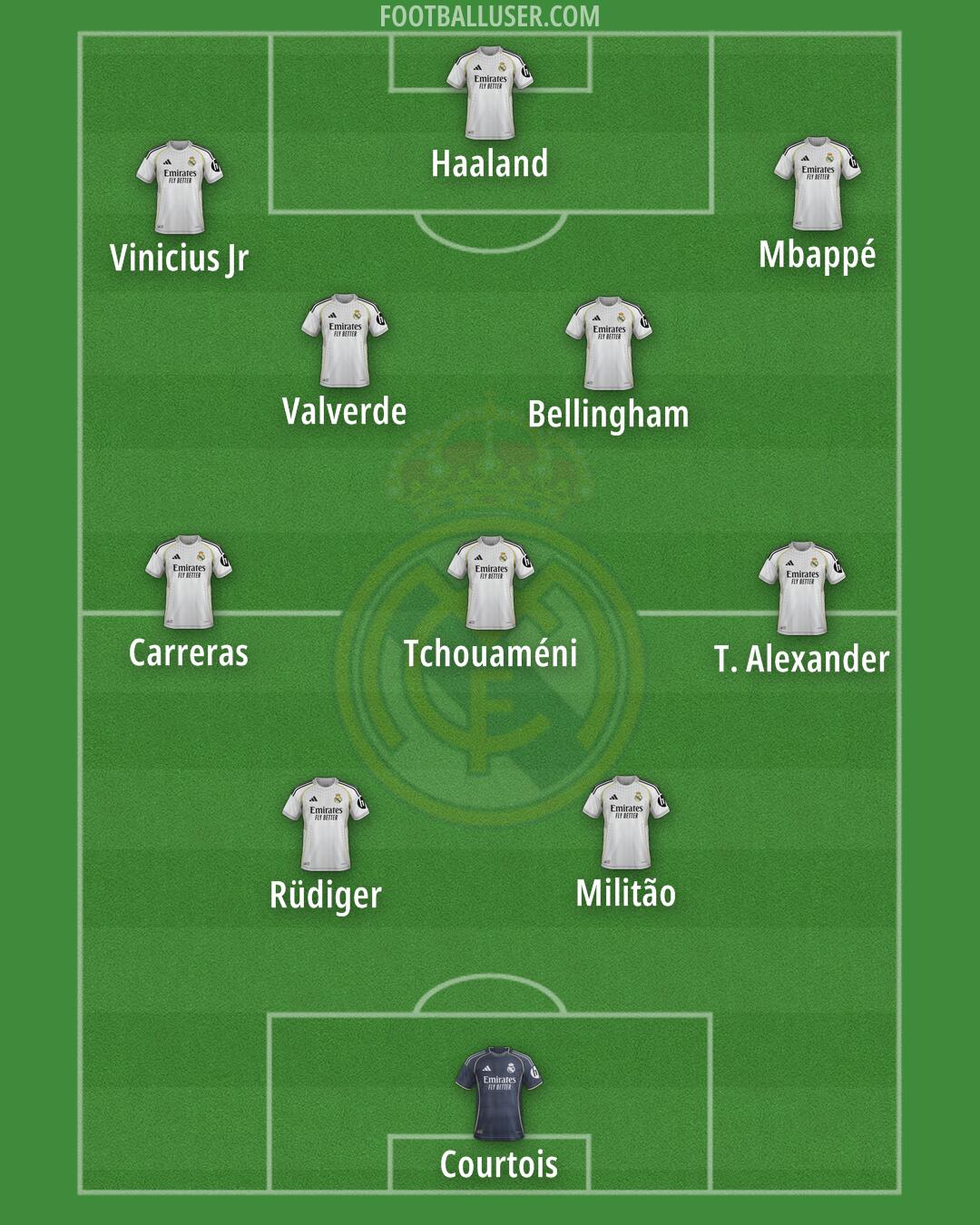
Haaland · Mbappé · Vinicius Jr · Bellingham · Valverde · Tchouaméni · Militão · Carreras · Rüdiger · T. Alexander · CourtoisPrioritizing quick transitions and heavy verticality, Real Madrid operates with a 5-2-3 formation. This lineup is built to strike with immense speed, using wide areas to stretch the pitch before finding goals through direct movements. The team wants to recover the ball and immediately push it forward into the final third.
Thibaut Courtois stands between the posts to anchor the defense. A back five provides a deep block when the team sits deep, featuring Tchouaméni in the center of the defense to sweep and provide cover. Rüdiger and Militão act as the primary central defenders, using their aerial strength and ability to intercept passes to stop attacks. On the flanks, Carreras and T. Alexander push up high as wing backs to provide width and support the press.
The midfield consists of a two man unit tasked with controlling the center of the pitch. Bellingham operates as a central midfielder who drives forward to join the attack, while Valverde covers ground to connect the defense to the front line. These two must work hard to track back and protect the center, ensuring they do not get overrun when the team loses possession. They act as the engine room to break the line with vertical passes.
In the attacking third, Real Madrid employs three powerful forwards. Haaland occupies the central space as a lone striker to hold up the ball and finish chances. On the wings, Vinicius Jr and Mbappé act as inverted attackers who cut inside to create goal scoring opportunities. This front line is designed to press high, forcing mistakes from the opposition as they try to build from the back.
This lineup offers significant advantages through its ability to create wide overloads. When Carreras and T. Alexander overlap, they isolate defenders and allow Vinicius Jr or Mbappé to find space in the box. Another strength is the speed of transition, as the distance between the midfield and the front three is short, allowing the team to move from defense to attack in seconds.
Real Madrid relies on this aggressive formation to punish teams that leave space behind their defensive line. This setup is best suited for matches where the opponent holds possession but struggles with high pressing intensity.