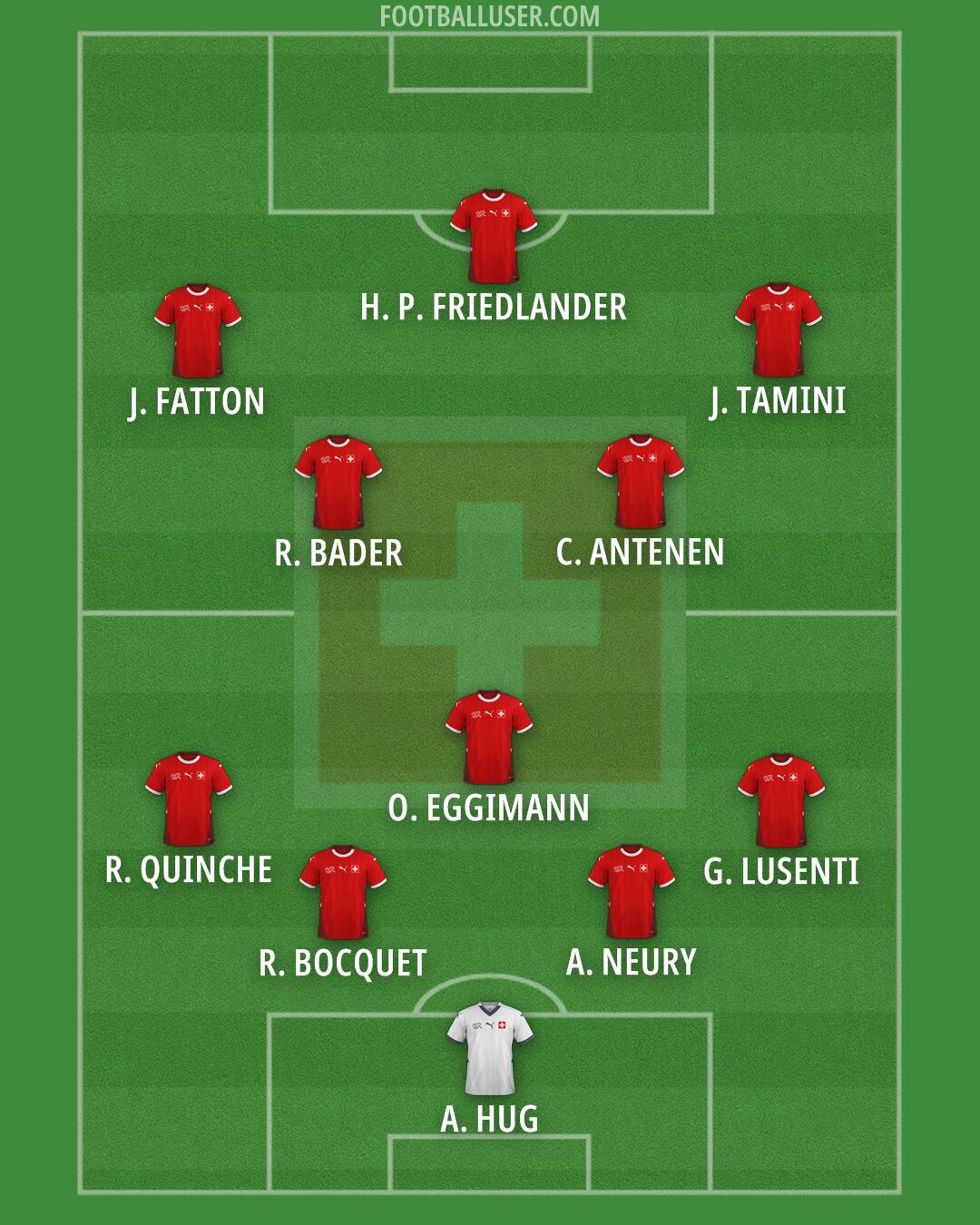

Switzerland National Football Team Formation
 March 14, 2026


Starting Lineup
A. HUG · A. NEURY · R. BOCQUET · O. EGGIMANN · R. QUINCHE · G. LUSENTI · R. BADER · C. ANTENEN · J. TAMINI · J. FATTON · H. P. FRIEDLANDERA focus on defensive solidity and rapid transitions defines Switzerland in this 5-2-3 formation. This lineup builds its identity around a compact block that remains difficult to break down through the middle. By maintaining a deep line, the team looks to absorb pressure before launching direct attacks through the wide areas.
A. HUG guards the goal while a back five provides heavy coverage across the width of the pitch. O. EGGIMANN sits in the center of the defense to command the box and clear crosses, supported by R. BOCQUET on the left and A. NEURY on the right. The wide players, G. LUSENTI and R. QUINCHE, act as wing backs who must track back to form a full five man line when defending deep. These wing backs push high to provide width during build up, but they drop quickly to prevent being caught out on the break.
The midfield operates as a double pivot to protect the center of the pitch. R. BADER and C. ANTENEN occupy the central spaces, tasked with breaking up play and intercepting passes before they reach the final third. They must work closely to close gaps and prevent opponents from playing through the middle. These two players link the defense to the front line by receiving the ball from the back three and immediately looking to switch play or find the forwards.
Switzerland utilizes three attackers to stretch the opposition defense. H. P. FRIEDLANDER leads the line as a lone striker, tasked with holding up the ball to allow others to join the attack. J. FATTON and J. TAMINI play as wide attackers, ready to cut inside or run into the channels to create goal scoring chances. These three forwards are the first line of the press, stepping up to pressure the opposition defenders and force mistakes.
This formation offers significant tactical advantages, particularly in its ability to defend the box with numerical superiority. The presence of three central defenders makes it very hard for opponents to find space in central areas. Additionally, the wide positioning of G. LUSENTI and R. QUINCHE allows for quick vertical transitions, where the team can move from a defensive block to an attacking wave in seconds.
The 5-2-3 formation makes Switzerland a very difficult unit to break down through central combinations. It is best suited for matches against teams that dominate possession and requires the wing backs to work hard to maintain balance.