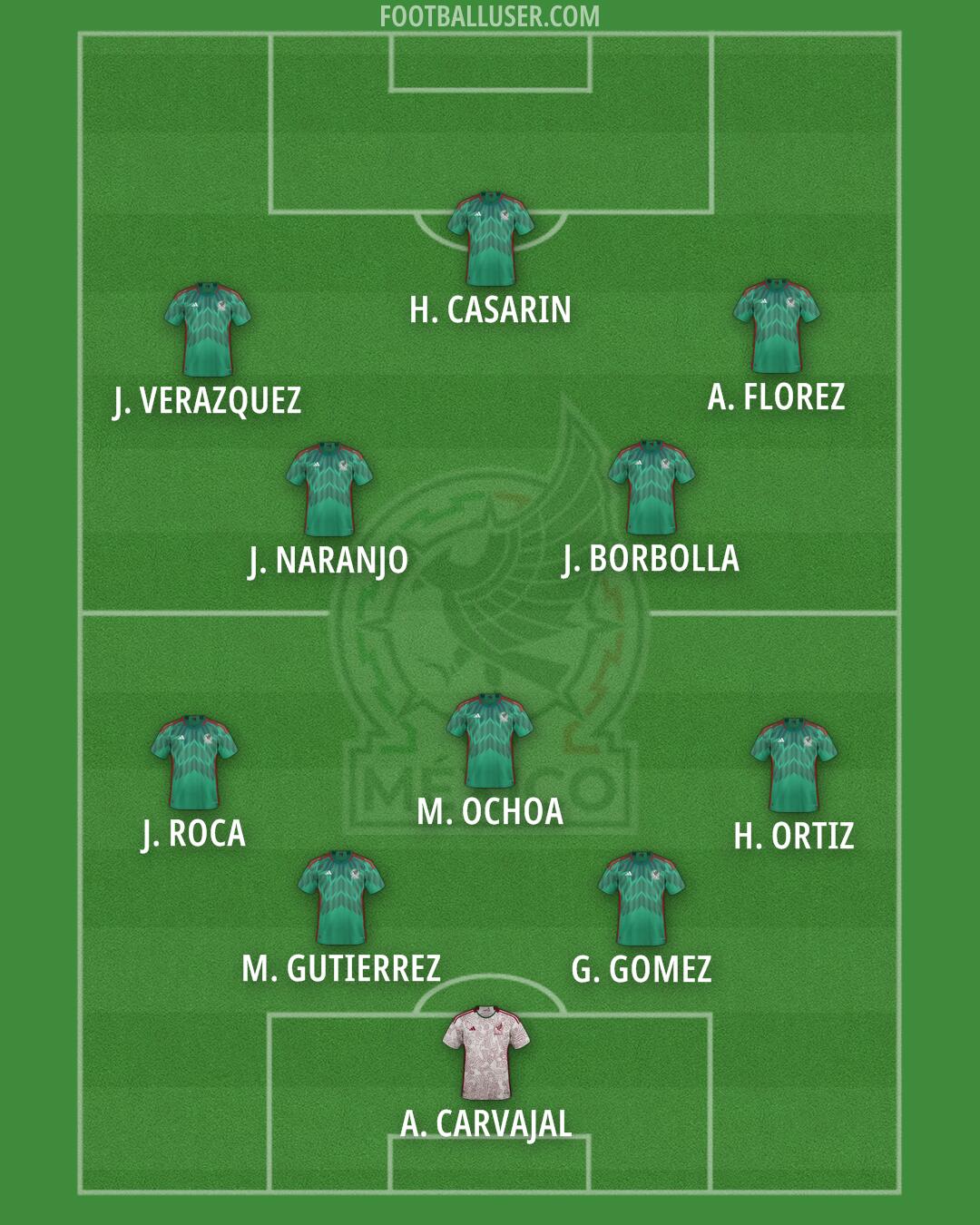

Mexico National Football Team Formation
 March 14, 2026


Starting Lineup
A. CARVAJAL · M. GUTIERREZ · G. GOMEZ · M. OCHOA · H. ORTIZ · J. ROCA · J. NARANJO · J. BORBOLLA · H. CASARIN · J. VERAZQUEZ · A. FLOREZA heavy emphasis on defensive solidity and rapid transitions defines Mexico in a 5-2-3. This formation is built to sit deep and absorb pressure before catching opponents on the break. The lineup aims to congest the central areas and use the wide channels to stretch the opposition when the ball is won back.
A. CARVAJAL guards the goal and directs the back line during defensive phases. The defense consists of a back three with M. OCHOA acting as the central anchor, while G. GOMEZ and M. GUTIERREZ cover the spaces to the left and right. To provide width, H. ORTIZ and J. ROCA act as wing backs who must track back to form a five man line when the team sits deep. These wide defenders are tasked with stopping crosses and pushing up to support the attack when possession is regained.
The midfield works as a double pivot to control the center of the pitch. J. NARANJO and J. BORBOLLA occupy the two central roles, tasked with shielding the back three and breaking up play. They act as the link between the defense and the front line, often dropping back to help the defenders or stepping up to press the opposition. Their primary job is to intercept passes and quickly switch play to the wide areas.
In the attacking third, Mexico uses three forwards to pressure the opposition defense. H. CASARIN leads the line as a lone striker to hold up the ball and occupy the central defenders. On the flanks, J. VERAZQUEZ and A. FLOREZ operate as wide attackers who look to cut inside or run into space behind the full backs. These players press high to force mistakes and create chances through quick movement.
This 5-2-3 formation offers several tactical advantages for Mexico. The presence of three central defenders makes the team very difficult to break down through the middle. Additionally, the team can create wide overloads as H. ORTIZ and J. ROCA push forward to join the attackers. This allows the wingers to move into central positions, creating numerical superiority in the final third.
The Mexican lineup relies on defensive compactness and lightning fast transitions to punish opponents. This formation is best suited for matches against teams that dominate possession and leave space behind their defensive line.