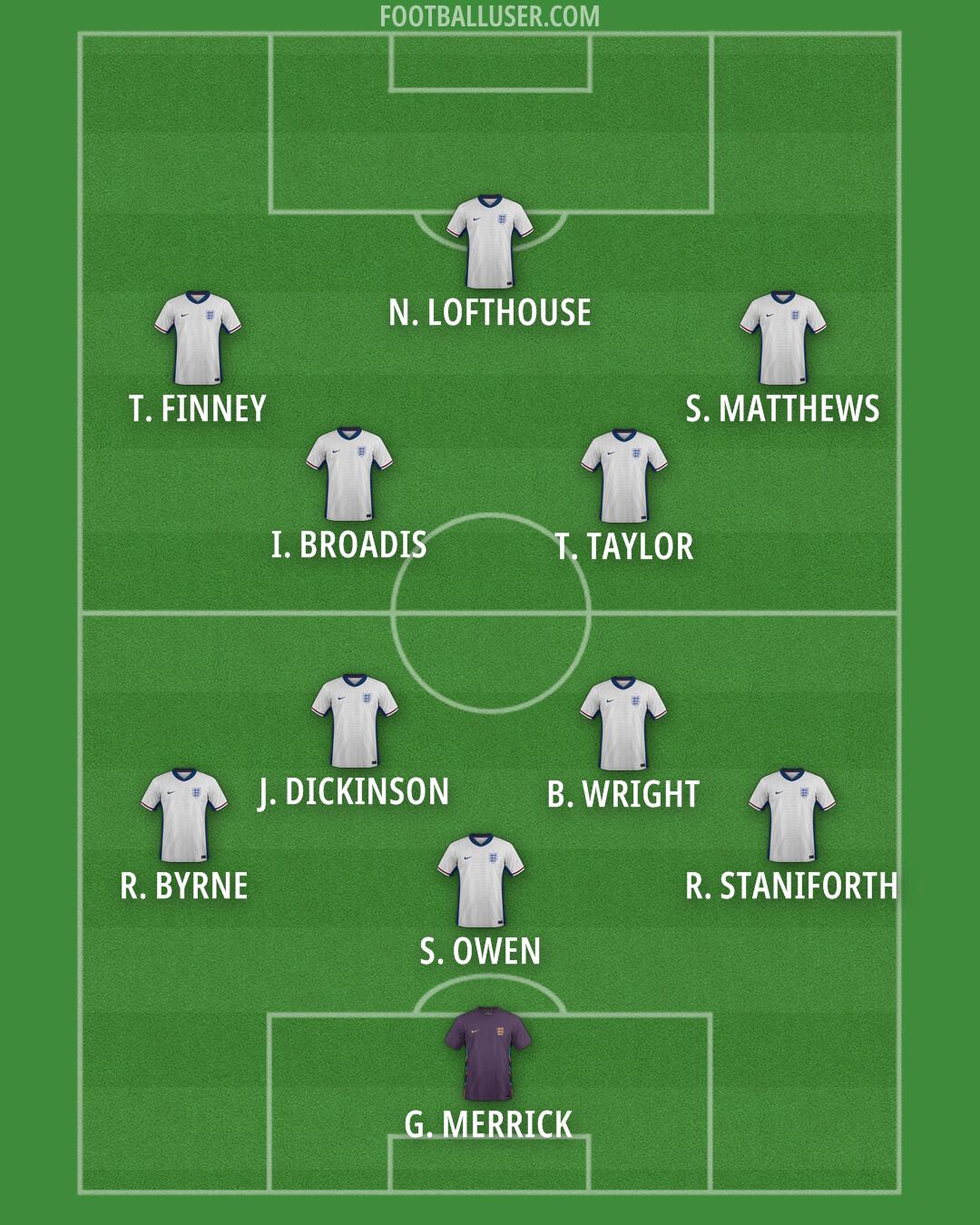
England National Football Team Formation
 March 16, 2026


Starting Lineup
G. MERRICK · R. BYRNE · S. OWEN · R. STANIFORTH · J. DICKINSON · B. WRIGHT · I. BROADIS · T. TAYLOR · T. FINNEY · S. MATTHEWS · N. LOFTHOUSEDominating through width and defensive solidity defines the England lineup in this 5-2-3 formation. This system aims to control the flanks while maintaining a compact block to stop central breakthroughs. It is a lineup built to transition quickly from a deep defensive stance into a heavy attacking presence.
G. Merrick guards the goal while a back five organizes the defensive line. S. Owen sits in the center of the trio to command the area. B. Wright and J. Dickinson act as the side center backs to cover the space behind the wing backs. R. Staniforth and R. Byrne provide the width as wing backs, tasked with pushing up to support the attack or tracking back to defend the channels. This defensive unit works to stay close together and block passing lanes through the middle.
The midfield works with a double pivot to control the center of the pitch. T. Taylor and I. Broadis occupy the two central roles, tasked with shielding the back five and breaking up opposition plays. They must connect the defense to the front three by finding short passes under pressure. When the team wins the ball, these two players look to drive forward or switch play to the wide players to bypass the opponent's pressing lines.
A high-energy front three leads the England attack. N. Lofthouse leads the line as the lone striker, tasked to hold up the ball and bring others into play. T. Finney and S. Matthews operate as wide attackers on the left and right. They are expected to cut inside to shoot or stay wide to receive crosses from the overlapping wing backs. The forwards lead the first line of the press to force turnovers high up the pitch.
One major strength of this 5-2-3 is the ability to create wide overloads by using the wing backs alongside the attackers. This forces the opposition to commit more players to the flanks, leaving gaps in the middle. Another advantage is the defensive compactness that makes it very hard for opponents to play through the center. The team can easily shift from a deep block into a vertical counter attack using the pace of the front three.
This 5-2-3 formation provides a balance of defensive security and wide attacking threat. It is ideally suited for matches against teams that dominate possession and require a disciplined low block to exploit on the break.