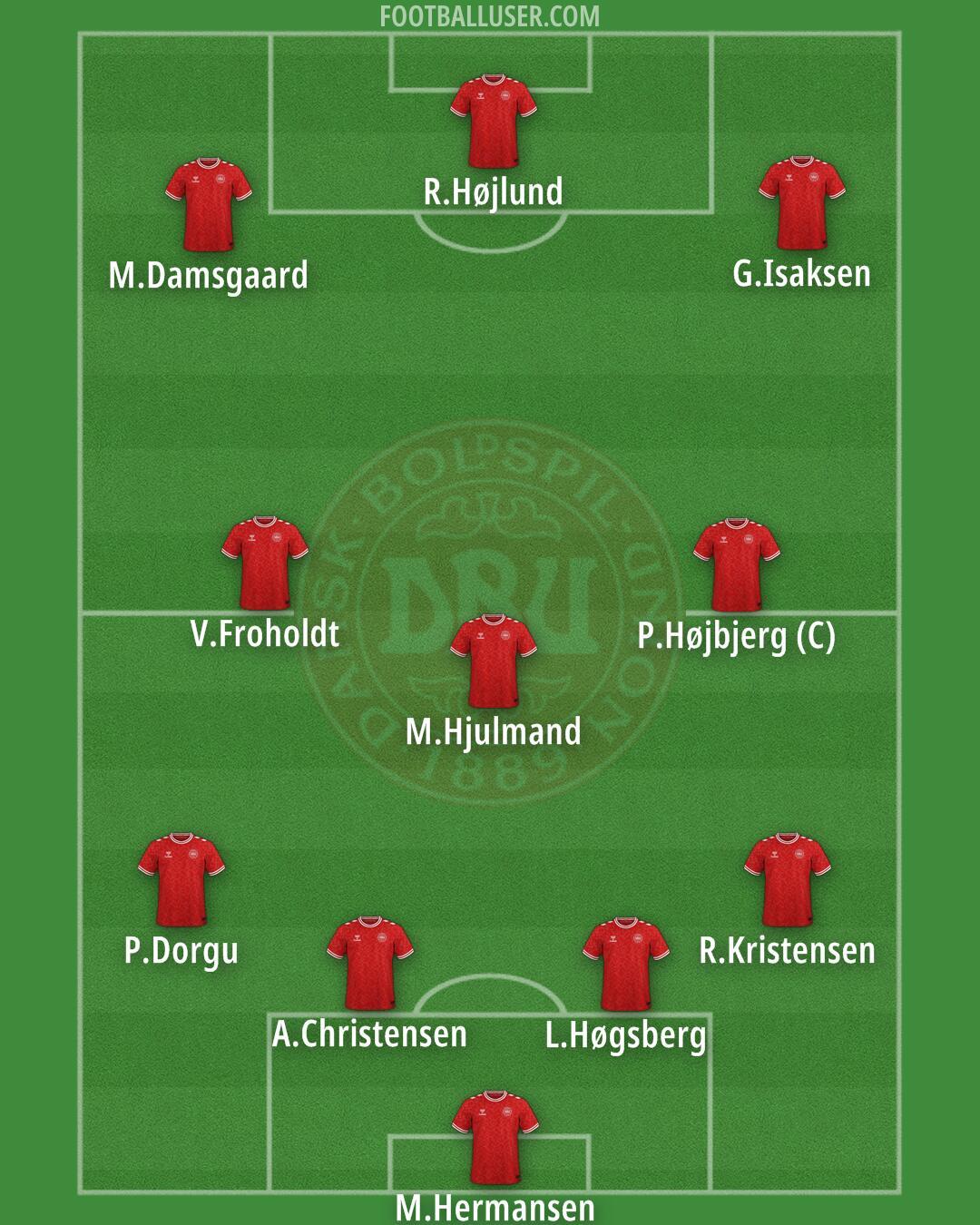

Denmark National Football Team Formation
 March 18, 2026


Starting Lineup
M.Hermansen · A.Christensen · L.Høgsberg · R.Kristensen · P.Dorgu · M.Hjulmand · V.Froholdt · P.Højbjerg (C) · R.Højlund · M.Damsgaard · G.IsaksenA high pressing and vertical style defines Denmark in this 4-3-3 formation. The Red Devils seek to win the ball high up the pitch and quickly drive forward to catch opponents off guard. This lineup relies on intense energy and quick transitions to break lines before the opposition can settle into a defensive block.
M.Hermansen guards the goal while the back four maintains a high line to compress the space. Andreas Christensen acts as a ball playing defender who can step up to intercept passes, while L.Høgsberg provides cover on the right side. P.Dorgu pushes forward as an attacking left back to provide width, and R.Kristensen works to balance the right side of the defense. The unit stays compact to ensure they can shift quickly when the ball moves from side to side.
The midfield operates as a three man unit designed to control the center of the pitch. M.Hjulmand sits deep as a single pivot to shield the defense and break up play. Beside him, captain P.Højbjerg uses his passing range and work rate to drive the team forward and connect the lines. V.Froholdt occupies the left central role, helping to move the ball from the back three into the attacking third.
In the final third, the attack is built around the movement of three forwards. R.Højlund acts as the lone striker, using his strength to hold up the ball and lead the press from the front. On the wings, M.Damsgaard looks to cut inside from the left to create chances, while G.Isaksen stays wide on the right to stretch the opposition. This movement creates pockets of space in the middle for the midfielders to exploit.
Denmark benefits from several tactical advantages with this lineup. The team can create wide overloads when P.Dorgu and M.Damsgaard push high together on the left. There is also a clear ability to press high in coordinated waves, with the front three forcing mistakes near the opponent's goal. The presence of P.Højbjerg allows the team to maintain control during transitions, making them difficult to counter.
This 4-3-3 formation creates a direct and aggressive presence on the pitch. It is best suited for games against teams that play a high line or struggle with intense physical pressure.