Man City Football Formation
 March 18, 2026


Starting Lineup
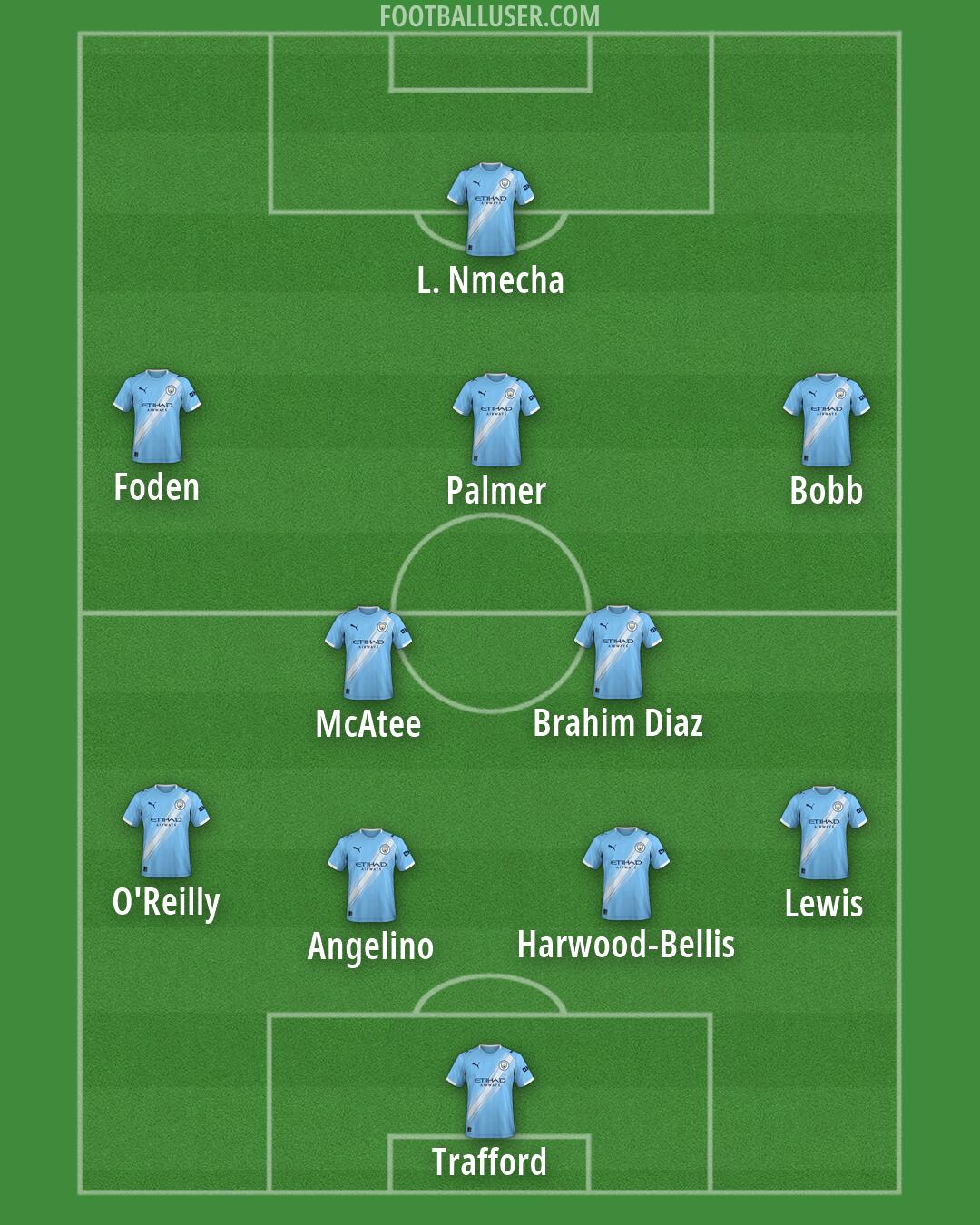
Foden · O'Reilly · Trafford · Lewis · Palmer · Bobb · McAtee · L. Nmecha · Harwood-Bellis · Angelino · Brahim DiazA high press and verticality define this Man City lineup in a 4-2-4 formation. This system aims to overwhelm the opposition with heavy numbers in the final third, forcing turnovers high up the pitch to create immediate scoring chances. It is built to play a direct and aggressive game that seeks to break the lines quickly.
Trafford stays between the posts to command the defensive unit. The back line consists of a flat four where Lewis and O'Reilly act as full backs to provide width. Angelino and Harwood-Bellis form the central pair, with Angelino often stepping up to support the midfield while Harwood-Bellis stays deeper to cover. The defenders work together to keep the distance between the lines small, often stepping up to squeeze the space available to the opponent.
The midfield operates as a double pivot to manage the center of the pitch. McAtee and Brahim Diaz occupy the central roles, tasked with both shielding the defense and driving forward into space. McAtee works to connect the play from the back, while Brahim Diaz looks to penetrate the opposition half with carries. This duo must work hard to track back and cover the space left behind when the wingers push high.
Man City utilizes four attackers to pin the opposition defense back. Bobb and Foden occupy the wide positions, with Foden looking to cut inside and create chances while Bobb stretches the play on the right. Palmer and L. Nmecha operate as two forwards in the center, with Palmer often dropping deeper to link play and L. Nmecha providing a physical presence to hold up the ball. This front four presses in waves, hunting the ball the moment it is lost.
One major advantage of this formation is the ability to create wide overloads when the full backs push forward to join the attackers. The team can also achieve numerical superiority in the attacking third, making it very difficult for a back four to mark everyone. Furthermore, the heavy presence of players in the final third allows for a high press that can trap opponents in their own half.
This 4-2-4 formation relies on intense pressing and rapid transitions to dominate matches. It is best suited for games against opponents who sit deep and struggle to handle high-intensity pressure.